 Add to Chrome
 Add to Firefox
 Add to Edge
Where are the Humans? A Scoping Review of Fairness in Multi-agent AI Systems
Apr 16, 2026
Rapid advances in Generative AI are giving rise to increasingly sophisticated Multi-Agent AI (MAAI) systems. While AI fairness has been extensively studied in traditional predictive scenarios, its examination in MAAI remains nascent and fragmented. This scoping review critically synthesizes existing research on fairness in MAAI systems. Through a qualitative content analysis of 23 selected studies, we identify five archetypal approaches. Our findings reveal that fairness in MAAI systems is often addressed superficially, lacks robust normative foundations, and frequently overlooks the complex dynamics introduced by agent autonomy and system-level interactions. We argue that fairness must be embedded structurally throughout the development lifecycle of MAAI, rather than appended as a post-hoc consideration. Meaningful evaluation requires explicit human oversight, normative clarity, and a precise articulation of fairness objectives and beneficiaries. This review provides a foundation for advancing fairness research in MAAI systems by highlighting critical gaps, exposing prevailing limitations, and suggesting pathways.

Normative Common Ground Replication (NormCoRe): Replication-by-Translation for Studying Norms in Multi-agent AI
Mar 12, 2026In the late 2010s, the fashion trend NormCore framed sameness as a signal of belonging, illustrating how norms emerge through collective coordination. Today, similar forms of normative coordination can be observed in systems based on Multi-agent Artificial Intelligence (MAAI), as AI-based agents deliberate, negotiate, and converge on shared decisions in fairness-sensitive domains. Yet, existing empirical approaches often treat norms as targets for alignment or replication, implicitly assuming equivalence between human subjects and AI agents and leaving collective normative dynamics insufficiently examined. To address this gap, we propose Normative Common Ground Replication (NormCoRe), a novel methodological framework to systematically translate the design of human subject experiments into MAAI environments. Building on behavioral science, replication research, and state-of-the-art MAAI architectures, NormCoRe maps the structural layers of human subject studies onto the design of AI agent studies, enabling systematic documentation of study design and analysis of norms in MAAI. We demonstrate the utility of NormCoRe by replicating a seminal experimental study on distributive justice, in which participants negotiate fairness principles under a "veil of ignorance". We show that normative judgments in AI agent studies can differ from human baselines and are sensitive to the choice of the foundation model and the language used to instantiate agent personas. Our work provides a principled pathway for analyzing norms in MAAI and helps to guide, reflect, and document design choices whenever AI agents are used to automate or support tasks formerly carried out by humans.
Mapping the Potential of Explainable Artificial Intelligence (XAI) for Fairness Along the AI Lifecycle
Apr 30, 2024


The widespread use of artificial intelligence (AI) systems across various domains is increasingly highlighting issues related to algorithmic fairness, especially in high-stakes scenarios. Thus, critical considerations of how fairness in AI systems might be improved, and what measures are available to aid this process, are overdue. Many researchers and policymakers see explainable AI (XAI) as a promising way to increase fairness in AI systems. However, there is a wide variety of XAI methods and fairness conceptions expressing different desiderata, and the precise connections between XAI and fairness remain largely nebulous. Besides, different measures to increase algorithmic fairness might be applicable at different points throughout an AI system's lifecycle. Yet, there currently is no coherent mapping of fairness desiderata along the AI lifecycle. In this paper, we set out to bridge both these gaps: We distill eight fairness desiderata, map them along the AI lifecycle, and discuss how XAI could help address each of them. We hope to provide orientation for practical applications and to inspire XAI research specifically focused on these fairness desiderata.
Implications of the AI Act for Non-Discrimination Law and Algorithmic Fairness
Mar 29, 2024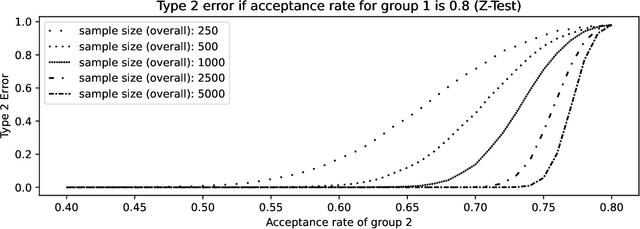
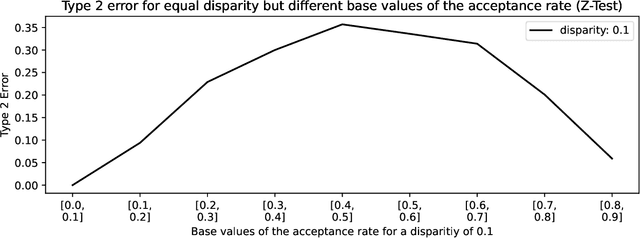
The topic of fairness in AI, as debated in the FATE (Fairness, Accountability, Transparency, and Ethics in AI) communities, has sparked meaningful discussions in the past years. However, from a legal perspective, particularly from European Union law, many open questions remain. Whereas algorithmic fairness aims to mitigate structural inequalities at the design level, European non-discrimination law is tailored to individual cases of discrimination after an AI model has been deployed. The AI Act might present a tremendous step towards bridging these two concepts by shifting non-discrimination responsibilities into the design stage of AI models. Based on an integrative reading of the AI Act, we comment on legal as well as technical enforcement problems and propose practical implications on bias detection and bias correction in order to specify and comply with specific technical requirements.
A Critical Survey on Fairness Benefits of XAI
Oct 15, 2023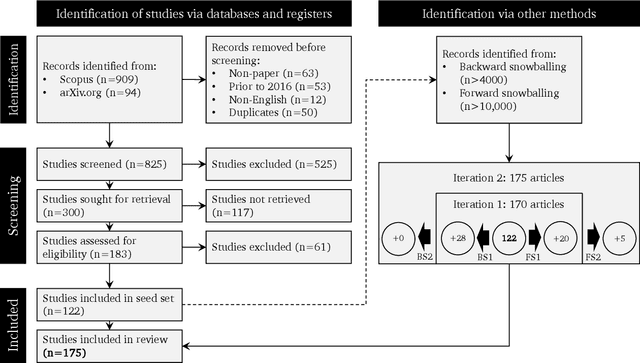
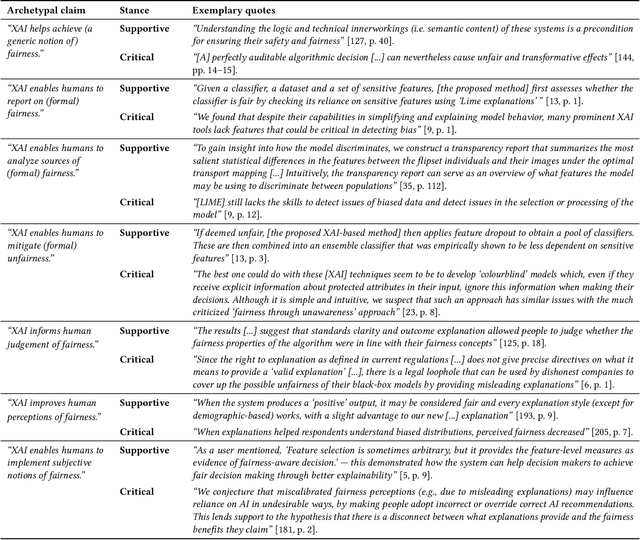
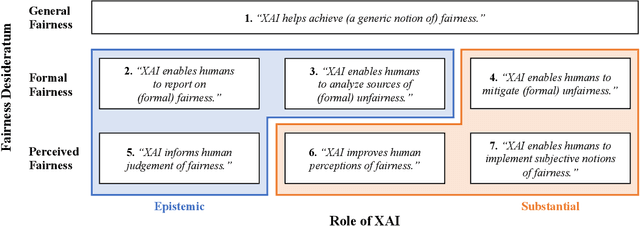

In this critical survey, we analyze typical claims on the relationship between explainable AI (XAI) and fairness to disentangle the multidimensional relationship between these two concepts. Based on a systematic literature review and a subsequent qualitative content analysis, we identify seven archetypal claims from 175 papers on the alleged fairness benefits of XAI. We present crucial caveats with respect to these claims and provide an entry point for future discussions around the potentials and limitations of XAI for specific fairness desiderata. While the literature often suggests XAI to be an enabler for several fairness desiderata, we notice a misalignment between these desiderata and the capabilities of XAI. We encourage to conceive XAI as one of many tools to approach the multidimensional, sociotechnical challenge of algorithmic fairness and to be more specific about how exactly what kind of XAI method enables whom to address which fairness desideratum.