 Add to Chrome
 Add to Firefox
 Add to Edge
How communicatively optimal are exact numeral systems? Once more on lexicon size and morphosyntactic complexity
Feb 23, 2026
Recent research argues that exact recursive numeral systems optimize communicative efficiency by balancing a tradeoff between the size of the numeral lexicon and the average morphosyntactic complexity (roughly length in morphemes) of numeral terms. We argue that previous studies have not characterized the data in a fashion that accounts for the degree of complexity languages display. Using data from 52 genetically diverse languages and an annotation scheme distinguishing between predictable and unpredictable allomorphy (formal variation), we show that many of the world's languages are decisively less efficient than one would expect. We discuss the implications of our findings for the study of numeral systems and linguistic evolution more generally.

Annotating and Inferring Compositional Structures in Numeral Systems Across Languages
Mar 04, 2025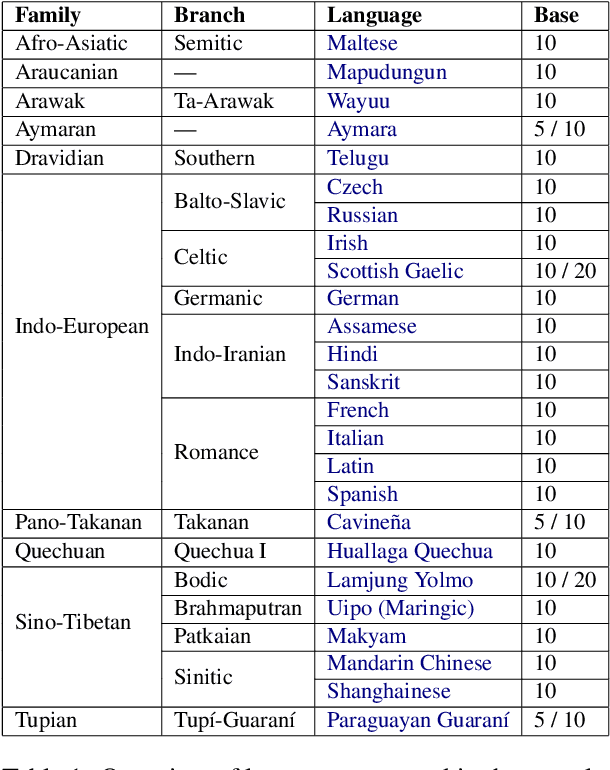
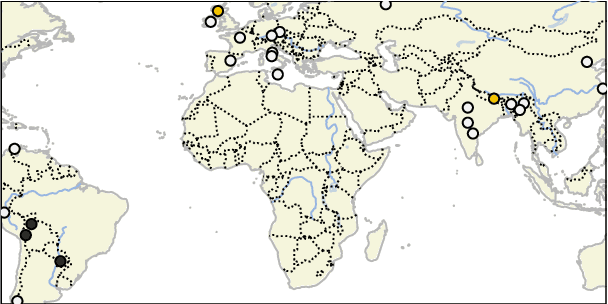
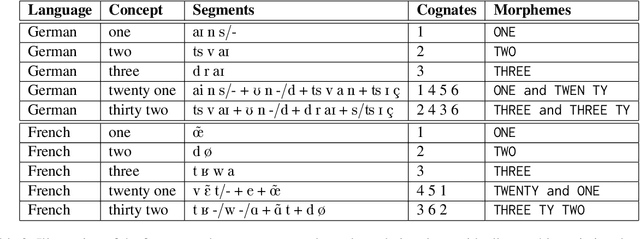
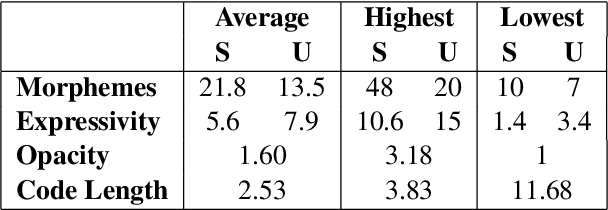
Numeral systems across the world's languages vary in fascinating ways, both regarding their synchronic structure and the diachronic processes that determined how they evolved in their current shape. For a proper comparison of numeral systems across different languages, however, it is important to code them in a standardized form that allows for the comparison of basic properties. Here, we present a simple but effective coding scheme for numeral annotation, along with a workflow that helps to code numeral systems in a computer-assisted manner, providing sample data for numerals from 1 to 40 in 25 typologically diverse languages. We perform a thorough analysis of the sample, focusing on the systematic comparison between the underlying and the surface morphological structure. We further experiment with automated models for morpheme segmentation, where we find allomorphy as the major reason for segmentation errors. Finally, we show that subword tokenization algorithms are not viable for discovering morphemes in low-resource scenarios.