 Add to Chrome
 Add to Firefox
 Add to Edge
Lightweight Pilot Estimation on LEO Satellite Signals for Enhanced SOP Navigation
Feb 06, 2026
The computation of positioning, navigation and timing (PNT) via signal of opportunity (SOP), where signals originally transmitted for communication, such as 5G, Wi-Fi, or DVB-S, are exploited due to their ubiquity and spectral characteristics, is an emerging research field. However, relying on these signals presents challenges, including limited knowledge of the signal modulation and the need to identify recurring sequences for correlation. We offer a guide to implement a receiver capable of capturing broadband downlink Ku-band signals from low Earth orbit (LEO) satellites (e.g., Starlink and OneWeb) and estimating the recurring symbols for SOP measurements. The methodology integrates recent approaches in the literature, highlighting the most effective aspects while guiding the replication of experiments even under limitations on the front-end gain and bandwidth. Using the proposed model, we can identify recurring symbols transmitted by Starlink satellites, which are then used to collect Doppler shift measurements over a 600 s interval. A position, velocity, and time (PVT) solution is also computed via least squares (LS), which achieves a positioning error of approximately 268 m after a post-fit refinement.

Performance Limits for Signals of Opportunity-Based Navigation
Jul 23, 2024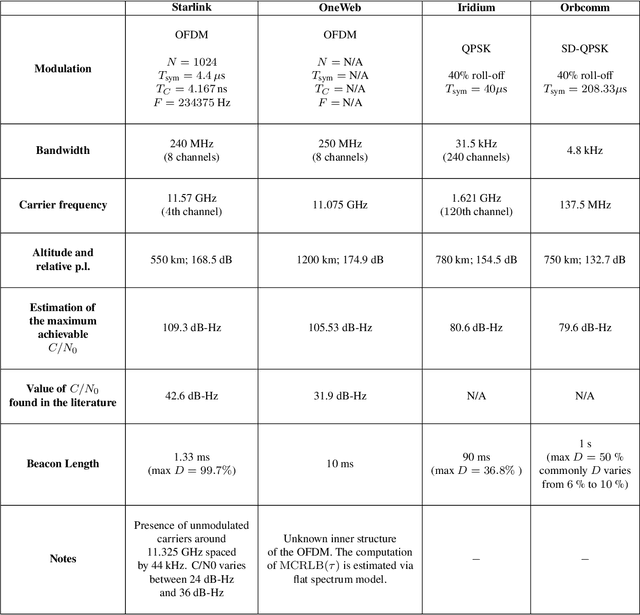
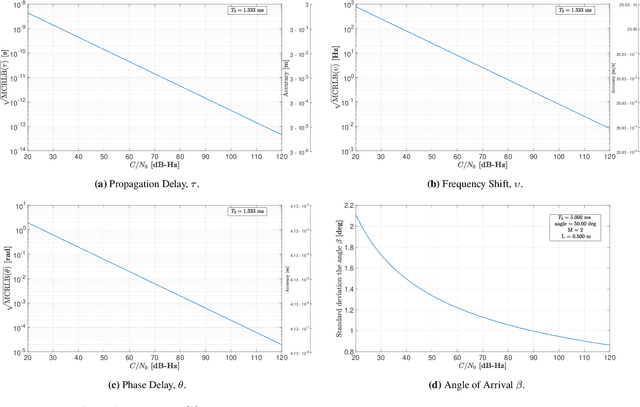
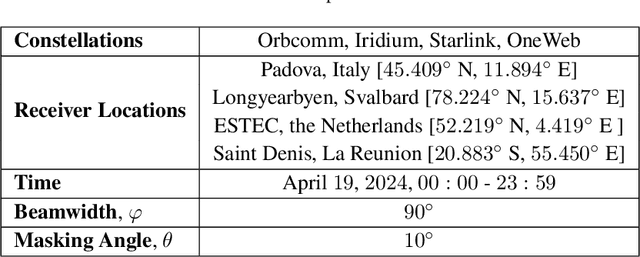
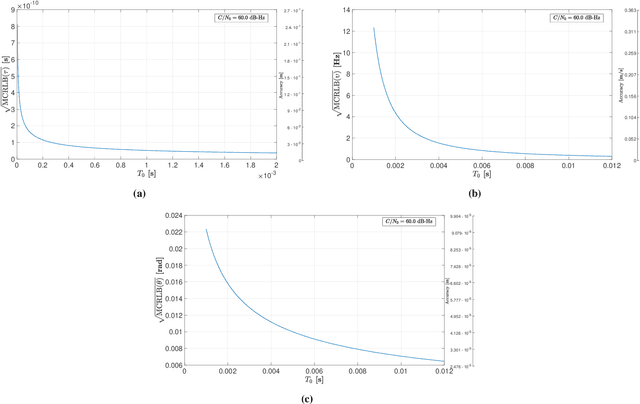
This paper investigates the potential of non-terrestrial and terrestrial signals of opportunity (SOOP) for navigation applications. Non-terrestrial SOOP analysis employs modified Cram\`er-Rao lower bound (MCRLB) to establish a relationship between SOOP characteristics and the accuracy of ranging information. This approach evaluates hybrid navigation module performance without direct signal simulation. The MCRLB is computed for ranging accuracy, considering factors like propagation delay, frequency offset, phase offset, and angle-of-arrival (AOA), across diverse non-terrestrial SOOP candidates. Additionally, Geometric Dilution of Precision (GDOP) and low earth orbit (LEO) SOOP availability are assessed. Validation involves comparing MCRLB predictions with actual ranging measurements obtained in a realistic simulated scenario. Furthermore, a qualitative evaluation examines terrestrial SOOP, considering signal availability, accuracy attainability, and infrastructure demands.
Ensemble of Distributed Learners for Online Classification of Dynamic Data Streams
Aug 24, 2013


We present an efficient distributed online learning scheme to classify data captured from distributed, heterogeneous, and dynamic data sources. Our scheme consists of multiple distributed local learners, that analyze different streams of data that are correlated to a common event that needs to be classified. Each learner uses a local classifier to make a local prediction. The local predictions are then collected by each learner and combined using a weighted majority rule to output the final prediction. We propose a novel online ensemble learning algorithm to update the aggregation rule in order to adapt to the underlying data dynamics. We rigorously determine a bound for the worst case misclassification probability of our algorithm which depends on the misclassification probabilities of the best static aggregation rule, and of the best local classifier. Importantly, the worst case misclassification probability of our algorithm tends asymptotically to 0 if the misclassification probability of the best static aggregation rule or the misclassification probability of the best local classifier tend to 0. Then we extend our algorithm to address challenges specific to the distributed implementation and we prove new bounds that apply to these settings. Finally, we test our scheme by performing an evaluation study on several data sets. When applied to data sets widely used by the literature dealing with dynamic data streams and concept drift, our scheme exhibits performance gains ranging from 34% to 71% with respect to state of the art solutions.