 Add to Chrome
 Add to Firefox
 Add to Edge
Noise-aware few-shot learning through bi-directional multi-view prompt alignment
Mar 12, 2026
Vision-language models offer strong few-shot capability through prompt tuning but remain vulnerable to noisy labels, which can corrupt prompts and degrade cross-modal alignment. Existing approaches struggle because they often lack the ability to model fine-grained semantic cues and to adaptively separate clean from noisy signals. To address these challenges, we propose NA-MVP, a framework for Noise-Aware few-shot learning through bi-directional Multi-View Prompt alignment. NA-MVP is built upon a key conceptual shift: robust prompt learning requires moving from global matching to region-aware alignment that explicitly distinguishes clean cues from noisy ones. To realize this, NA-MVP employs (1) multi-view prompts combined with unbalanced optimal transport to achieve fine-grained patch-to-prompt correspondence while suppressing unreliable regions; (2) a bi-directional prompt design that captures complementary clean-oriented and noise-aware cues, enabling the model to focus on stable semantics; and (3) an alignment-guided selective refinement strategy that uses optimal transport to correct only mislabeled samples while retaining reliable data. Experiments on synthetic and real-world noisy benchmarks demonstrate that NA-MVP consistently outperforms state-of-the-art baselines, confirming its effectiveness in enabling robust few-shot learning under noisy supervision.

MSPM: A Multi-Site Physiological Monitoring Dataset for Remote Pulse, Respiration, and Blood Pressure Estimation
Feb 03, 2024Visible-light cameras can capture subtle physiological biomarkers without physical contact with the subject. We present the Multi-Site Physiological Monitoring (MSPM) dataset, which is the first dataset collected to support the study of simultaneous camera-based vital signs estimation from multiple locations on the body. MSPM enables research on remote photoplethysmography (rPPG), respiration rate, and pulse transit time (PTT); it contains ground-truth measurements of pulse oximetry (at multiple body locations) and blood pressure using contacting sensors. We provide thorough experiments demonstrating the suitability of MSPM to support research on rPPG, respiration rate, and PTT. Cross-dataset rPPG experiments reveal that MSPM is a challenging yet high quality dataset, with intra-dataset pulse rate mean absolute error (MAE) below 4 beats per minute (BPM), and cross-dataset pulse rate MAE below 2 BPM in certain cases. Respiration experiments find a MAE of 1.09 breaths per minute by extracting motion features from the chest. PTT experiments find that across the pairs of different body sites, there is high correlation between remote PTT and contact-measured PTT, which facilitates the possibility for future camera-based PTT research.
Full-Body Cardiovascular Sensing with Remote Photoplethysmography
Mar 16, 2023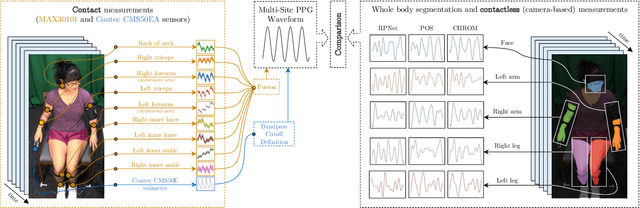

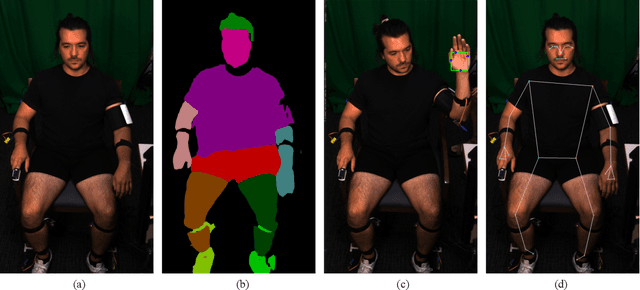
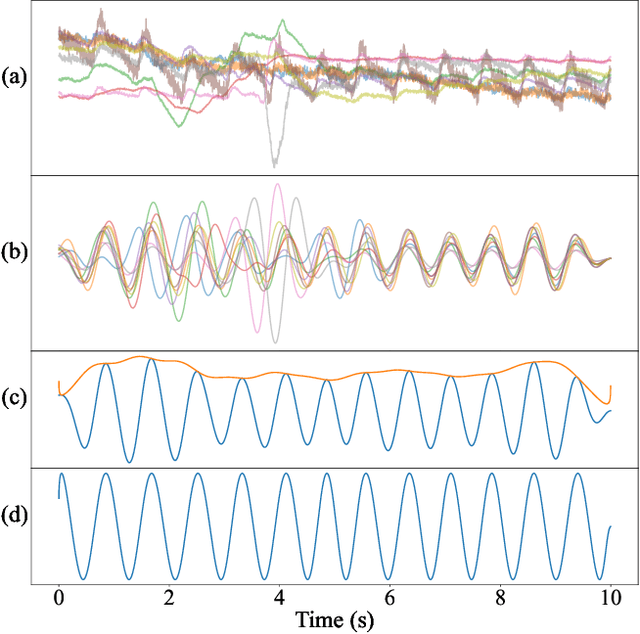
Remote photoplethysmography (rPPG) allows for noncontact monitoring of blood volume changes from a camera by detecting minor fluctuations in reflected light. Prior applications of rPPG focused on face videos. In this paper we explored the feasibility of rPPG from non-face body regions such as the arms, legs, and hands. We collected a new dataset titled Multi-Site Physiological Monitoring (MSPM), which will be released with this paper. The dataset consists of 90 frames per second video of exposed arms, legs, and face, along with 10 synchronized PPG recordings. We performed baseline heart rate estimation experiments from non-face regions with several state-of-the-art rPPG approaches, including chrominance-based (CHROM), plane-orthogonal-to-skin (POS) and RemotePulseNet (RPNet). To our knowledge, this is the first evaluation of the fidelity of rPPG signals simultaneously obtained from multiple regions of a human body. Our experiments showed that skin pixels from arms, legs, and hands are all potential sources of the blood volume pulse. The best-performing approach, POS, achieved a mean absolute error peaking at 7.11 beats per minute from non-facial body parts compared to 1.38 beats per minute from the face. Additionally, we performed experiments on pulse transit time (PTT) from both the contact PPG and rPPG signals. We found that remote PTT is possible with moderately high frame rate video when distal locations on the body are visible. These findings and the supporting dataset should facilitate new research on non-face rPPG and monitoring blood flow dynamics over the whole body with a camera.
Hallucinated Heartbeats: Anomaly-Aware Remote Pulse Estimation
Mar 11, 2023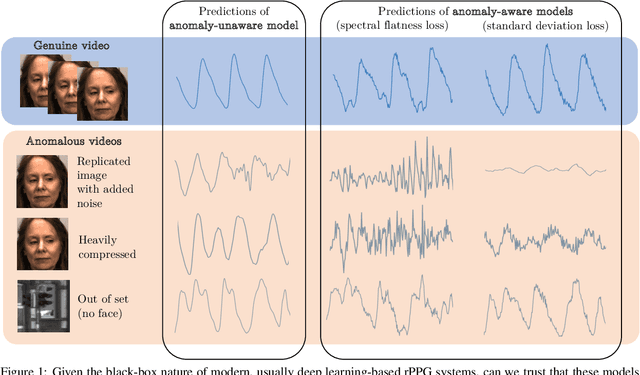
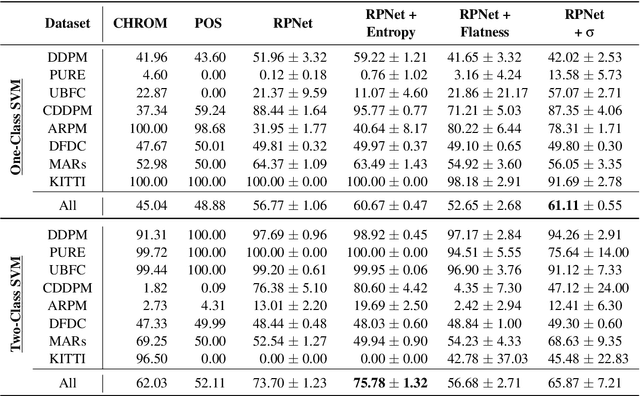
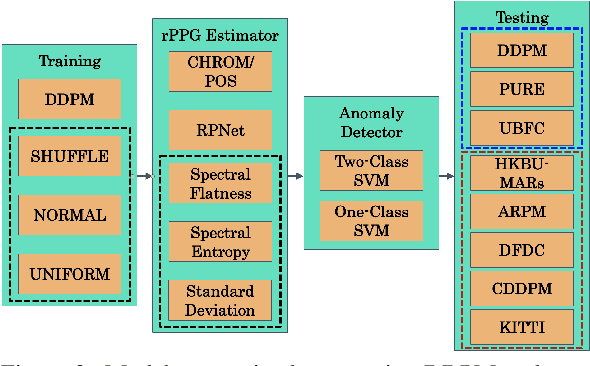
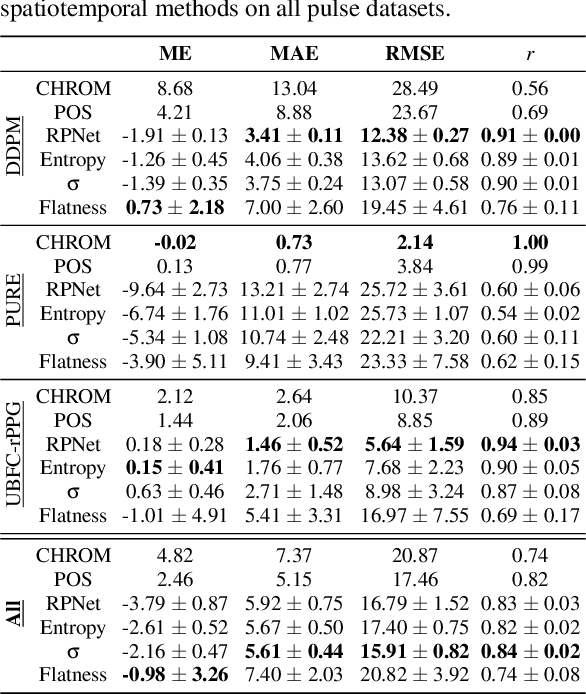
Camera-based physiological monitoring, especially remote photoplethysmography (rPPG), is a promising tool for health diagnostics, and state-of-the-art pulse estimators have shown impressive performance on benchmark datasets. We argue that evaluations of modern solutions may be incomplete, as we uncover failure cases for videos without a live person, or in the presence of severe noise. We demonstrate that spatiotemporal deep learning models trained only with live samples "hallucinate" a genuine-shaped pulse on anomalous and noisy videos, which may have negative consequences when rPPG models are used by medical personnel. To address this, we offer: (a) An anomaly detection model, built on top of the predicted waveforms. We compare models trained in open-set (unknown abnormal predictions) and closed-set (abnormal predictions known when training) settings; (b) An anomaly-aware training regime that penalizes the model for predicting periodic signals from anomalous videos. Extensive experimentation with eight research datasets (rPPG-specific: DDPM, CDDPM, PURE, UBFC, ARPM; deep fakes: DFDC; face presentation attack detection: HKBU-MARs; rPPG outlier: KITTI) show better accuracy of anomaly detection for deep learning models incorporating the proposed training (75.8%), compared to models trained regularly (73.7%) and to hand-crafted rPPG methods (52-62%).