 Add to Chrome
 Add to Firefox
 Add to Edge
A Wavefield Correlation Approach to Improve Sound Speed Estimation in Ultrasound Autofocusing
Feb 13, 2026
Aberration often degrades ultrasound image quality when beamforming does not account for wavefront distortions. In the past decade, local sound speed estimators have been developed for distributed aberration correction throughout a medium. Recently, iterative sound speed optimization approaches have achieved more accurate estimates than earlier approaches, but these newer methods still struggle with decreased accuracy for media with reverberation clutter and large sound speed changes. To address these challenges, we propose using a wavefield correlation (WFC) beamforming approach when performing sound speed optimization. WFC correlates simulated forward-propagated transmit wavefields and backwards-propagated receive wavefields in order to form images. This process more accurately models wave propagation in heterogeneous media and can decrease diffuse clutter due to its spatiotemporal matched filtering effect. This beamformer is implemented using auto-differentiation software to then perform gradient descent optimization, using a total-variation regularized common midpoint phase focus metric loss, on the local sound speed map used during beamforming. This approach is compared to using delay and sum (DAS) with straight-ray time delay calculations in the same sound speed optimization approach on a variety of simulated, phantom, and in vivo data with large sound speed changes and clutter. Results show that using WFC decreases sound speed estimation error, and using the estimates for aberration correction improves image resolution and contrast. These promising results have potential to improve pulse-echo imaging for challenging clinical scenarios.

Ultrasound Autofocusing: Common Midpoint Phase Error Optimization via Differentiable Beamforming
Oct 03, 2024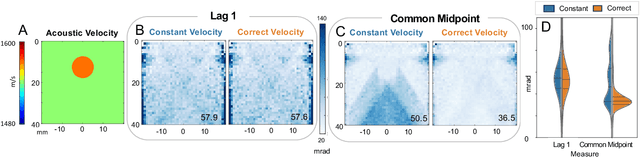
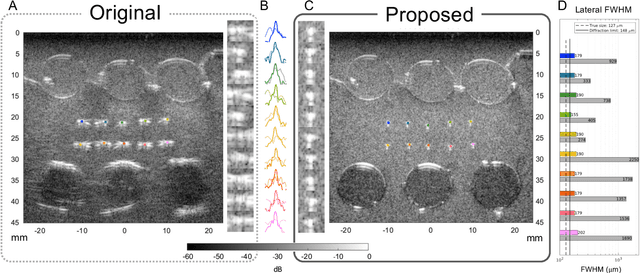
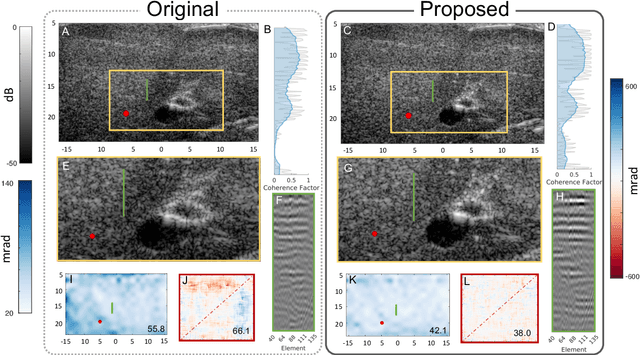
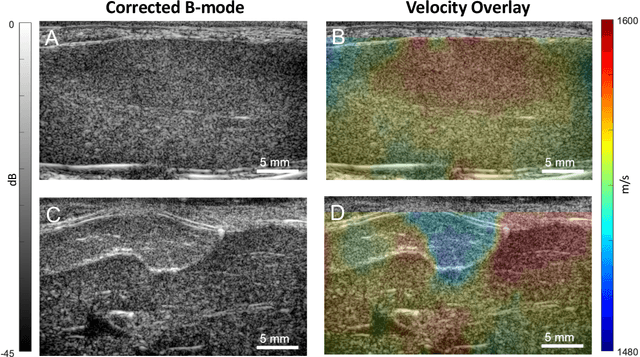
Wavefield imaging reconstructs physical properties from wavefield measurements across an aperture, using modalities like radar, optics, sonar, seismic, and ultrasound imaging. Propagation of a wavefront from unknown sources through heterogeneous media causes phase aberrations that degrade the coherence of the wavefront leading to reduced image resolution and contrast. Adaptive imaging techniques attempt to correct phase aberration and restore coherence leading to improved focus. We propose an autofocusing paradigm for aberration correction in ultrasound imaging by fitting an acoustic velocity field to pressure measurements, via optimization of the common midpoint phase error (CMPE), using a straight-ray wave propagation model for beamforming in diffusely scattering media. We show that CMPE induced by heterogeneous acoustic velocity is a robust measure of phase aberration that can be used for acoustic autofocusing. CMPE is optimized iteratively using a differentiable beamforming approach to simultaneously improve the image focus while estimating the acoustic velocity field of the interrogated medium. The approach relies solely on wavefield measurements using a straight-ray integral solution of the two-way time-of-flight without explicit numerical time-stepping models of wave propagation. We demonstrate method performance through in silico simulations, in vitro phantom measurements, and in vivo mammalian models, showing practical applications in distributed aberration quantification, correction, and velocity estimation for medical ultrasound autofocusing.