 Add to Chrome
 Add to Firefox
 Add to Edge
Explaining RhythmFormer: A Systematic XAI Analysis of Periodic Sparse Attention for Remote Photoplethysmography
Jun 11, 2026
Remote photoplethysmography (rPPG) transformers achieve low heart-rate error on benchmarks, yet their decisions remain opaque--a growing concern as rPPG moves toward clinical heart rate estimation. Existing rPPG XAI is dominated by qualitative heatmap inspection without quantitative faithfulness metrics or physiology-grounded validation, leaving a gap between visual plausibility and auditable evidence. We address this gap. First, we adapt four attribution methods (raw attention, rollout, flow, Beyond Intuition) to RhythmFormer's bi-level routing attention with top-$k$ selection. Second, we introduce a skin coverage metric quantifying how much attribution mass falls on skin regions. Third, we adapt the SaCo faithfulness coefficient from its original classification setting to rPPG regression by using the MAE between original and perturbed predicted rPPG waveforms as the perturbation impact. Applying these tools, we quantify a multi-hop leakage effect under sparse top-$k$ routing: attention rollout and flow almost completely restores the connections that individual refined-attention layers explicitly set to zero. Beyond Intuition mitigates this via its value-projection-weighted rollout and gradient-supported mask, attaining the highest median refined skin coverage ($0.83$ vs. $0.57$ for vanilla rollout) and faithfulness ($F=0.92$) among the evaluated methods on UBFC-rPPG. Validation across diverse datasets and model variants is needed. A case study on a low-SaCo outlier further shows all four methods recovering consistently once an artefactual region is replaced, suggesting consistent SaCo behavior across attribution families in this illustrative case. Together, these metrics move XAI for rPPG toward auditable numerical evidence about spatial alignment and perturbation faithfulness, i.e. trustworthy rPPG XAI.

Correlation Robust Influence Maximization
Oct 24, 2020
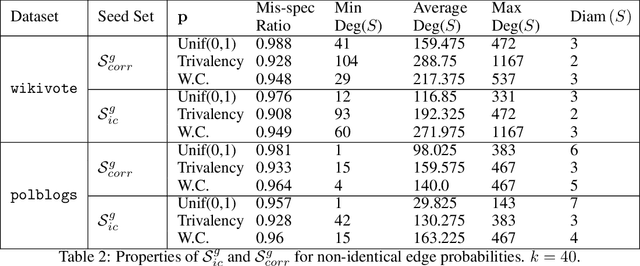
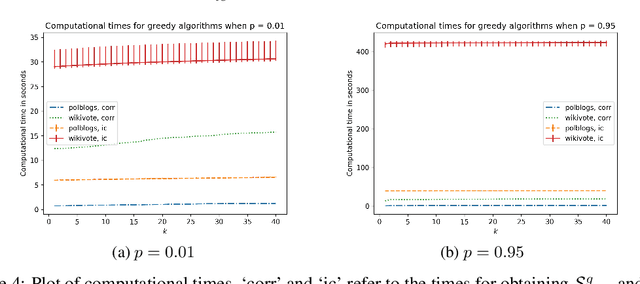
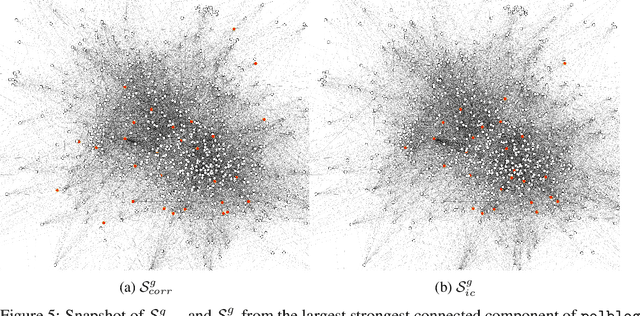
We propose a distributionally robust model for the influence maximization problem. Unlike the classic independent cascade model \citep{kempe2003maximizing}, this model's diffusion process is adversarially adapted to the choice of seed set. Hence, instead of optimizing under the assumption that all influence relationships in the network are independent, we seek a seed set whose expected influence under the worst correlation, i.e. the "worst-case, expected influence", is maximized. We show that this worst-case influence can be efficiently computed, and though the optimization is NP-hard, a ($1 - 1/e$) approximation guarantee holds. We also analyze the structure to the adversary's choice of diffusion process, and contrast with established models. Beyond the key computational advantages, we also highlight the extent to which the independence assumption may cost optimality, and provide insights from numerical experiments comparing the adversarial and independent cascade model.