 Add to Chrome
 Add to Firefox
 Add to Edge
Lexicographic Minimum-Violation Motion Planning using Signal Temporal Logic
Apr 22, 2026
Motion planning for autonomous vehicles often requires satisfying multiple conditionally conflicting specifications. In situations where not all specifications can be met simultaneously, minimum-violation motion planning maintains system operation by minimizing violations of specifications in accordance with their priorities. Signal temporal logic (STL) provides a formal language for rigorously defining these specifications and enables the quantitative evaluation of their violations. However, a total ordering of specifications yields a lexicographic optimization problem, which is typically computationally expensive to solve using standard methods. We address this problem by transforming the multi-objective lexicographic optimization problem into a single-objective scalar optimization problem using non-uniform quantization and bit-shifting. Specifically, we extend a deterministic model predictive path integral (MPPI) solver to efficiently solve optimization problems without quadratic input cost. Additionally, a novel predicate-robustness measure that combines spatial and temporal violations is introduced. Our results show that the proposed method offers an interpretable and scalable solution for lexicographic STL minimum-violation motion planning within a single-objective solver framework.

Trajectory Planning with Signal Temporal Logic Costs using Deterministic Path Integral Optimization
Mar 03, 2025
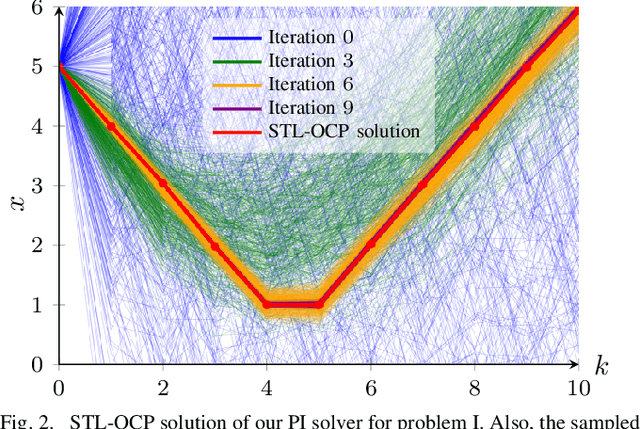
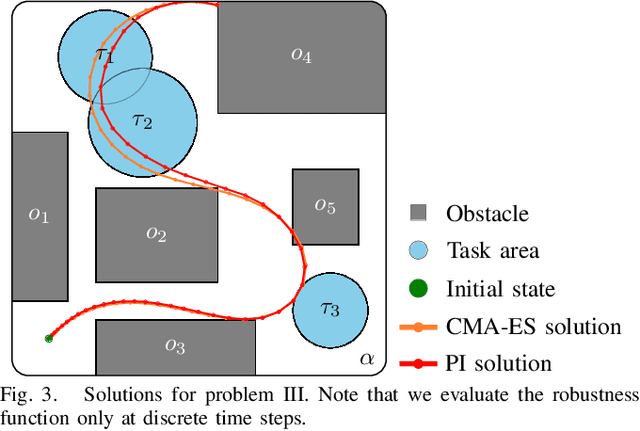
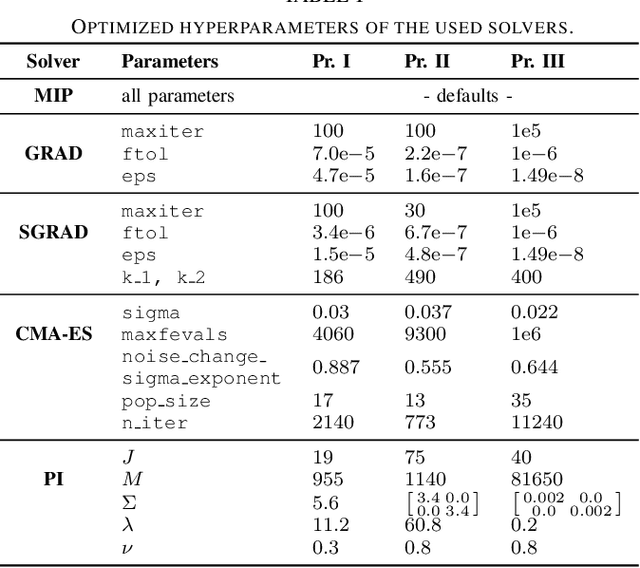
Formulating the intended behavior of a dynamic system can be challenging. Signal temporal logic (STL) is frequently used for this purpose due to its suitability in formalizing comprehensible, modular, and versatile spatiotemporal specifications. Due to scaling issues with respect to the complexity of the specifications and the potential occurrence of non-differentiable terms, classical optimization methods often solve STL-based problems inefficiently. Smoothing and approximation techniques can alleviate these issues but require changing the optimization problem. This paper proposes a novel sampling-based method based on model predictive path integral control to solve optimal control problems with STL cost functions. We demonstrate the effectiveness of our method on benchmark motion planning problems and compare its performance with state-of-the-art methods. The results show that our method efficiently solves optimal control problems with STL costs.