 Add to Chrome
 Add to Firefox
 Add to Edge
Model selection with proper scoring rules on data sets of time series: prefer the mean scaled score
Jun 24, 2026
We study the problem of model selection among probabilistic forecasting models evaluated on datasets of multiple time series. The performance of a model on a single time series is quantified by the average value (score) of a proper scoring rule over a test set, but extending model selection to data sets of time series requires aggregating these scores. Common approaches either rely on scaling scores and averaging them (mean scaled score) or avoid scaling by using alternative statistics such as mean ranks or win rates. However, these approaches can yield conflicting conclusions. We show that such discrepancies arise from the skewness of the distribution of the scores, which is particularly pronounced when test sets are short. The skewness can cause non-mean criteria (e.g., mean rank, median, win rate) to select misspecified models. In contrast, the mean score is immune from this problem. We further show that, as the size of the test sets increases, all aggregation criteria converge to the same model selection decision, mitigating these discrepancies. Our experiments on intermittent demand time series, including data from the M5 competition, highlight the importance of sufficiently large test sets; the mean scaled score appears to be the more reliable approach, also because empirically we found its decision to remain consistent when different scaling factors are adopted.

Probabilistic reconciliation of forecasts via importance sampling
Oct 05, 2022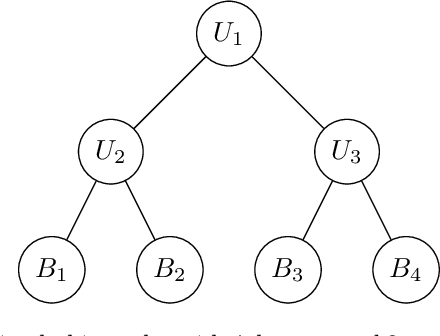
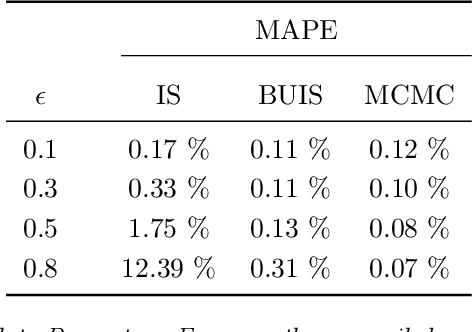
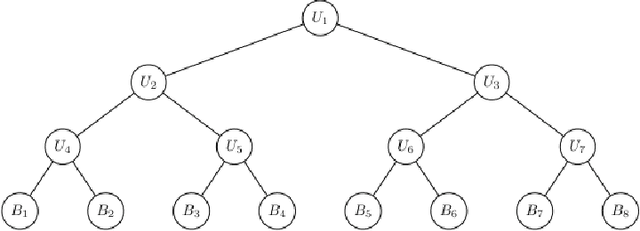
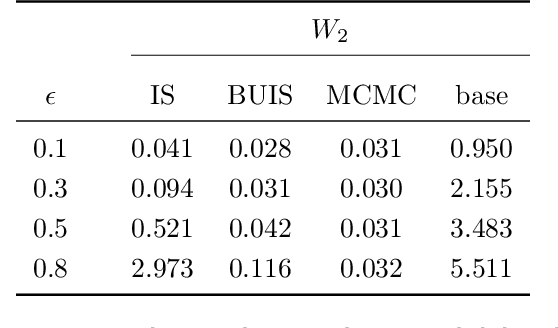
Hierarchical time series are common in several applied fields. Forecasts are required to be coherent, that is, to satisfy the constraints given by the hierarchy. The most popular technique to enforce coherence is called reconciliation, which adjusts the base forecasts computed for each time series. However, recent works on probabilistic reconciliation present several limitations. In this paper, we propose a new approach based on conditioning to reconcile any type of forecast distribution. We then introduce a new algorithm, called Bottom-Up Importance Sampling, to efficiently sample from the reconciled distribution. It can be used for any base forecast distribution: discrete, continuous, or even in the form of samples. The method was tested on several temporal hierarchies showing that our reconciliation effectively improves the quality of probabilistic forecasts. Moreover, our algorithm is up to 3 orders of magnitude faster than vanilla MCMC methods.