 Add to Chrome
 Add to Firefox
 Add to Edge
PoseDreamer: Scalable and Photorealistic Human Data Generation Pipeline with Diffusion Models
Mar 30, 2026
Acquiring labeled datasets for 3D human mesh estimation is challenging due to depth ambiguities and the inherent difficulty of annotating 3D geometry from monocular images. Existing datasets are either real, with manually annotated 3D geometry and limited scale, or synthetic, rendered from 3D engines that provide precise labels but suffer from limited photorealism, low diversity, and high production costs. In this work, we explore a third path: generated data. We introduce PoseDreamer, a novel pipeline that leverages diffusion models to generate large-scale synthetic datasets with 3D mesh annotations. Our approach combines controllable image generation with Direct Preference Optimization for control alignment, curriculum-based hard sample mining, and multi-stage quality filtering. Together, these components naturally maintain correspondence between 3D labels and generated images, while prioritizing challenging samples to maximize dataset utility. Using PoseDreamer, we generate more than 500,000 high-quality synthetic samples, achieving a 76% improvement in image-quality metrics compared to rendering-based datasets. Models trained on PoseDreamer achieve performance comparable to or superior to those trained on real-world and traditional synthetic datasets. In addition, combining PoseDreamer with synthetic datasets results in better performance than combining real-world and synthetic datasets, demonstrating the complementary nature of our dataset. We will release the full dataset and generation code.

GST: Precise 3D Human Body from a Single Image with Gaussian Splatting Transformers
Sep 06, 2024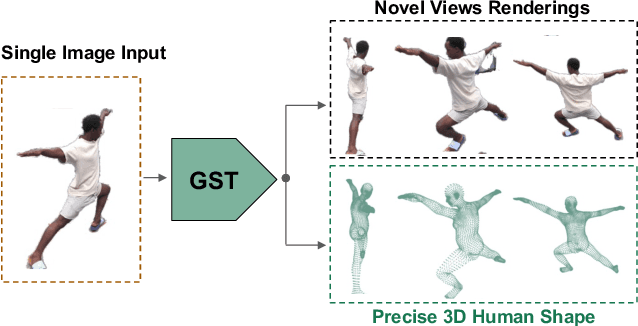
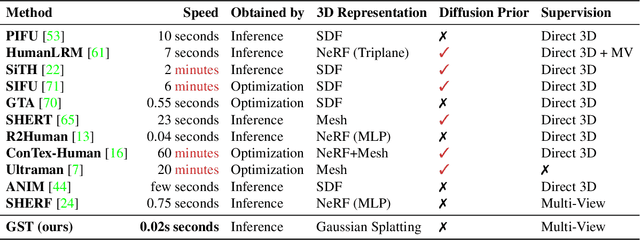
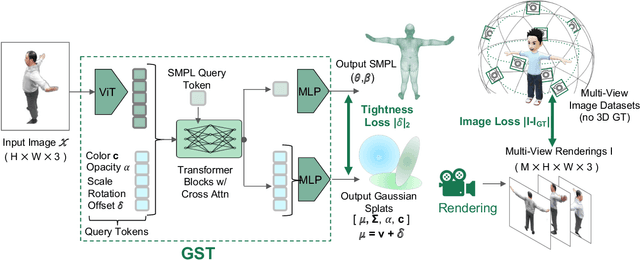
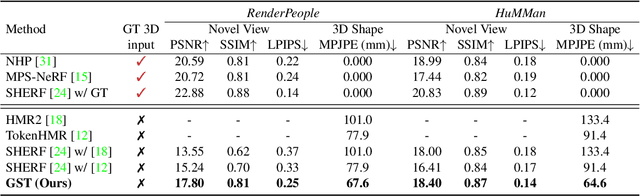
Reconstructing realistic 3D human models from monocular images has significant applications in creative industries, human-computer interfaces, and healthcare. We base our work on 3D Gaussian Splatting (3DGS), a scene representation composed of a mixture of Gaussians. Predicting such mixtures for a human from a single input image is challenging, as it is a non-uniform density (with a many-to-one relationship with input pixels) with strict physical constraints. At the same time, it needs to be flexible to accommodate a variety of clothes and poses. Our key observation is that the vertices of standardized human meshes (such as SMPL) can provide an adequate density and approximate initial position for Gaussians. We can then train a transformer model to jointly predict comparatively small adjustments to these positions, as well as the other Gaussians' attributes and the SMPL parameters. We show empirically that this combination (using only multi-view supervision) can achieve fast inference of 3D human models from a single image without test-time optimization, expensive diffusion models, or 3D points supervision. We also show that it can improve 3D pose estimation by better fitting human models that account for clothes and other variations. The code is available on the project website https://abdullahamdi.com/gst/ .