 Add to Chrome
 Add to Firefox
 Add to Edge
Neural Robust Control on Lie Groups Using Contraction Methods (Extended Version)
Apr 01, 2026
In this paper, we propose a learning framework for synthesizing a robust controller for dynamical systems evolving on a Lie group. A robust control contraction metric (RCCM) and a neural feedback controller are jointly trained to enforce contraction conditions on the Lie group manifold. Sufficient conditions are derived for the existence of such an RCCM and neural controller, ensuring that the geometric constraints imposed by the manifold structure are respected while establishing a disturbance-dependent tube that bounds the output trajectories. As a case study, a feedback controller for a quadrotor is designed using the proposed framework. Its performance is evaluated using numerical simulations and compared with a geometric controller.

A Robust Neural Control Design for Multi-drone Slung Payload Manipulation with Control Contraction Metrics
Oct 01, 2025This paper presents a robust neural control design for a three-drone slung payload transportation system to track a reference path under external disturbances. The control contraction metric (CCM) is used to generate a neural exponentially converging baseline controller while complying with control input saturation constraints. We also incorporate the uncertainty and disturbance estimator (UDE) technique to dynamically compensate for persistent disturbances. The proposed framework yields a modularized design, allowing the controller and estimator to perform their individual tasks and achieve a zero trajectory tracking error if the disturbances meet certain assumptions. The stability and robustness of the complete system, incorporating both the CCM controller and the UDE compensator, are presented. Simulations are conducted to demonstrate the capability of the proposed control design to follow complicated trajectories under external disturbances.
Observability-Aware Control for Cooperatively Localizing Quadrotor UAVs
Nov 06, 2024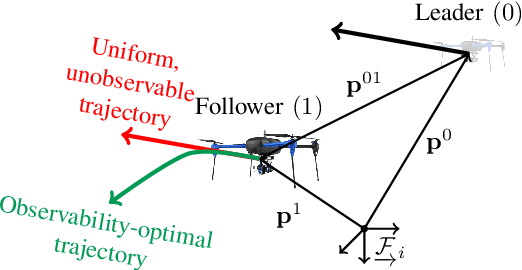


Cooperatively Localizing robots should seek optimal control strategies to maximize precision of position estimation and ensure safety in flight. Observability-Aware Trajectory Optimization has strong potential to address this issue, but no concrete link between observability and precision has been proven yet. In this paper, we prove that improvement in positioning precision inherently follows from optimizing observability. Based on this finding, we develop an Observability-Aware Control principle to generate observability-optimal control strategies. We implement this principle in a Model Predictive Control framework, and we verify it on a team of quadrotor Unmanned Aerial Vehicles comprising a follower vehicle localizing itself by tracking a leader vehicle in both simulations and real-world flight tests. Our results demonstrate that maximizing observability contributed to improving global positioning precision for the quadrotor team.