 Add to Chrome
 Add to Firefox
 Add to Edge
Follow the Norm: Accounting for Fine-Tuning and Prompt Effects on Model Rationales
Aug 13, 2026
Normative datasets are often used to train and align AI systems, but the norms they contain can function as action-guiding patterns rather than neutral moral knowledge. We propose treating the AI system as a proxy actor and test whether dataset-level norms can shift it away from its baseline safety behavior when it faces high-conflict dilemmas. We make three contributions. First, we demonstrate in controlled experiments that norm-breaking fine-tuning yields norm-divergent actions justified by self-interested rationales, suggesting a systematic shift in patterns of justification. Second, we establish a practical audit trail linking downstream justifications to upstream norms using mixed methods. Third, we show that system prompts can both suppress and elicit these patterns. We conducted experiments on three models (LLaMA-3.2-11B, Qwen-3.5-9B, and Pixtral-12B) using Low-Rank Adaptation (LoRA) fine-tuning on Social Chemistry 101 Fairness/Cheating (norm-following vs. norm-breaking) with prompt steering. Across all three models, we find that norm-breaking fine-tuning shifts the model's default rationale style from safety compliance to instrumental self-interest, whereas system prompts can override this behavior. Our results support a distributed view of alignment in which observed behavior depends jointly on training data, fine-tuning, and prompting, motivating norm-aware documentation and rationale logging for contestable oversight.

No One to Blame: A Framework of Constitutive AI Unaccountability
Aug 12, 2026The increasing deployment of autonomous, agentic AI systems challenges traditional accountability mechanisms. Existing research predominantly frames AI accountability gaps as barriers that can be overcome through better standards, transparency, and institutional reform. We argue that this framing is insufficient: certain configurations of actors, systems, and institutions render AI accountability conceptually unachievable regardless of effort. We introduce the concept of constitutive AI unaccountability to capture these configurations. Through a three-stage qualitative study comprising a concept-centric literature analysis, a secondary analysis of 27 expert interviews with AI professionals from technical, legal, and sociotechnical backgrounds, and an illustrative framework application to the open-source agentic AI system OpenClaw, we identify nine categories and 20 themes of constitutive AI unaccountability. These are organized across structural, technological, and normative clusters and reinforce one another through eight directed interdependencies. Our framework is operationalized as a diagnostic instrument of 20 questions, which detected 17 of 20 conditions when applied to OpenClaw, including an inverted anthropomorphism configuration in which the AI agent was the only identifiable actor. We contribute a reframing of AI unaccountability as a constitutive property of sociotechnical systems, an extension of the four barriers to accountability, and a practical instrument for identifying accountability voids in specific AI deployments.
Complex-Valued Kernel-based Phase and Amplitude Distortion Compensation in Parametrically Amplified Optical Links
Jun 23, 2024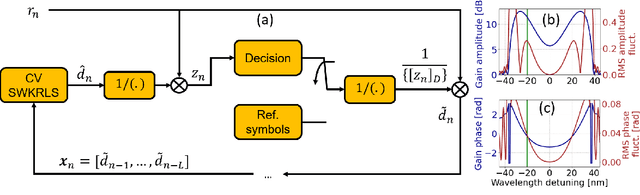
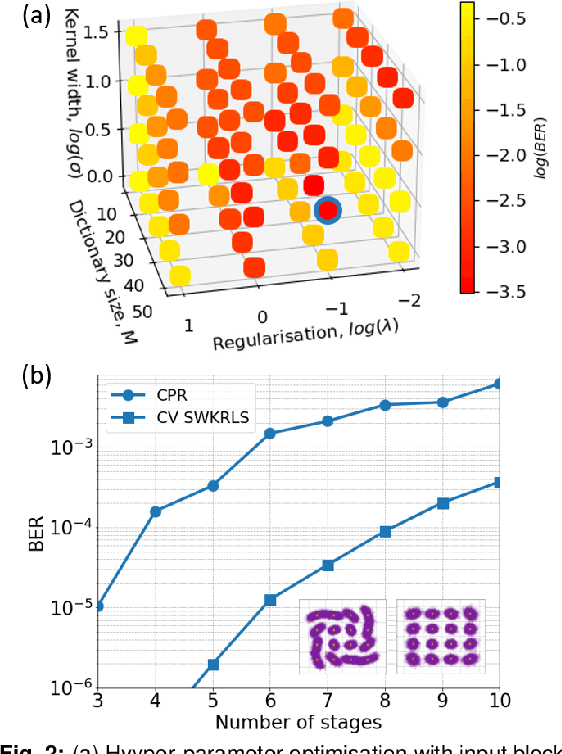
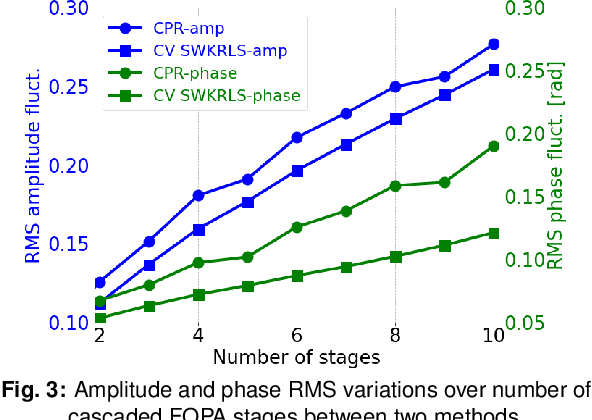
We develop a complex-valued kernel-adaptive-filtering based method for phase and amplitude distortion compensation in cascaded fibre-optical parametric amplifier (FOPA) links. Our algorithm predicts and cancels both distortions induced by pump-phase modulation across all amplification stages, achieving more than an order of magnitude improvement in BER.