 Add to Chrome
 Add to Firefox
 Add to Edge
Let Distortion Guide Restoration (DGR): A physics-informed learning framework for Prostate Diffusion MRI
Jan 01, 2026
We present Distortion-Guided Restoration (DGR), a physics-informed hybrid CNN-diffusion framework for acquisition-free correction of severe susceptibility-induced distortions in prostate single-shot EPI diffusion-weighted imaging (DWI). DGR is trained to invert a realistic forward distortion model using large-scale paired distorted and undistorted data synthesized from distortion-free prostate DWI and co-registered T2-weighted images from 410 multi-institutional studies, together with 11 measured B0 field maps from metal-implant cases incorporated into a forward simulator to generate low-b DWI (b = 50 s per mm squared), high-b DWI (b = 1400 s per mm squared), and ADC distortions. The network couples a CNN-based geometric correction module with conditional diffusion refinement under T2-weighted anatomical guidance. On a held-out synthetic validation set (n = 34) using ground-truth simulated distortion fields, DGR achieved higher PSNR and lower NMSE than FSL TOPUP and FUGUE. In 34 real clinical studies with severe distortion, including hip prostheses and marked rectal distension, DGR improved geometric fidelity and increased radiologist-rated image quality and diagnostic confidence. Overall, learning the inverse of a physically simulated forward process provides a practical alternative to acquisition-dependent distortion-correction pipelines for prostate DWI.

Fully Automated Multi-Organ Segmentation in Abdominal Magnetic Resonance Imaging with Deep Neural Networks
Dec 23, 2019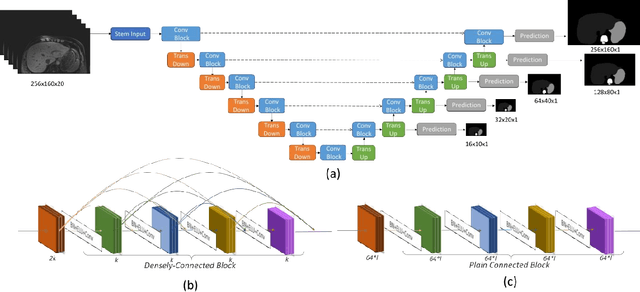
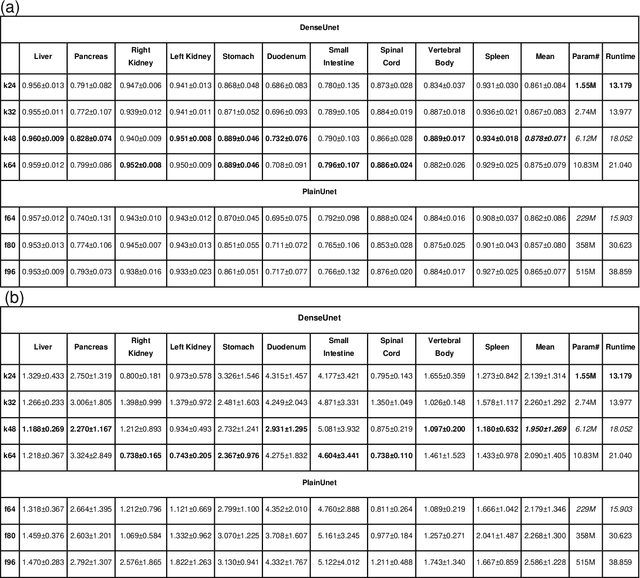
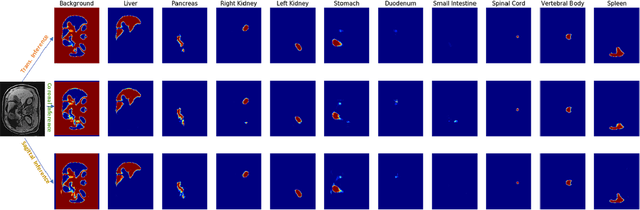
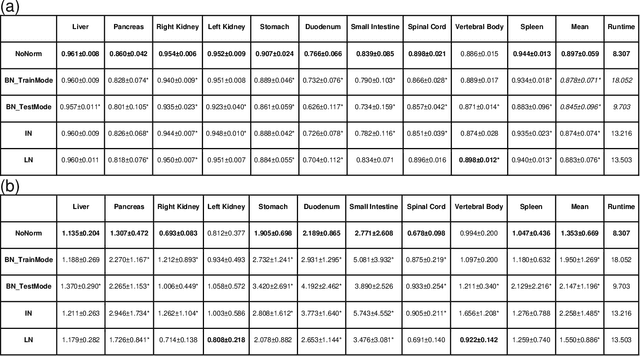
Segmentation of multiple organs-at-risk (OARs) is essential for radiation therapy treatment planning and other clinical applications. We developed an Automated deep Learning-based Abdominal Multi-Organ segmentation (ALAMO) framework based on 2D U-net and a densely connected network structure with tailored design in data augmentation and training procedures such as deep connection, auxiliary supervision, and multi-view. The model takes in multi-slice MR images and generates the output of segmentation results. Three-Tesla T1 VIBE (Volumetric Interpolated Breath-hold Examination) images of 102 subjects were collected and used in our study. Ten OARs were studied, including the liver, spleen, pancreas, left/right kidneys, stomach, duodenum, small intestine, spinal cord, and vertebral bodies. Two radiologists manually labeled and obtained the consensus contours as the ground-truth. In the complete cohort of 102, 20 samples were held out for independent testing, and the rest were used for training and validation. The performance was measured using volume overlapping and surface distance. The ALAMO framework generated segmentation labels in good agreement with the manual results. Specifically, among the 10 OARs, 9 achieved high Dice Similarity Coefficients (DSCs) in the range of 0.87-0.96, except for the duodenum with a DSC of 0.80. The inference completes within one minute for a 3D volume of 320x288x180. Overall, the ALAMO model matches the state-of-the-art performance. The proposed ALAMO framework allows for fully automated abdominal MR segmentation with high accuracy and low memory and computation time demands.