 Add to Chrome
 Add to Firefox
 Add to Edge
What's in an Earth Embedding? An Explainability Analysis of Location Encoders
Jun 23, 2026
Geographic implicit neural representations (INRs) learn to map any coordinate on Earth to a location embedding, implicitly encoding geospatial data into the weights of a neural network. Location embeddings are widely used off the shelf as general-purpose geospatial representations, yet users lack principled tools to audit what geographic or semantic information these embeddings capture. In this work, we analyze the information content of geographic INRs through their location embeddings. We decompose these embeddings into human-interpretable features$\unicode{x2014}$namely, (i) sparse latent concepts, (ii) natural language concepts, and (iii) visual features. The latent concept embeddings are learned using sparse autoencoders. To recover natural language concepts, we apply sparse linear concept embeddings (SpLiCE) over a predefined geospatial dictionary. Finally, visual features are extracted using saliency maps derived from CLIP Surgery. We show that location embeddings can be decomposed into human-interpretable representations while retaining high reconstruction capability, revealing interpretable geographic structures such as forests, deserts, and urban features. Across methods, sparse decompositions expose systematic differences in encoded information, ranging from urban structures to broader biome and climate signals, and pretraining-space saliency maps further highlight complementary features such as roads and landmarks. We hope this work provides a first step toward interpretable geospatial representations.

Mapping on a Budget: Optimizing Spatial Data Collection for ML
Sep 03, 2025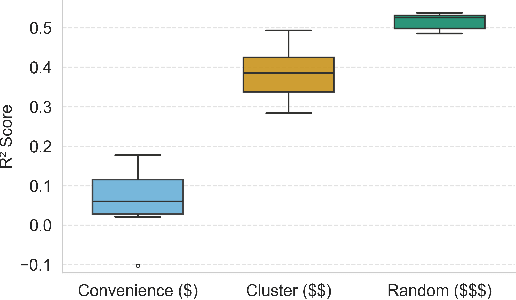
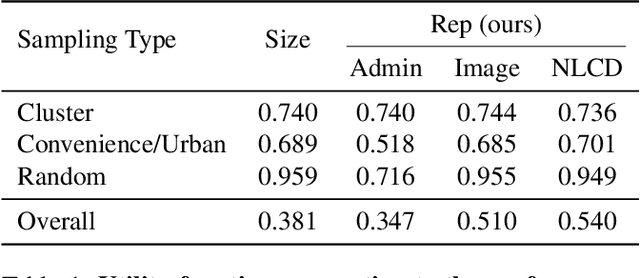
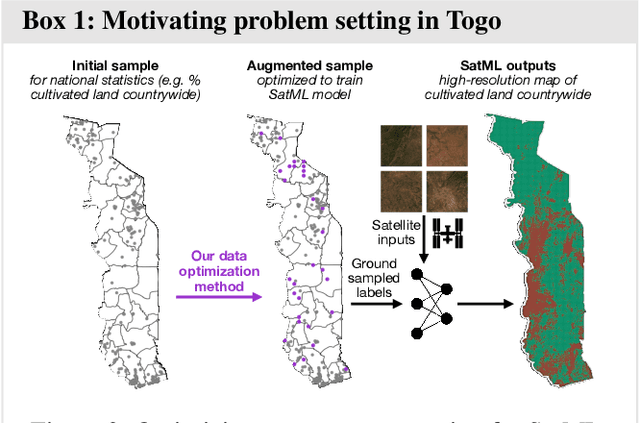
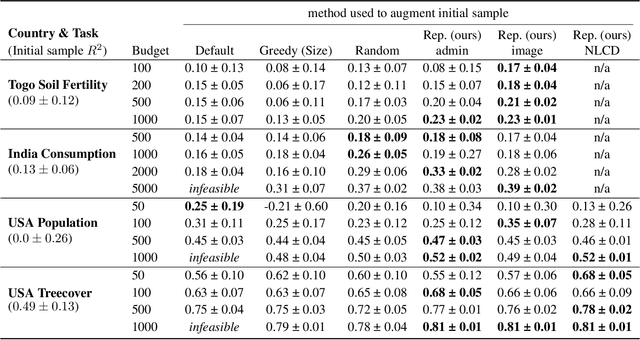
In applications across agriculture, ecology, and human development, machine learning with satellite imagery (SatML) is limited by the sparsity of labeled training data. While satellite data cover the globe, labeled training datasets for SatML are often small, spatially clustered, and collected for other purposes (e.g., administrative surveys or field measurements). Despite the pervasiveness of this issue in practice, past SatML research has largely focused on new model architectures and training algorithms to handle scarce training data, rather than modeling data conditions directly. This leaves scientists and policymakers who wish to use SatML for large-scale monitoring uncertain about whether and how to collect additional data to maximize performance. Here, we present the first problem formulation for the optimization of spatial training data in the presence of heterogeneous data collection costs and realistic budget constraints, as well as novel methods for addressing this problem. In experiments simulating different problem settings across three continents and four tasks, our strategies reveal substantial gains from sample optimization. Further experiments delineate settings for which optimized sampling is particularly effective. The problem formulation and methods we introduce are designed to generalize across application domains for SatML; we put special emphasis on a specific problem setting where our coauthors can immediately use our findings to augment clustered agricultural surveys for SatML monitoring in Togo.