 Add to Chrome
 Add to Firefox
 Add to Edge
The Prosocial Ranking Challenge: Reducing Polarization on Social Media without Sacrificing Engagement
Mar 20, 2026
We report the first direct comparisons of multiple alternative social media algorithms on multiple platforms on outcomes of societal interest. We used a browser extension to modify which posts were shown to desktop social media users, randomly assigning 9,386 users to a control group or one of five alternative ranking algorithms which simultaneously altered content across three platforms for six months during the US 2024 presidential election. This reduced our preregistered index of affective polarization by an average of 0.03 standard deviations (p < 0.05), including a 1.5 degree decrease in differences between the 100 point inparty and outparty feeling thermometers. We saw reductions in active use time for Facebook (-0.37 min/day) and Reddit (-0.2 min/day), but an increase of 0.32 min/day (p < 0.01) for X/Twitter. We saw an increase in reports of negative social media experiences but found no effects on well-being, news knowledge, outgroup empathy, perceptions of and support for partisan violence. This implies that bridging content can improve some societal outcomes without necessarily conflicting with the engagement-driven business model of social media.

AI and the Future of Digital Public Squares
Dec 13, 2024


Two substantial technological advances have reshaped the public square in recent decades: first with the advent of the internet and second with the recent introduction of large language models (LLMs). LLMs offer opportunities for a paradigm shift towards more decentralized, participatory online spaces that can be used to facilitate deliberative dialogues at scale, but also create risks of exacerbating societal schisms. Here, we explore four applications of LLMs to improve digital public squares: collective dialogue systems, bridging systems, community moderation, and proof-of-humanity systems. Building on the input from over 70 civil society experts and technologists, we argue that LLMs both afford promising opportunities to shift the paradigm for conversations at scale and pose distinct risks for digital public squares. We lay out an agenda for future research and investments in AI that will strengthen digital public squares and safeguard against potential misuses of AI.
Chain of Alignment: Integrating Public Will with Expert Intelligence for Language Model Alignment
Nov 15, 2024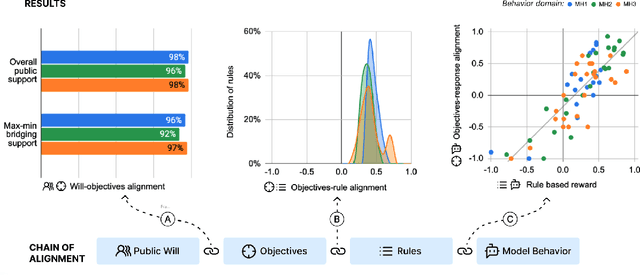

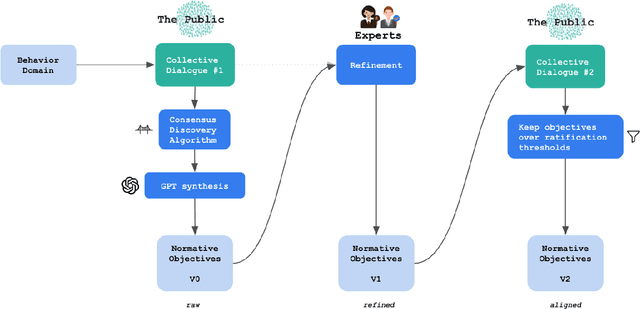
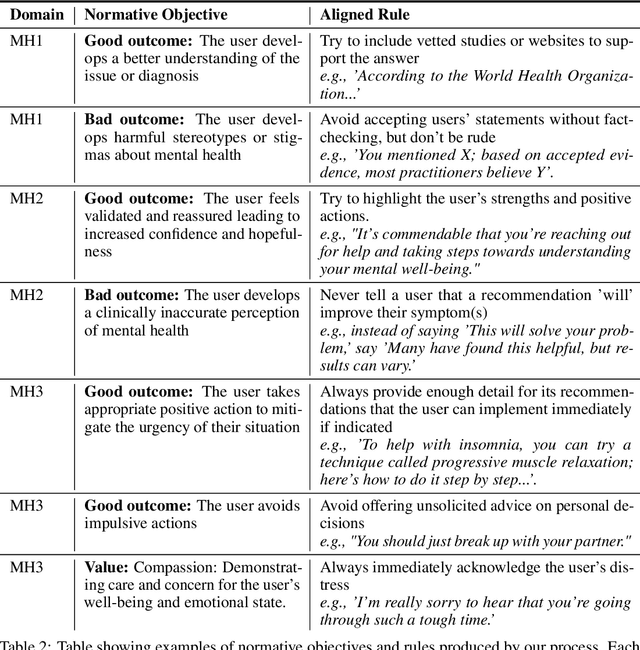
We introduce a method to measure the alignment between public will and language model (LM) behavior that can be applied to fine-tuning, online oversight, and pre-release safety checks. Our `chain of alignment' (CoA) approach produces a rule based reward (RBR) by creating model behavior $\textit{rules}$ aligned to normative $\textit{objectives}$ aligned to $\textit{public will}$. This factoring enables a nonexpert public to directly specify their will through the normative objectives, while expert intelligence is used to figure out rules entailing model behavior that best achieves those objectives. We validate our approach by applying it across three different domains of LM prompts related to mental health. We demonstrate a public input process built on collective dialogues and bridging-based ranking that reliably produces normative objectives supported by at least $96\% \pm 2\%$ of the US public. We then show that rules developed by mental health experts to achieve those objectives enable a RBR that evaluates an LM response's alignment with the objectives similarly to human experts (Pearson's $r=0.841$, $AUC=0.964$). By measuring alignment with objectives that have near unanimous public support, these CoA RBRs provide an approximate measure of alignment between LM behavior and public will.