 Add to Chrome
 Add to Firefox
 Add to Edge
Behavioral Audit of Machine Unlearning Has a Privacy Cost
Jun 12, 2026
The removal of learned data from Machine Learning models through Machine Unlearning (MU) has been widely studied; however, there has yet to be an agreed-upon scheme for auditing MU. Existing work has shown that a dishonest model owner can falsify evidence to avoid executing MU, while curious auditors (and adversaries) can infer the privacy-sensitive properties of the model and its training data even with limited access. Yet auditing of MU under mutual distrust between the model owner and the auditor remains unexplored. We provide an information-theoretic proof for this scenario: for convex ML models, a generic audit scheme that relies solely on querying the model for \textit{behavioral} signals cannot identify insufficiently unlearned models without revealing membership information of the retained set. Therefore, auditing MU under the assumption of a dishonest model owner and an honest-but-curious auditor faces an inherent privacy-audit tradeoff. Our empirical results on convex models strongly supports this result, while further experiments demonstrate that this privacy-audit tension persists in non-convex models. Our results call for a more careful consideration of the privacy-audit tension under a realistic auditor threat model, and serve as a foundation for more scrutiny of designs of privacy-preserving audit schemes for the MU pipeline. We also release our code implementation at https://github.com/LiouTang/Behavioral-Unlearn-Audit.

Apollo: A Posteriori Label-Only Membership Inference Attack Towards Machine Unlearning
Jun 11, 2025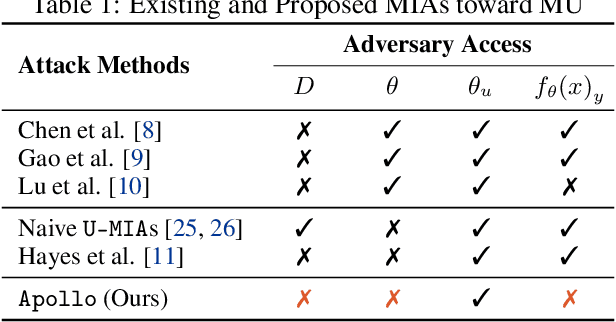
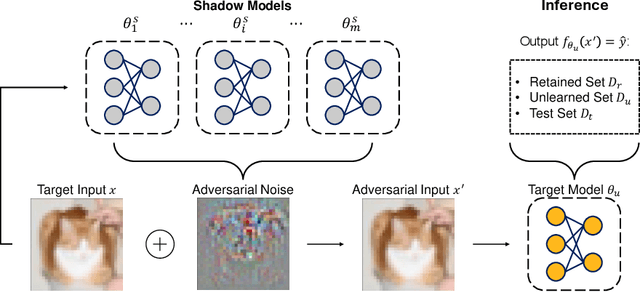
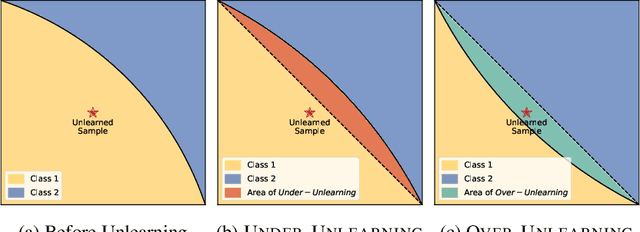

Machine Unlearning (MU) aims to update Machine Learning (ML) models following requests to remove training samples and their influences on a trained model efficiently without retraining the original ML model from scratch. While MU itself has been employed to provide privacy protection and regulatory compliance, it can also increase the attack surface of the model. Existing privacy inference attacks towards MU that aim to infer properties of the unlearned set rely on the weaker threat model that assumes the attacker has access to both the unlearned model and the original model, limiting their feasibility toward real-life scenarios. We propose a novel privacy attack, A Posteriori Label-Only Membership Inference Attack towards MU, Apollo, that infers whether a data sample has been unlearned, following a strict threat model where an adversary has access to the label-output of the unlearned model only. We demonstrate that our proposed attack, while requiring less access to the target model compared to previous attacks, can achieve relatively high precision on the membership status of the unlearned samples.