 Add to Chrome
 Add to Firefox
 Add to Edge
Dreamer-SAC: Off-Policy Learning in Latent World Models for Sample-Efficient Autonomous Driving
Aug 11, 2026
Sample-efficient reinforcement learning for autonomous driving is often limited by the trade-off between data efficiency and model bias. While world models reduce the reliance on costly environment interactions, policy optimization over learned dynamics remains sensitive to prediction errors. This paper proposes the Dreamer-SAC framework, which integrates a recurrent state-space world model with an off-policy soft actor-critic algorithm trained directly in latent space. The framework uses a combination of real interactions and short-horizon generated trajectories with n-step target estimation and multi-objective supervision. Evaluated in autonomous driving scenarios with objectives encompassing driving efficiency and safety, the proposed framework consistently outperforms representative reinforcement learning baselines, including DreamerV3, SAC, and PPO, while achieving improved performance with substantially fewer real environment interactions. Experiments reveal an inverted-U relationship between rollout horizon and policy performance, where short-horizon latent rollouts achieve the best trade-off between additional training signals and accumulated model bias. Furthermore, n-step target estimation demonstrates more effectiveness over one-step temporal-difference targets in exploiting predicted experience for value learning.

A Large Language Model-Enhanced Q-learning for Capacitated Vehicle Routing Problem with Time Windows
May 09, 2025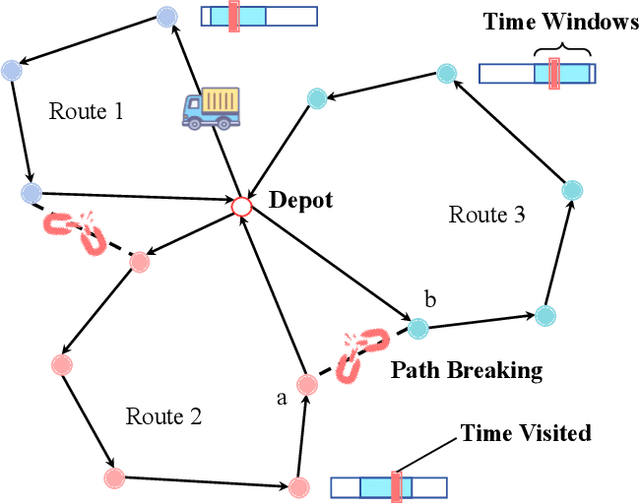
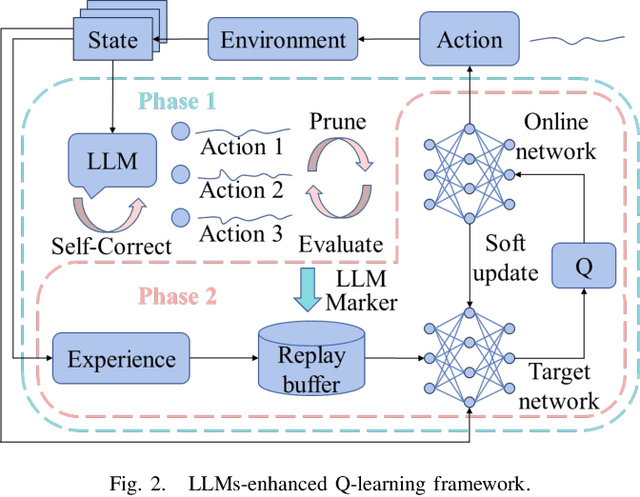
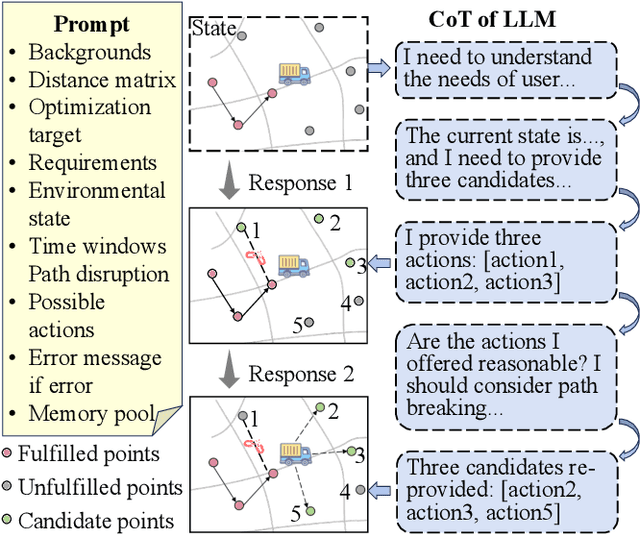
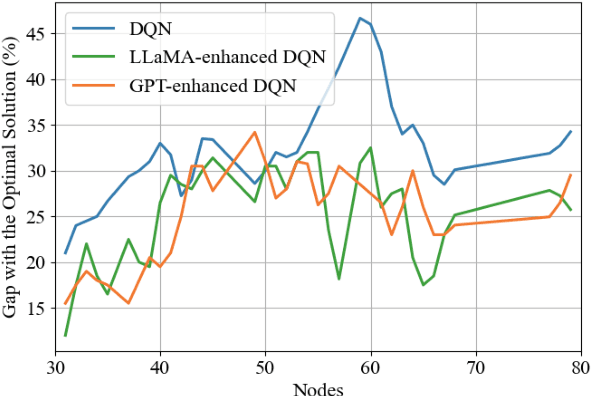
The Capacitated Vehicle Routing Problem with Time Windows (CVRPTW) is a classic NP-hard combinatorial optimization problem widely applied in logistics distribution and transportation management. Its complexity stems from the constraints of vehicle capacity and time windows, which pose significant challenges to traditional approaches. Advances in Large Language Models (LLMs) provide new possibilities for finding approximate solutions to CVRPTW. This paper proposes a novel LLM-enhanced Q-learning framework to address the CVRPTW with real-time emergency constraints. Our solution introduces an adaptive two-phase training mechanism that transitions from the LLM-guided exploration phase to the autonomous optimization phase of Q-network. To ensure reliability, we design a three-tier self-correction mechanism based on the Chain-of-Thought (CoT) for LLMs: syntactic validation, semantic verification, and physical constraint enforcement. In addition, we also prioritized replay of the experience generated by LLMs to amplify the regulatory role of LLMs in the architecture. Experimental results demonstrate that our framework achieves a 7.3\% average reduction in cost compared to traditional Q-learning, with fewer training steps required for convergence.