 Add to Chrome
 Add to Firefox
 Add to Edge
A Local-Linearly Convergent Algorithm for Nonconvex Equality-Constrained Optimization
Aug 12, 2026
For solving nonconvex equality-constrained optimization problems, a recent Gradient-Eigenstep Algorithm by Goyens et al.~is an iteration-efficient approach, based on minimizing Fletcher's augmented Lagrangian function, for finding an approximate second-order stationary point from an arbitrary starting point. In this paper, the analysis of this algorithm is extended, offering a two-fold contribution. First, it is shown that a local-linear rate of convergence can be obtained by this method if it is initiated sufficiently close to a strong second-order stationary point and employs a sufficiently small step-size parameter and sufficiently large penalty parameter. In this case, the algorithm reduces to a gradient descent algorithm applied to minimize Fletcher's augmented Lagrangian. Second, as a particularly useful application of the first result, it is shown that the Gradient-Eigenstep algorithm can be used as an iteration-efficient subproblem solver in the context of a progressive sampling strategy for solving equality-constrained optimization problems when the objective and constraint functions are defined by large sample averages, ultimately offering an algorithm with an improved worst-case sample complexity when compared to an approach that solves a full-sample problem directly.

Behind the Scenes of Gradient Descent: A Trajectory Analysis via Basis Function Decomposition
Oct 04, 2022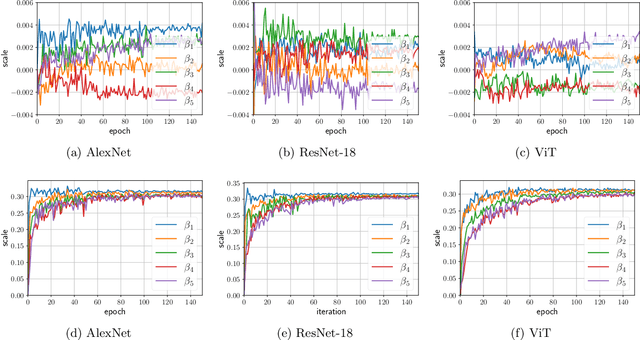

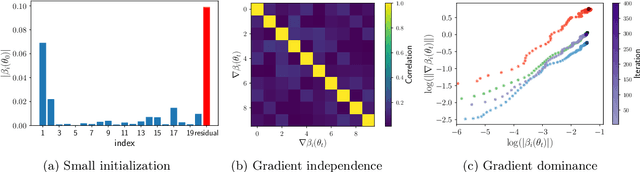
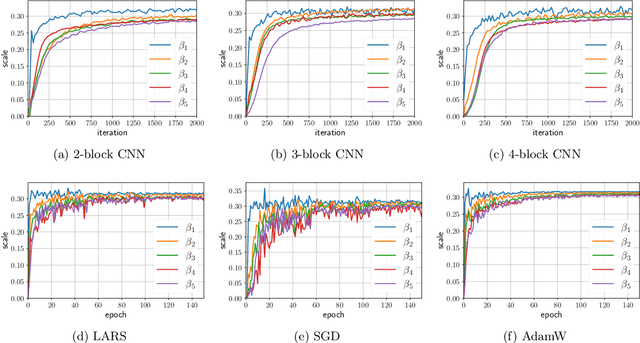
This work analyzes the solution trajectory of gradient-based algorithms via a novel basis function decomposition. We show that, although solution trajectories of gradient-based algorithms may vary depending on the learning task, they behave almost monotonically when projected onto an appropriate orthonormal function basis. Such projection gives rise to a basis function decomposition of the solution trajectory. Theoretically, we use our proposed basis function decomposition to establish the convergence of gradient descent (GD) on several representative learning tasks. In particular, we improve the convergence of GD on symmetric matrix factorization and provide a completely new convergence result for the orthogonal symmetric tensor decomposition. Empirically, we illustrate the promise of our proposed framework on realistic deep neural networks (DNNs) across different architectures, gradient-based solvers, and datasets. Our key finding is that gradient-based algorithms monotonically learn the coefficients of a particular orthonormal function basis of DNNs defined as the eigenvectors of the conjugate kernel after training. Our code is available at https://github.com/jianhaoma/function-basis-decomposition.