 Add to Chrome
 Add to Firefox
 Add to Edge
Calibration and Evaluation of Car-Following Models for Autonomous Shuttles Using a Novel Multi-Criteria Framework
Feb 12, 2026
Autonomous shuttles (AS) are fully autonomous transit vehicles with operating characteristics distinct from conventional autonomous vehicles (AV). Developing dedicated car-following models for AS is critical to understanding their traffic impacts; however, few studies have calibrated such models with field data. More advanced machine learning (ML) techniques have not yet been applied to AS trajectories, leaving the potential of ML for capturing AS dynamics unexplored and constraining the development of dedicated AS models. Furthermore, there is a lack of a unified framework for systematically evaluating and comparing the performance of car-following models to replicate real trajectories. Existing car-following studies often rely on disparate metrics, which limit reproducibility and performance comparability. This study addresses these gaps through two main contributions: (1) the calibration of a diverse set of car-following models using real-world AS trajectory data, including eight machine learning algorithms and two physics-based models; and (2) the introduction of a multi-criteria evaluation framework that integrates measures of prediction accuracy, trajectory stability, and statistical similarity, which provides a generalizable methodology for a systematic assessment of car-following models. Results indicated that the proposed calibrated XGBoost model achieved the best overall performance. Sequential model type, such as LSTM and CNN, captured long-term positional stability but were less responsive to short-term dynamics. LSTM and CNN captured long-term positional stability but were less responsive to short-term dynamics. Traditional models (IDM, ACC) and kernel methods showed lower accuracy and stability than most ML models tested.

Machine Learning Methods for Solving Assignment Problems in Multi-Target Tracking
Feb 19, 2018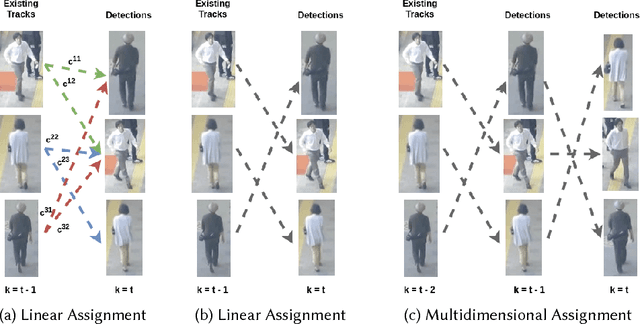

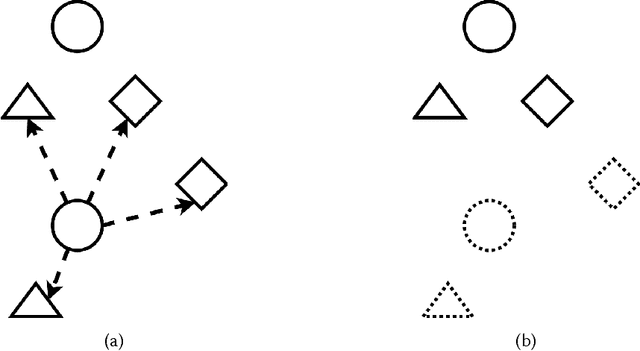
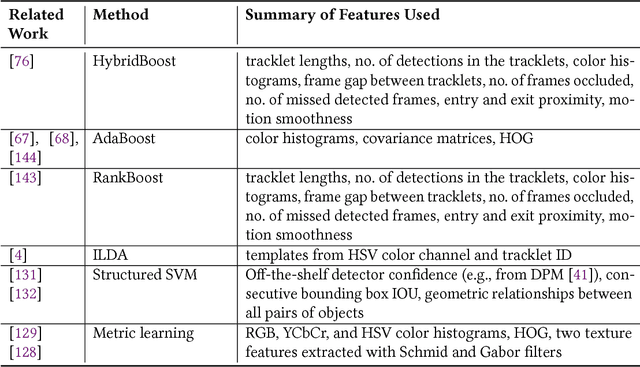
Data association and track-to-track association, two fundamental problems in single-sensor and multi-sensor multi-target tracking, are instances of an NP-hard combinatorial optimization problem known as the multidimensional assignment problem (MDAP). Over the last few years, data-driven approaches to tackling MDAPs in tracking have become increasingly popular. We argue that viewing multi-target tracking as an assignment problem conceptually unifies the wide variety of machine learning methods that have been proposed for data association and track-to-track association. In this survey, we review recent literature, provide rigorous formulations of the assignment problems encountered in multi-target tracking, and review classic approaches used prior to the shift towards data-driven techniques. Recent attempts at using deep learning to solve NP-hard combinatorial optimization problems, including data association, are discussed as well. We highlight representation learning methods for multi-sensor applications and conclude by providing an overview of current multi-target tracking benchmarks.