 Add to Chrome
 Add to Firefox
 Add to Edge
CellWorld: From Gene-Level Reconstruction to Latent Cell Prediction in Spatial Transcriptomics Foundation Models
Aug 07, 2026
This paper shows that latent-space predictive pretraining can provide a scalable route to foundation models for spatial transcriptomics. Existing spatial transcriptomics foundation models primarily reconstruct masked gene identities or expression values, potentially encouraging the reproduction of assay-specific technical variation and limiting representation transferability. To avoid directly reconstructing such variation, we shift the prediction target from observed gene measurements to latent cell representations and introduce CellWorld, which predicts the latent representations of masked cells from visible spatial context and a limited partial-expression hint. We pretrain four CellWorld variants, spanning 5.74M to 94.56M trainable parameters, on a corpus of 46 million human cells. Our controlled scaling experiments show that performance improves with model capacity, particularly on spatial tasks, while spatial transfer depends more on sufficient optimization and broad biological source diversity than on cell count alone. Across four held-out datasets, even CellWorld-Small, with 5.74M trainable parameters, outperforms every baseline on all 11 linear-probe benchmarks and all seven fine-tuned spatial benchmarks. Most notably, a frozen CellWorld-Large pretrained on only 5\% of the corpus with broad biological source coverage outperforms every fully fine-tuned baseline across all seven spatial benchmarks. Code is available at https://github.com/UoM-HealthAI/CellWorld.

A systematic review of causal methods enabling predictions under hypothetical interventions
Nov 19, 2020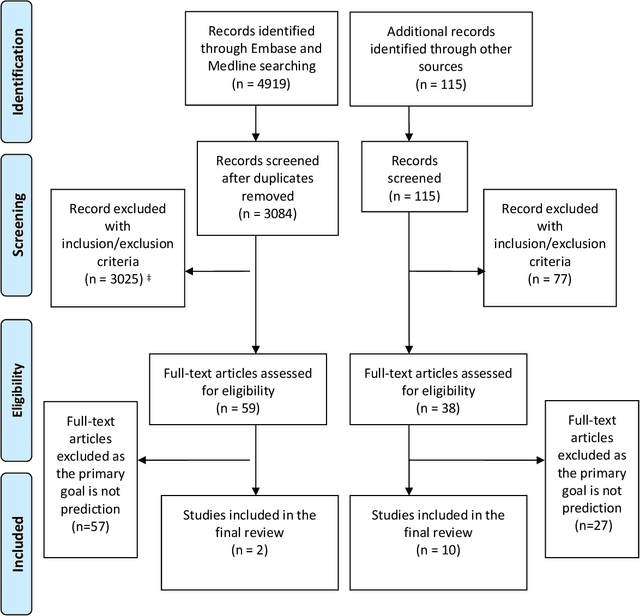
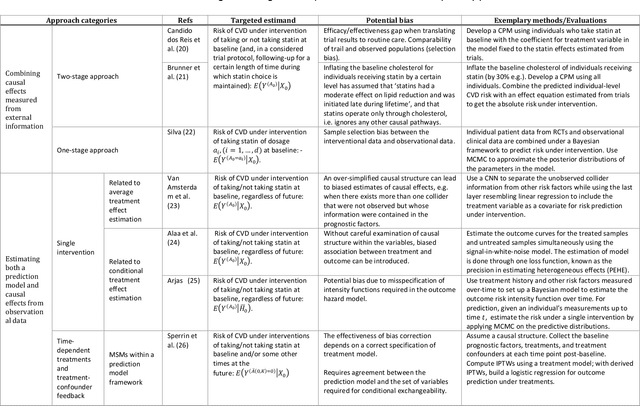
Background: The methods with which prediction models are usually developed mean that neither the parameters nor the predictions should be interpreted causally. For many applications this is perfectly acceptable. However, when prediction models are used to support decision making, there is often a need for predicting outcomes under hypothetical interventions. Aims: We aimed to identify and compare published methods for developing and validating prediction models that enable risk estimation of outcomes under hypothetical interventions, utilizing causal inference. We aimed to identify the main methodological approaches, their underlying assumptions, targeted estimands, and possible sources of bias. Finally, we aimed to highlight unresolved methodological challenges. Methods: We systematically reviewed literature published by December 2019, considering papers in the health domain that used causal considerations to enable prediction models to be used to evaluate predictions under hypothetical interventions. We included both methodology development studies and applied studies. Results: We identified 4919 papers through database searches and a further 115 papers through manual searches. Of these, 87 papers were retained for full text screening, of which 12 were selected for inclusion. We found papers from both the statistical and the machine learning literature. Most of the identified methods for causal inference from observational data were based on marginal structural models and g-estimation.