 Add to Chrome
 Add to Firefox
 Add to Edge
DeepMoLM: Leveraging Visual and Geometric Structural Information for Molecule-Text Modeling
Jan 21, 2026
AI models for drug discovery and chemical literature mining must interpret molecular images and generate outputs consistent with 3D geometry and stereochemistry. Most molecular language models rely on strings or graphs, while vision-language models often miss stereochemical details and struggle to map continuous 3D structures into discrete tokens. We propose DeepMoLM: Deep Molecular Language M odeling, a dual-view framework that grounds high-resolution molecular images in geometric invariants derived from molecular conformations. DeepMoLM preserves high-frequency evidence from 1024 $\times$ 1024 inputs, encodes conformer neighborhoods as discrete Extended 3-Dimensional Fingerprints, and fuses visual and geometric streams with cross-attention, enabling physically grounded generation without atom coordinates. DeepMoLM improves PubChem captioning with a 12.3% relative METEOR gain over the strongest generalist baseline while staying competitive with specialist methods. It produces valid numeric outputs for all property queries and attains MAE 13.64 g/mol on Molecular Weight and 37.89 on Complexity in the specialist setting. On ChEBI-20 description generation from images, it exceeds generalist baselines and matches state-of- the-art vision-language models. Code is available at https://github.com/1anj/DeepMoLM.

Structure-Aware Contrastive Learning with Fine-Grained Binding Representations for Drug Discovery
Sep 18, 2025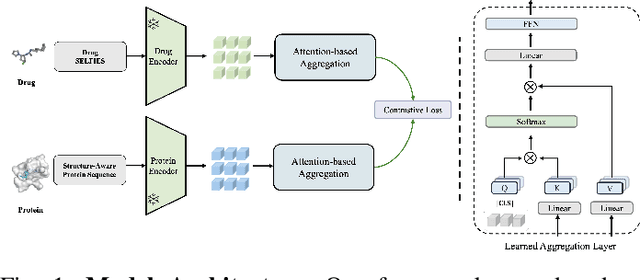
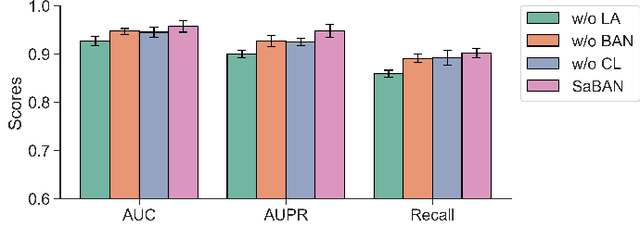
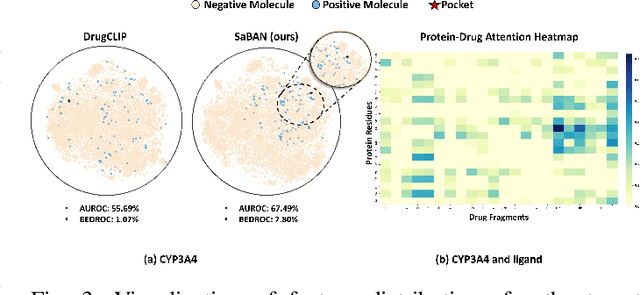
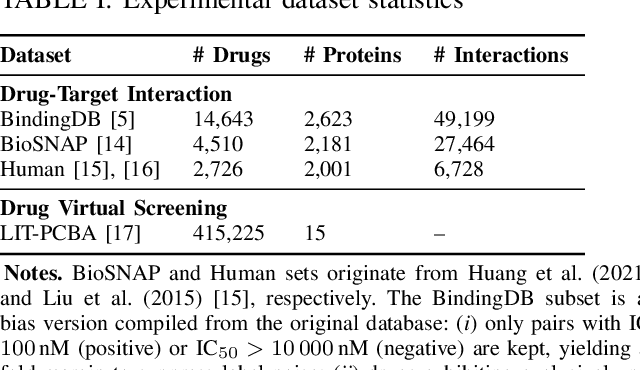
Accurate identification of drug-target interactions (DTI) remains a central challenge in computational pharmacology, where sequence-based methods offer scalability. This work introduces a sequence-based drug-target interaction framework that integrates structural priors into protein representations while maintaining high-throughput screening capability. Evaluated across multiple benchmarks, the model achieves state-of-the-art performance on Human and BioSNAP datasets and remains competitive on BindingDB. In virtual screening tasks, it surpasses prior methods on LIT-PCBA, yielding substantial gains in AUROC and BEDROC. Ablation studies confirm the critical role of learned aggregation, bilinear attention, and contrastive alignment in enhancing predictive robustness. Embedding visualizations reveal improved spatial correspondence with known binding pockets and highlight interpretable attention patterns over ligand-residue contacts. These results validate the framework's utility for scalable and structure-aware DTI prediction.