 Add to Chrome
 Add to Firefox
 Add to Edge
TEmBed-T: A Multi-Dimensional Benchmark for Table-Level Embeddings
Jul 27, 2026
Tabular data is the dominant structured-data modality, and learning table representations has become a core research direction. Table-level embeddings in particular underpin a wide range of applications, including table retrieval, data lake discovery, and table classification. Despite their importance, there is still limited understanding of how different embedding approaches behave across tasks, making systematic evaluation and analysis essential. In this work, we introduce a systematic evaluation of table-level embeddings that captures several complementary properties required for downstream effectiveness. We realize this evaluation by extending TEmBed, a recently proposed testbed for tabular embeddings, whose table-level coverage is currently limited to a single retrieval task. An empirical study over the TEmBed model pool confirms that no single model excels across all tasks, demonstrating that table-level embedding quality cannot be reduced to retrieval alone.

Towards Universal Tabular Embeddings: A Benchmark Across Data Tasks
Apr 23, 2026Tabular foundation models aim to learn universal representations of tabular data that transfer across tasks and domains, enabling applications such as table retrieval, semantic search and table-based prediction. Despite the growing number of such models, it remains unclear which approach works best in practice, as existing methods are often evaluated under task-specific settings that make direct comparison difficult. To address this, we introduce TEmBed, the Tabular Embedding Test Bed, a comprehensive benchmark for systematically evaluating tabular embeddings across four representation levels: cell, row, column, and table. Evaluating a diverse set of tabular representation learning models, we show that which model to use depends on the task and representation level. Our results offer practical guidance for selecting tabular embeddings in real-world applications and lay the groundwork for developing more general-purpose tabular representation models.
Towards Foundation Models for Relational Databases [Vision Paper]
May 24, 2023Tabular representation learning has recently gained a lot of attention. However, existing approaches only learn a representation from a single table, and thus ignore the potential to learn from the full structure of relational databases, including neighboring tables that can contain important information for a contextualized representation. Moreover, current models are significantly limited in scale, which prevents that they learn from large databases. In this paper, we thus introduce our vision of relational representation learning, that can not only learn from the full relational structure, but also can scale to larger database sizes that are commonly found in real-world. Moreover, we also discuss opportunities and challenges we see along the way to enable this vision and present initial very promising results. Overall, we argue that this direction can lead to foundation models for relational databases that are today only available for text and images.
Investigating User Radicalization: A Novel Dataset for Identifying Fine-Grained Temporal Shifts in Opinion
Apr 29, 2022
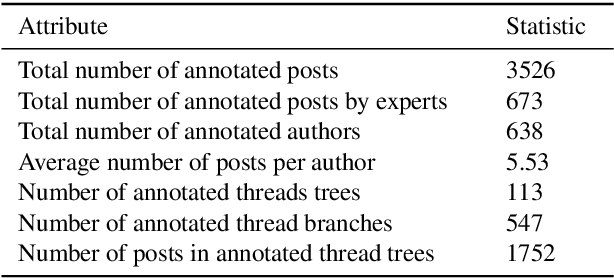
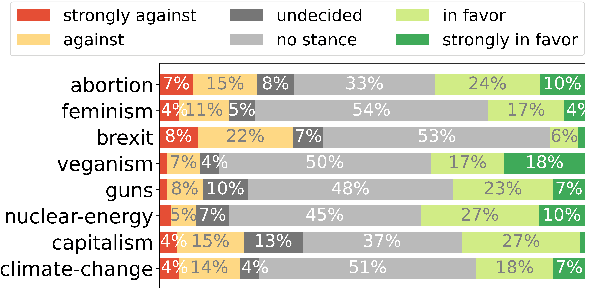

There is an increasing need for the ability to model fine-grained opinion shifts of social media users, as concerns about the potential polarizing social effects increase. However, the lack of publicly available datasets that are suitable for the task presents a major challenge. In this paper, we introduce an innovative annotated dataset for modeling subtle opinion fluctuations and detecting fine-grained stances. The dataset includes a sufficient amount of stance polarity and intensity labels per user over time and within entire conversational threads, thus making subtle opinion fluctuations detectable both in long term and in short term. All posts are annotated by non-experts and a significant portion of the data is also annotated by experts. We provide a strategy for recruiting suitable non-experts. Our analysis of the inter-annotator agreements shows that the resulting annotations obtained from the majority vote of the non-experts are of comparable quality to the annotations of the experts. We provide analyses of the stance evolution in short term and long term levels, a comparison of language usage between users with vacillating and resolute attitudes, and fine-grained stance detection baselines.