 Add to Chrome
 Add to Firefox
 Add to Edge
A Surveillance Evasion Game with Continuous Sensor Redeployment via Bilevel Optimization
May 27, 2026
Uncrewed Aerial Systems (UASs) have become a growing threat to the security of critical infrastructure, exploiting spatiotemporal gaps in sensor perimeters to infiltrate restricted airspace undetected. We formulate this interaction as a two-player zero-sum differential game between an adversarial UAS and a heterogeneous sensor network of directional and omnidirectional sensors. Unlike earlier game-theoretic approaches that restrict the defender to discrete placement graphs or fixed configurations, we introduce a continuous sensor redeployment technique in which each sensor slides freely along the convex building boundaries. This is enforced via a log-sum-exp smooth approximation that preserves differentiability at polygon vertices, enabling optimization with gradient-based methods. The attacker's best response is computed via a two-step approach combining STP-RRT* for feasible trajectory initialization and nonlinear programming for detection-minimization refinement. The joint optimization converges to a Local Nash Equilibrium (LNE) via alternating bilevel optimization, with analytical first-order stationarity conditions derived for both players, thereby establishing a deployable baseline for heterogeneous sensor placements in CUAS missions.

SAFE-TAXI: A Hierarchical Multi-UAS Safe Auto-Taxiing Framework with Runtime Safety Assurance and Conflict Resolution
Mar 06, 2025
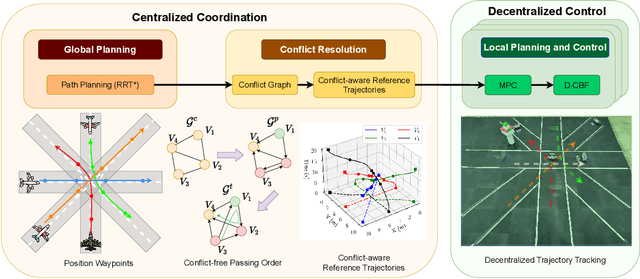
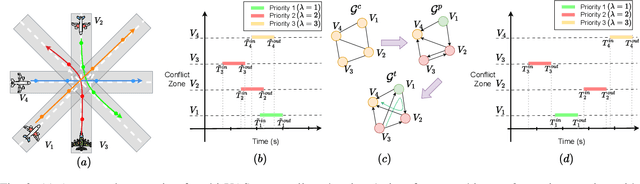
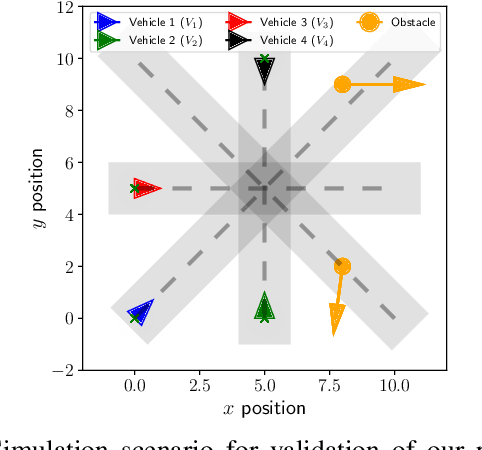
We present a hierarchical safe auto-taxiing framework to enhance the automated ground operations of multiple unmanned aircraft systems (multi-UAS). The auto-taxiing problem becomes particularly challenging due to (i) unknown disturbances, such as crosswind affecting the aircraft dynamics, (ii) taxiway incursions due to unplanned obstacles, and (iii) spatiotemporal conflicts at the intersections between multiple entry points in the taxiway. To address these issues, we propose a hierarchical framework, i.e., SAFE-TAXI, combining centralized spatiotemporal planning with decentralized MPC-CBF-based control to safely navigate the aircraft through the taxiway while avoiding intersection conflicts and unplanned obstacles (e.g., other aircraft or ground vehicles). Our proposed framework decouples the auto-taxiing problem temporally into conflict resolution and motion planning, respectively. Conflict resolution is handled in a centralized manner by computing conflict-aware reference trajectories for each aircraft. In contrast, safety assurance from unplanned obstacles is handled by an MPC-CBF-based controller implemented in a decentralized manner. We demonstrate the effectiveness of our proposed framework through numerical simulations and experimentally validate it using Night Vapor, a small-scale fixed-wing test platform.
MIXED-SENSE: A Mixed Reality Sensor Emulation Framework for Test and Evaluation of UAVs Against False Data Injection Attacks
Jul 12, 2024
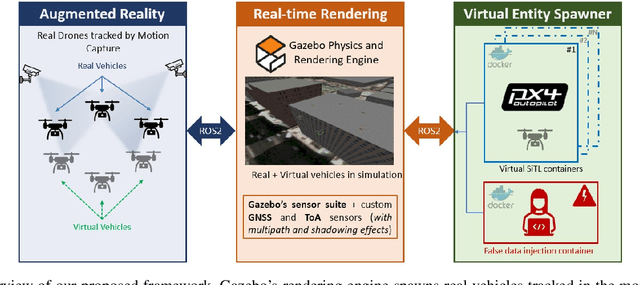


We present a high-fidelity Mixed Reality sensor emulation framework for testing and evaluating the resilience of Unmanned Aerial Vehicles (UAVs) against false data injection (FDI) attacks. The proposed approach can be utilized to assess the impact of FDI attacks, benchmark attack detector performance, and validate the effectiveness of mitigation/reconfiguration strategies in single-UAV and UAV swarm operations. Our Mixed Reality framework leverages high-fidelity simulations of Gazebo and a Motion Capture system to emulate proprioceptive (e.g., GNSS) and exteroceptive (e.g., camera) sensor measurements in real-time. We propose an empirical approach to faithfully recreate signal characteristics such as latency and noise in these measurements. Finally, we illustrate the efficacy of our proposed framework through a Mixed Reality experiment consisting of an emulated GNSS attack on an actual UAV, which (i) demonstrates the impact of false data injection attacks on GNSS measurements and (ii) validates a mitigation strategy utilizing a distributed camera network developed in our previous work. Our open-source implementation is available at \href{https://github.com/CogniPilot/mixed\_sense}{\texttt{https://github.com/CogniPilot/mixed\_sense}}