 Add to Chrome
 Add to Firefox
 Add to Edge
Learning Therapist Policy from Therapist-Exoskeleton-Patient Interaction
Mar 02, 2026
Post-stroke rehabilitation is often necessary for patients to regain proper walking gait. However, the typical therapy process can be exhausting and physically demanding for therapists, potentially reducing therapy intensity, duration, and consistency over time. We propose a Patient-Therapist Force Field (PTFF) to visualize therapist responses to patient kinematics and a Synthetic Therapist (ST) machine learning model to support the therapist in dyadic robot-mediated physical interaction therapy. The first encodes patient and therapist stride kinematics into a shared low-dimensional latent manifold using a Variational Autoencoder (VAE) and models their interaction through a Gaussian Mixture Model (GMM), which learns a probabilistic vector field mapping patient latent states to therapist responses. This representation visualizes patient-therapist interaction dynamics to inform therapy strategies and robot controller design. The latter is implemented as a Long Short-Term Memory (LSTM) network trained on patient-therapist interaction data to predict therapist-applied joint torques from patient kinematics. Trained and validated using leave-one-out cross-validation across eight post-stroke patients, the model was integrated into a ROS-based exoskeleton controller to generate real-time torque assistance based on predicted therapist responses. Offline results and preliminary testing indicate the potential of their use as an alternative approach to post-stroke exoskeleton therapy. The PTFF provides understanding of the therapist's actions while the ST frees the human therapist from the exoskeleton, allowing them to continuously monitor the patient's nuanced condition.

Deep-Learning Control of Lower-Limb Exoskeletons via simplified Therapist Input
Dec 10, 2024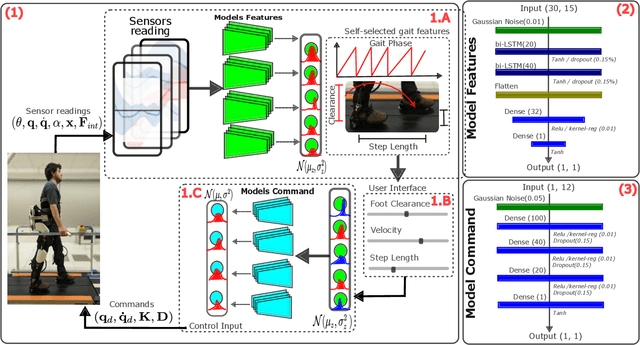
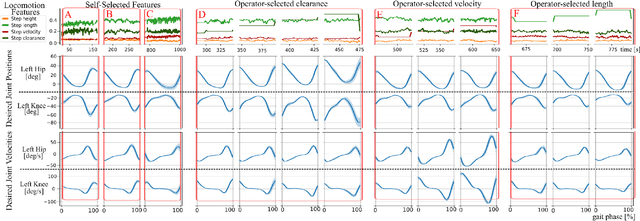
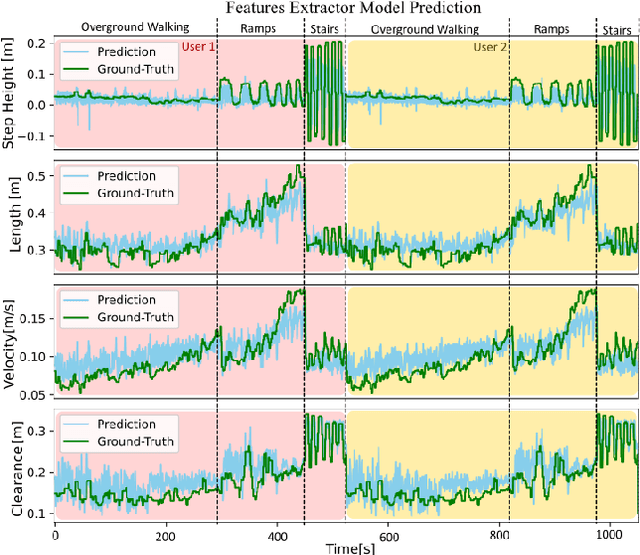
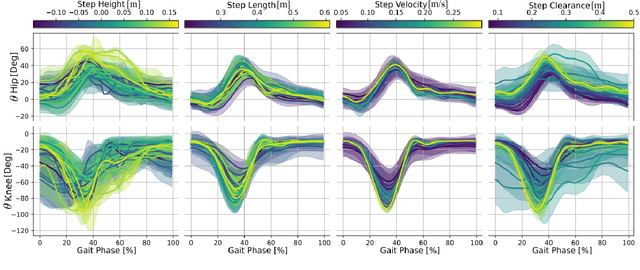
Partial-assistance exoskeletons hold significant potential for gait rehabilitation by promoting active participation during (re)learning of normative walking patterns. Typically, the control of interaction torques in partial-assistance exoskeletons relies on a hierarchical control structure. These approaches require extensive calibration due to the complexity of the controller and user-specific parameter tuning, especially for activities like stair or ramp navigation. To address the limitations of hierarchical control in exoskeletons, this work proposes a three-step, data-driven approach: (1) using recent sensor data to probabilistically infer locomotion states (landing step length, landing step height, walking velocity, step clearance, gait phase), (2) allowing therapists to modify these features via a user interface, and (3) using the adjusted locomotion features to predict the desired joint posture and model stiffness in a spring-damper system based on prediction uncertainty. We evaluated the proposed approach with two healthy participants engaging in treadmill walking and stair ascent and descent at varying speeds, with and without external modification of the gait features through a user interface. Results showed a variation in kinematics according to the gait characteristics and a negative interaction power suggesting exoskeleton assistance across the different conditions.
Unidirectional Human-Robot-Human Physical Interaction for Gait Training
Sep 17, 2024
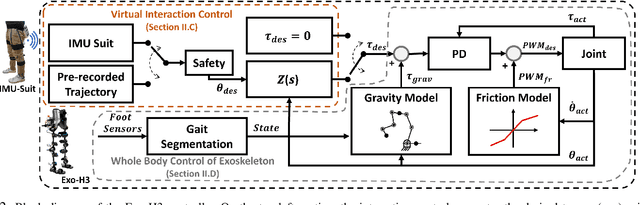
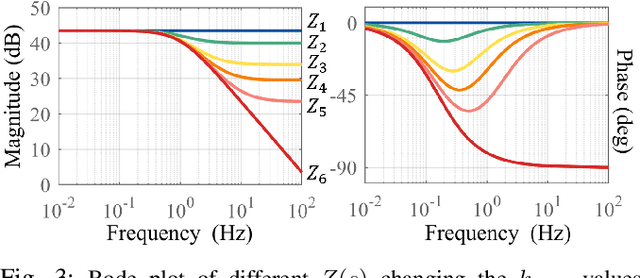

This work presents a novel rehabilitation framework designed for a therapist, wearing an inertial measurement unit (IMU) suit, to virtually interact with a lower-limb exoskeleton worn by a patient with motor impairments. This framework aims to harmonize the skills and knowledge of the therapist with the capabilities of the exoskeleton. The therapist can guide the patient's movements by moving their own joints and making real-time adjustments to meet the patient's needs, while reducing the physical effort of the therapist. This eliminates the need for a predefined trajectory for the patient to follow, as in conventional robotic gait training. For the virtual interaction medium between the therapist and patient, we propose an impedance profile that is stiff at low frequencies and less stiff at high frequencies, that can be tailored to individual patient needs and different stages of rehabilitation. The desired interaction torque from this medium is commanded to a whole-exoskeleton closed-loop compensation controller. The proposed virtual interaction framework was evaluated with a pair of unimpaired individuals in different teacher-student gait training exercises. Results show the proposed interaction control effectively transmits haptic cues, informing future applications in rehabilitation scenarios.
Haptic Transparency and Interaction Force Control for a Lower-Limb Exoskeleton
Jan 16, 2023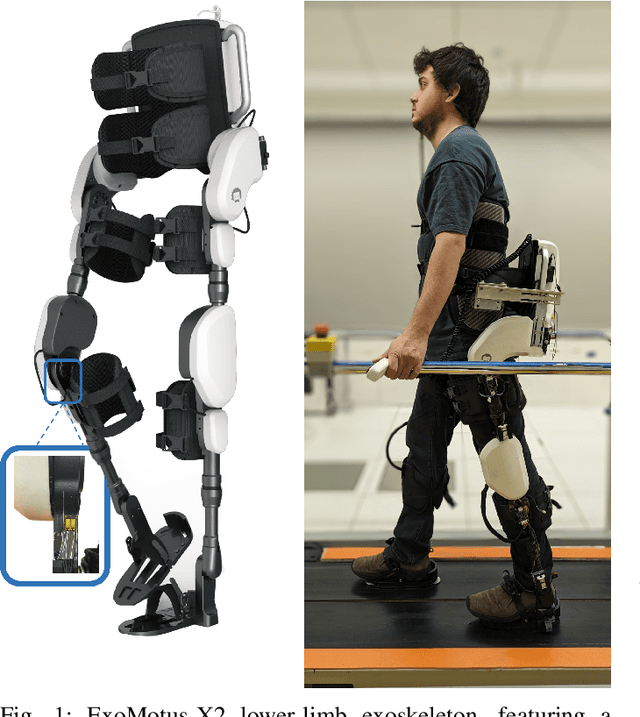
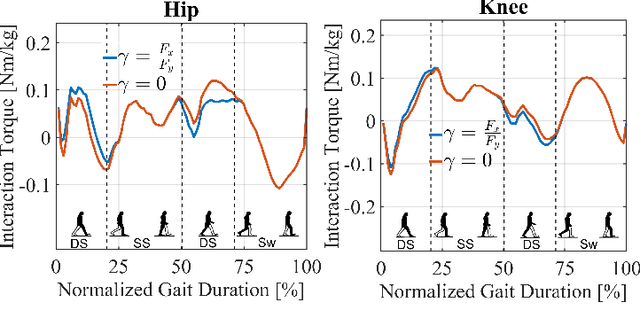
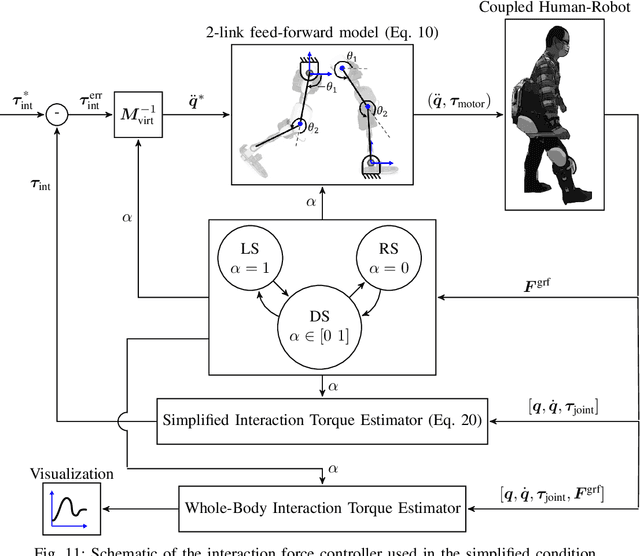
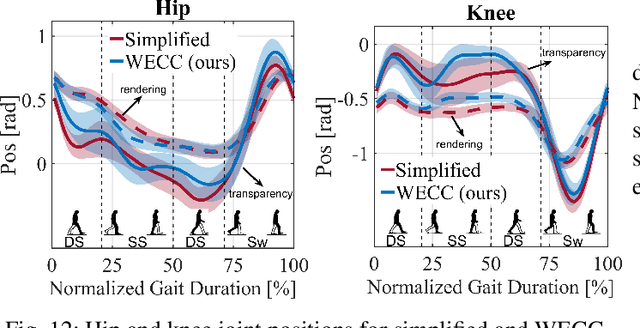
It is an open problem to control the interaction forces of lower-limb exoskeletons designed for unrestricted overground walking, i.e., floating base exoskeletons with feet that contact the ground. For these types of exoskeletons, it is challenging to measure interaction forces as it is not feasible to implement force/torque sensors at every contact between the user and the exoskeleton. Moreover, it is important to compensate for the exoskeleton's whole-body gravitational and dynamical forces. Previous works either simplified the dynamic model by treating the legs as independent double pendulums, or they did not close the loop with interaction force feedback. This paper presents a novel method to calculate interaction torques during the complete gait cycle by using whole-body dynamics and joint torque measurements on a hip-knee exoskeleton. Furthermore, we propose a constrained optimization scheme combined with a virtual model controller to track desired interaction torques in a closed loop while considering physical limits and safety considerations. Together, we call this approach whole-exoskeleton closed-loop compensation (WECC) control. We evaluated the haptic transparency and spring-damper rendering performance of WECC control on three subjects. We also compared the performance of WECC with a controller based on a simplified dynamic model and a passive version of the exoskeleton with disassembled drives. The WECC controller resulted in consistent interaction torque tracking during the whole gait cycle for both zero and nonzero desired interaction torques. On the contrary, the simplified controller failed to track desired interaction torques during the stance phase. The proposed interaction force control method is especially beneficial for heavy lower-limb exoskeletons where the dynamics of the entire exoskeleton should be compensated.