 Add to Chrome
 Add to Firefox
 Add to Edge
How Log-Barrier Helps Exploration in Policy Optimization
Mar 16, 2026
Recently, it has been shown that the Stochastic Gradient Bandit (SGB) algorithm converges to a globally optimal policy with a constant learning rate. However, these guarantees rely on unrealistic assumptions about the learning process, namely that the probability of the optimal action is always bounded away from zero. We attribute this to the lack of an explicit exploration mechanism in SGB. To address these limitations, we propose to regularize the SGB objective with a log-barrier on the parametric policy, structurally enforcing a minimal amount of exploration. We prove that Log-Barrier Stochastic Gradient Bandit (LB-SGB) matches the sample complexity of SGB, but also converges (at a slower rate) without any assumptions on the learning process. We also show a connection between the log-barrier regularization and Natural Policy Gradient, as both exploit the geometry of the policy space by controlling the Fisher information. We validate our theoretical findings through numerical simulations, showing the benefits of the log-barrier regularization.

Learning Deterministic Policies with Policy Gradients in Constrained Markov Decision Processes
Jun 06, 2025

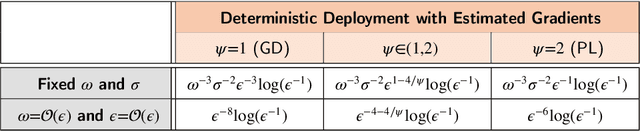
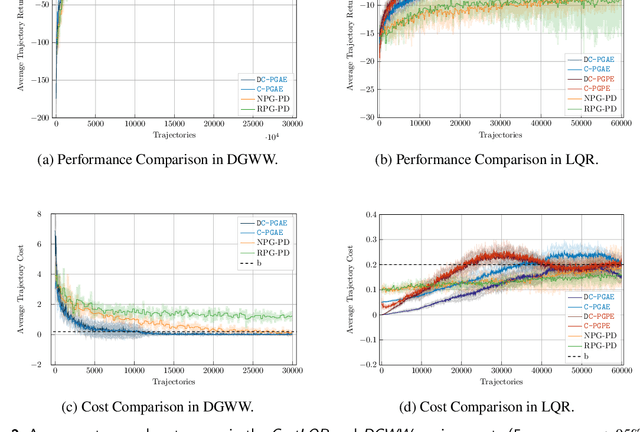
Constrained Reinforcement Learning (CRL) addresses sequential decision-making problems where agents are required to achieve goals by maximizing the expected return while meeting domain-specific constraints. In this setting, policy-based methods are widely used thanks to their advantages when dealing with continuous-control problems. These methods search in the policy space with an action-based or a parameter-based exploration strategy, depending on whether they learn the parameters of a stochastic policy or those of a stochastic hyperpolicy. We introduce an exploration-agnostic algorithm, called C-PG, which enjoys global last-iterate convergence guarantees under gradient domination assumptions. Furthermore, under specific noise models where the (hyper)policy is expressed as a stochastic perturbation of the actions or of the parameters of an underlying deterministic policy, we additionally establish global last-iterate convergence guarantees of C-PG to the optimal deterministic policy. This holds when learning a stochastic (hyper)policy and subsequently switching off the stochasticity at the end of training, thereby deploying a deterministic policy. Finally, we empirically validate both the action-based (C-PGAE) and parameter-based (C-PGPE) variants of C-PG on constrained control tasks, and compare them against state-of-the-art baselines, demonstrating their effectiveness, in particular when deploying deterministic policies after training.