 Add to Chrome
 Add to Firefox
 Add to Edge
Learning to Detect Cross-Modal Negation: An Analysis of Latent Representations and an Attention-Based Solution
Jul 20, 2026
Detecting high-level semantic concepts like negation across modalities remains a challenge for current multimodal systems. We analyze this as a fundamental representation learning problem, providing the first evidence that negation does not form a linearly or non-linearly separable class in the latent spaces of standard vision-language models (VLMs). We demonstrate that pretrained embeddings primarily encode modality-specific features, lacking a generalizable negation signal. To overcome this, we propose a novel cross-modal attention architecture that explicitly models inter-modal dependencies, achieving performance gains of up to +7.03% F1 over unimodal baselines. Our analysis reveals a key asymmetry: while textual negation often appears independently, visual negation is semantically dependent on linguistic context, a finding validated through our statistical analysis of 3,222 political video-text pairs automatically annotated via \textsc{Qwen2.5-VL}. By combining this analysis with self-supervised video representations (JEPA2), we advance the modeling of temporal negation. This work provides new methods and insights for learning robust, semantically-aligned representations in multimodal systems.
* This manuscript is an accepted version of the article (published at ICNLP2026). Published in IEEE Xplore, DOI:10.1109/ICNLP69856.2026.11527861 document: https://ieeexplore.ieee.org/abstract/document/11527861

German Parliamentary Corpus (GerParCor)
Apr 21, 2022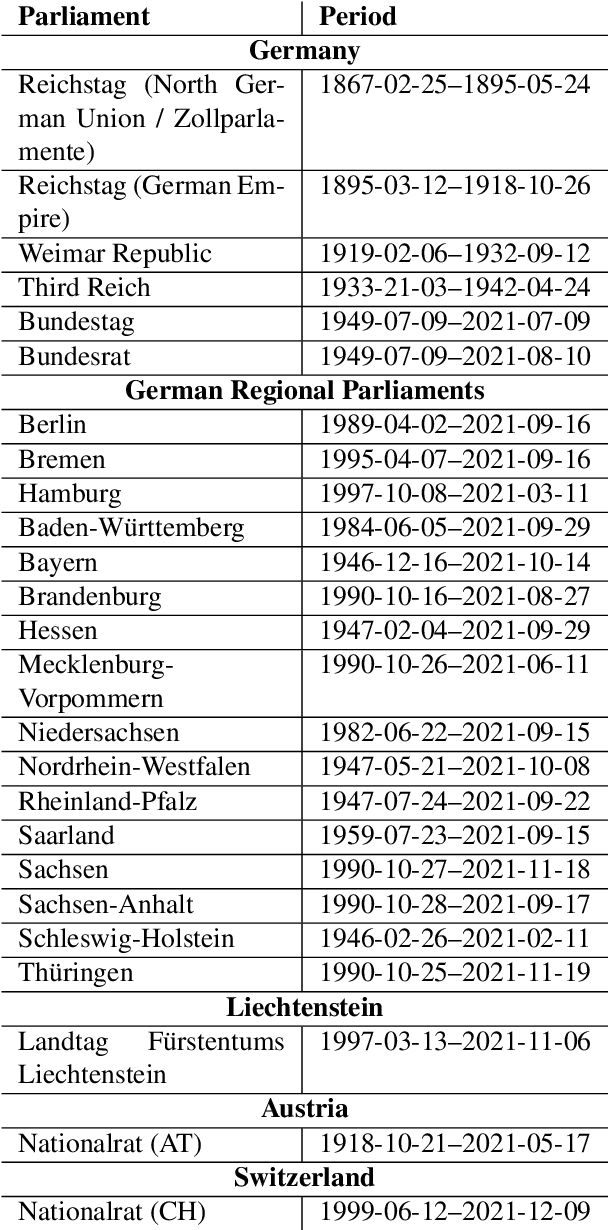
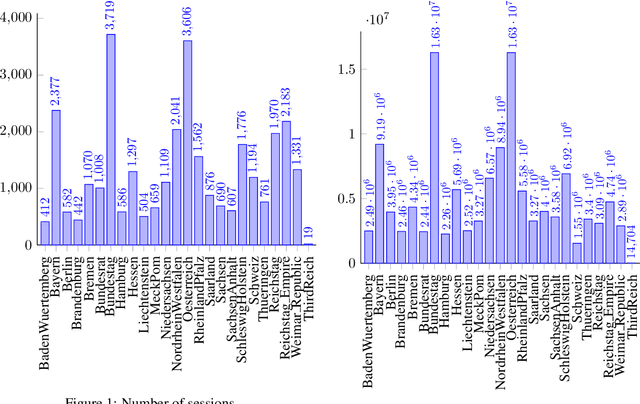
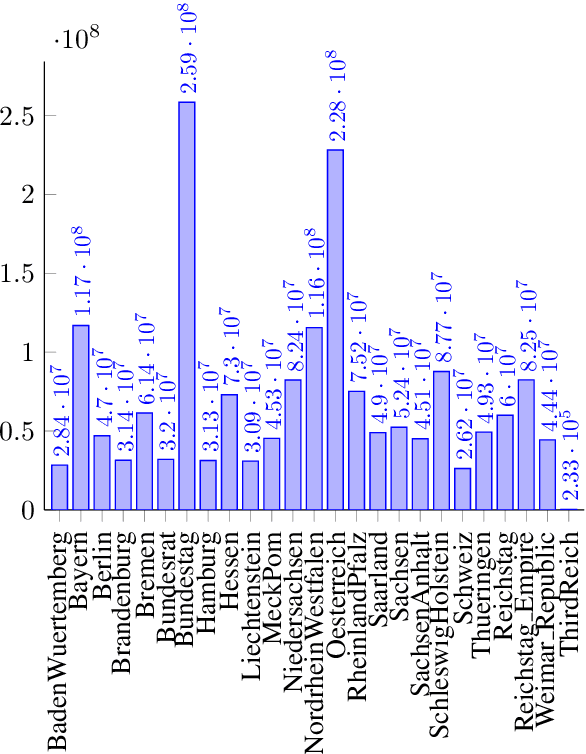
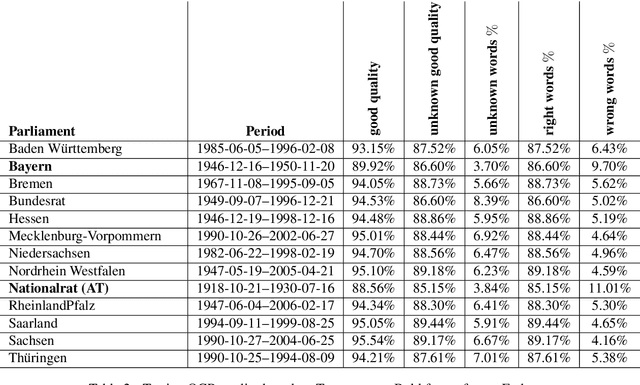
Parliamentary debates represent a large and partly unexploited treasure trove of publicly accessible texts. In the German-speaking area, there is a certain deficit of uniformly accessible and annotated corpora covering all German-speaking parliaments at the national and federal level. To address this gap, we introduce the German Parliament Corpus (GerParCor). GerParCor is a genre-specific corpus of (predominantly historical) German-language parliamentary protocols from three centuries and four countries, including state and federal level data. In addition, GerParCor contains conversions of scanned protocols and, in particular, of protocols in Fraktur converted via an OCR process based on Tesseract. All protocols were preprocessed by means of the NLP pipeline of spaCy3 and automatically annotated with metadata regarding their session date. GerParCor is made available in the XMI format of the UIMA project. In this way, GerParCor can be used as a large corpus of historical texts in the field of political communication for various tasks in NLP.