 Add to Chrome
 Add to Firefox
 Add to Edge
Agents Explore but Agents Ignore: LLMs Lack Environmental Curiosity
Apr 19, 2026
LLM-based agents are assumed to integrate environmental observations into their reasoning: discovering highly relevant but unexpected information should naturally lead to a model exploiting its own discoveries. We show that this assumption is false for current LLM-based agents, which struggle to reflect or react to unexpected information. Across three benchmarks (Terminal-Bench, SWE-Bench, AppWorld), we inject complete task solutions into the agent environments to deliberately expose a task's solution to a model. While agents discover these solutions on Terminal-Bench in 79-81% of runs, they interact, or exploit, them in only 37-50% of cases. This gap is starkest in AppWorld: agents see documentation stating that a command "returns the complete solution to this task" in over 90% of attempts but exploit this in fewer than 7% of trials. We show that agents lack what we call environmental curiosity: the capability to recognize and investigate unexpected but relevant observations in response to environmental stimuli. We identify three main factors influencing environmental curiosity: available tools in the agent scaffold, test-time compute, and training data distribution. Our findings identify configurations that maximize curiosity also achieve the best performance on the unmodified benchmarks. Yet even jointly optimized agents still ignore discovered solutions in the majority of trials: current agents use the environment to fetch expected information, but not to revise their strategy or maximally exploit useful stimuli.

M2QA: Multi-domain Multilingual Question Answering
Jul 01, 2024
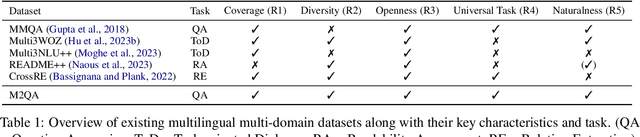
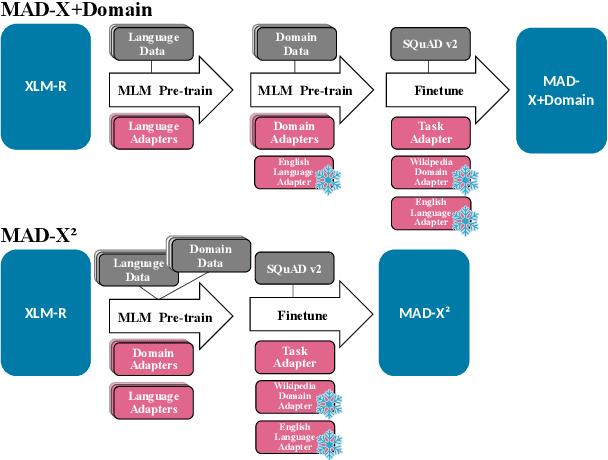
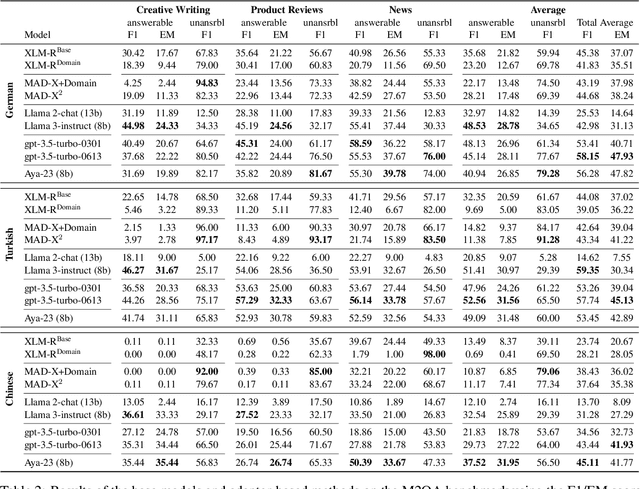
Generalization and robustness to input variation are core desiderata of machine learning research. Language varies along several axes, most importantly, language instance (e.g. French) and domain (e.g. news). While adapting NLP models to new languages within a single domain, or to new domains within a single language, is widely studied, research in joint adaptation is hampered by the lack of evaluation datasets. This prevents the transfer of NLP systems from well-resourced languages and domains to non-dominant language-domain combinations. To address this gap, we introduce M2QA, a multi-domain multilingual question answering benchmark. M2QA includes 13,500 SQuAD 2.0-style question-answer instances in German, Turkish, and Chinese for the domains of product reviews, news, and creative writing. We use M2QA to explore cross-lingual cross-domain performance of fine-tuned models and state-of-the-art LLMs and investigate modular approaches to domain and language adaptation. We witness 1) considerable performance variations across domain-language combinations within model classes and 2) considerable performance drops between source and target language-domain combinations across all model sizes. We demonstrate that M2QA is far from solved, and new methods to effectively transfer both linguistic and domain-specific information are necessary. We make M2QA publicly available at https://github.com/UKPLab/m2qa.
Adapters: A Unified Library for Parameter-Efficient and Modular Transfer Learning
Nov 18, 2023We introduce Adapters, an open-source library that unifies parameter-efficient and modular transfer learning in large language models. By integrating 10 diverse adapter methods into a unified interface, Adapters offers ease of use and flexible configuration. Our library allows researchers and practitioners to leverage adapter modularity through composition blocks, enabling the design of complex adapter setups. We demonstrate the library's efficacy by evaluating its performance against full fine-tuning on various NLP tasks. Adapters provides a powerful tool for addressing the challenges of conventional fine-tuning paradigms and promoting more efficient and modular transfer learning. The library is available via https://adapterhub.ml/adapters.