 Add to Chrome
 Add to Firefox
 Add to Edge
Training LLMs to Enforce Multi-Level Instruction Hierarchies via Gravity-Weighted Direct Preference Optimization
Jun 09, 2026
Production LLMs receive instructions from sources with very different levels of trust, yet attend to every token with uniform architectural privilege. This is the structural vulnerability that enables malicious prompt injections and, more broadly, leaves models without a principled way to resolve conflicts between legitimate but competing instructions. A common training-based response is to teach models an explicit instruction hierarchy; existing approaches, however, formalize hierarchies of only three or four levels, treat all violations as equally severe, and rarely evaluate the full set of pairwise level interactions. We formalize a k-level instruction hierarchy problem and instantiate it for k=5, yielding ten pairwise priority relations that a compliant model must enforce. We then introduce Gravity-Weighted DPO (GW-DPO), a preference-optimization objective whose per-sample offset scales with the structural distance between conflicting levels under a linear or bilateral schedule, the latter weighting severity by both the privilege gap and the privilege of the victim level. Combined with hierarchy-specific delimiter tokens (Chen et al., 2025) and Instructional Segment Embeddings (ISE; Wu et al., 2025), GW-DPO with the bilateral schedule Pareto-improves over standard DPO and the linear variant on Llama-3.1-8B-Instruct, raising macro pairwise priority adherence while keeping over-refusal at half the standard DPO rate. Ablations isolate ISE as a refusal-threshold calibrator and recast five- versus three-level training as a generality-specialization tradeoff.

Eye-Tracking-while-Reading: A Living Survey of Datasets with Open Library Support
Feb 23, 2026Eye-tracking-while-reading corpora are a valuable resource for many different disciplines and use cases. Use cases range from studying the cognitive processes underlying reading to machine-learning-based applications, such as gaze-based assessments of reading comprehension. The past decades have seen an increase in the number and size of eye-tracking-while-reading datasets as well as increasing diversity with regard to the stimulus languages covered, the linguistic background of the participants, or accompanying psychometric or demographic data. The spread of data across different disciplines and the lack of data sharing standards across the communities lead to many existing datasets that cannot be easily reused due to a lack of interoperability. In this work, we aim at creating more transparency and clarity with regards to existing datasets and their features across different disciplines by i) presenting an extensive overview of existing datasets, ii) simplifying the sharing of newly created datasets by publishing a living overview online, https://dili-lab.github.io/datasets.html, presenting over 45 features for each dataset, and iii) integrating all publicly available datasets into the Python package pymovements which offers an eye-tracking datasets library. By doing so, we aim to strengthen the FAIR principles in eye-tracking-while-reading research and promote good scientific practices, such as reproducing and replicating studies.
Language models emulate certain cognitive profiles: An investigation of how predictability measures interact with individual differences
Jun 07, 2024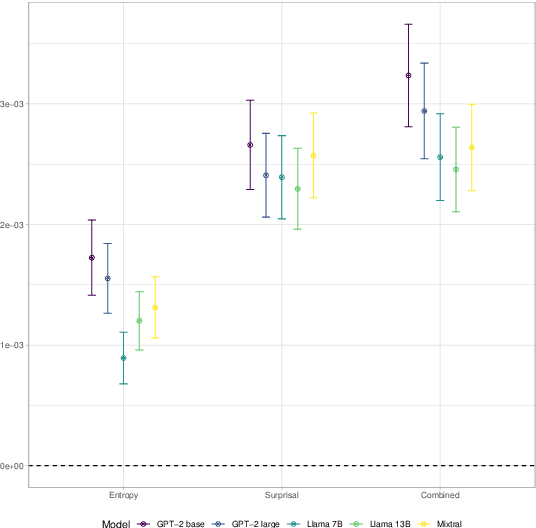

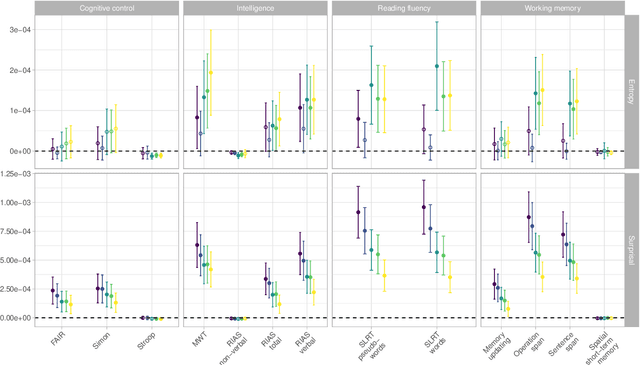
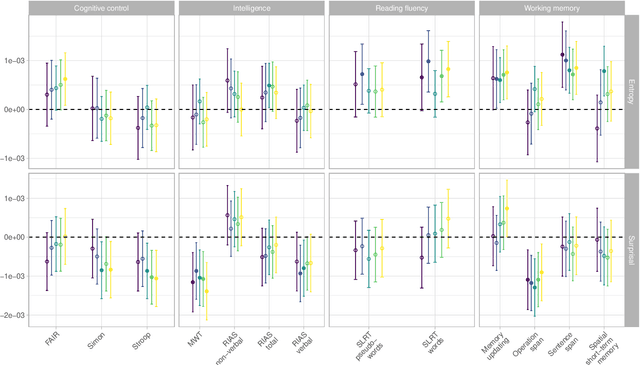
To date, most investigations on surprisal and entropy effects in reading have been conducted on the group level, disregarding individual differences. In this work, we revisit the predictive power of surprisal and entropy measures estimated from a range of language models (LMs) on data of human reading times as a measure of processing effort by incorporating information of language users' cognitive capacities. To do so, we assess the predictive power of surprisal and entropy estimated from generative LMs on reading data obtained from individuals who also completed a wide range of psychometric tests. Specifically, we investigate if modulating surprisal and entropy relative to cognitive scores increases prediction accuracy of reading times, and we examine whether LMs exhibit systematic biases in the prediction of reading times for cognitively high- or low-performing groups, revealing what type of psycholinguistic subject a given LM emulates. Our study finds that in most cases, incorporating cognitive capacities increases predictive power of surprisal and entropy on reading times, and that generally, high performance in the psychometric tests is associated with lower sensitivity to predictability effects. Finally, our results suggest that the analyzed LMs emulate readers with lower verbal intelligence, suggesting that for a given target group (i.e., individuals with high verbal intelligence), these LMs provide less accurate predictability estimates.
ScanDL: A Diffusion Model for Generating Synthetic Scanpaths on Texts
Oct 24, 2023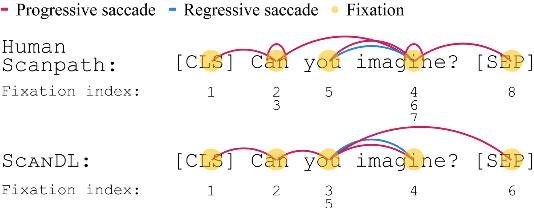
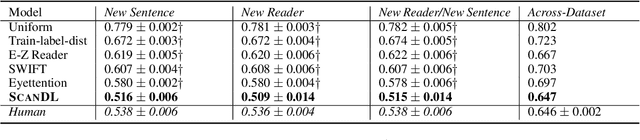

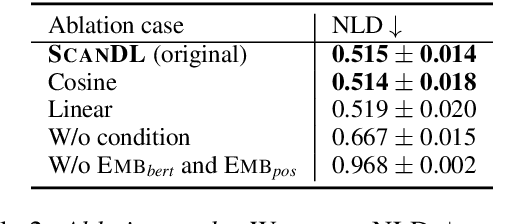
Eye movements in reading play a crucial role in psycholinguistic research studying the cognitive mechanisms underlying human language processing. More recently, the tight coupling between eye movements and cognition has also been leveraged for language-related machine learning tasks such as the interpretability, enhancement, and pre-training of language models, as well as the inference of reader- and text-specific properties. However, scarcity of eye movement data and its unavailability at application time poses a major challenge for this line of research. Initially, this problem was tackled by resorting to cognitive models for synthesizing eye movement data. However, for the sole purpose of generating human-like scanpaths, purely data-driven machine-learning-based methods have proven to be more suitable. Following recent advances in adapting diffusion processes to discrete data, we propose ScanDL, a novel discrete sequence-to-sequence diffusion model that generates synthetic scanpaths on texts. By leveraging pre-trained word representations and jointly embedding both the stimulus text and the fixation sequence, our model captures multi-modal interactions between the two inputs. We evaluate ScanDL within- and across-dataset and demonstrate that it significantly outperforms state-of-the-art scanpath generation methods. Finally, we provide an extensive psycholinguistic analysis that underlines the model's ability to exhibit human-like reading behavior. Our implementation is made available at https://github.com/DiLi-Lab/ScanDL.