 Add to Chrome
 Add to Firefox
 Add to Edge
Mining Legal Arguments to Study Judicial Formalism
Dec 12, 2025
Courts must justify their decisions, but systematically analyzing judicial reasoning at scale remains difficult. This study refutes claims about formalistic judging in Central and Eastern Europe (CEE) by developing automated methods to detect and classify judicial reasoning in Czech Supreme Courts' decisions using state-of-the-art natural language processing methods. We create the MADON dataset of 272 decisions from two Czech Supreme Courts with expert annotations of 9,183 paragraphs with eight argument types and holistic formalism labels for supervised training and evaluation. Using a corpus of 300k Czech court decisions, we adapt transformer LLMs for Czech legal domain by continued pretraining and experiment with methods to address dataset imbalance including asymmetric loss and class weighting. The best models successfully detect argumentative paragraphs (82.6\% macro-F1), classify traditional types of legal argument (77.5\% macro-F1), and classify decisions as formalistic/non-formalistic (83.2\% macro-F1). Our three-stage pipeline combining ModernBERT, Llama 3.1, and traditional feature-based machine learning achieves promising results for decision classification while reducing computational costs and increasing explainability. Empirically, we challenge prevailing narratives about CEE formalism. This work shows that legal argument mining enables reliable judicial philosophy classification and shows the potential of legal argument mining for other important tasks in computational legal studies. Our methodology is easily replicable across jurisdictions, and our entire pipeline, datasets, guidelines, models, and source codes are available at https://github.com/trusthlt/madon.

LaCour!: Enabling Research on Argumentation in Hearings of the European Court of Human Rights
Dec 08, 2023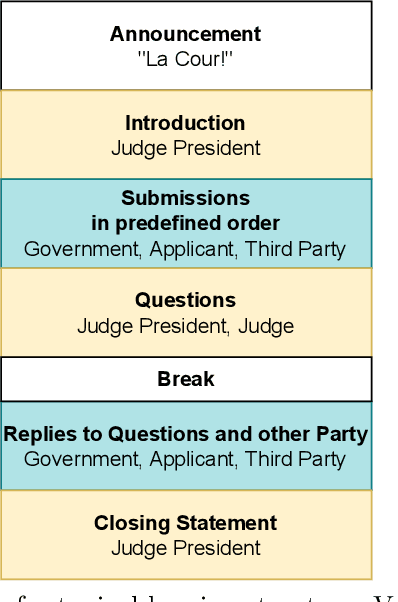
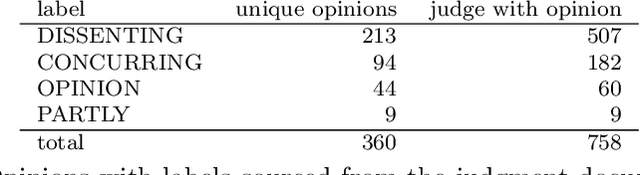
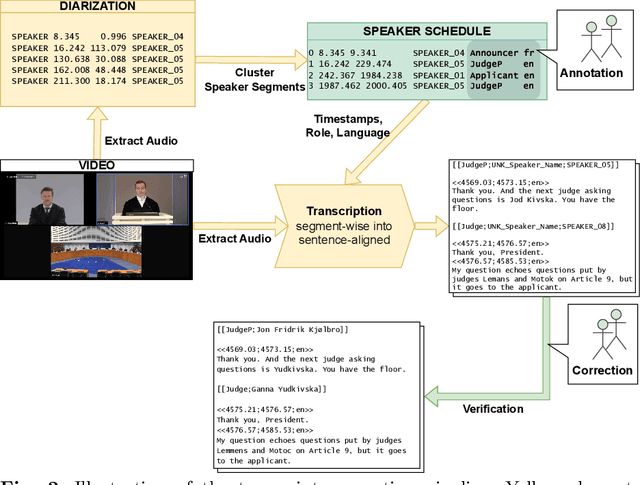
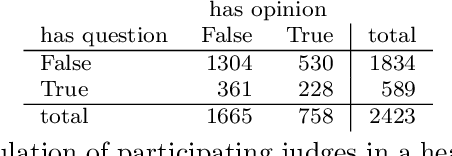
Why does an argument end up in the final court decision? Was it deliberated or questioned during the oral hearings? Was there something in the hearings that triggered a particular judge to write a dissenting opinion? Despite the availability of the final judgments of the European Court of Human Rights (ECHR), none of these legal research questions can currently be answered as the ECHR's multilingual oral hearings are not transcribed, structured, or speaker-attributed. We address this fundamental gap by presenting LaCour!, the first corpus of textual oral arguments of the ECHR, consisting of 154 full hearings (2.1 million tokens from over 267 hours of video footage) in English, French, and other court languages, each linked to the corresponding final judgment documents. In addition to the transcribed and partially manually corrected text from the video, we provide sentence-level timestamps and manually annotated role and language labels. We also showcase LaCour! in a set of preliminary experiments that explore the interplay between questions and dissenting opinions. Apart from the use cases in legal NLP, we hope that law students or other interested parties will also use LaCour! as a learning resource, as it is freely available in various formats at https://huggingface.co/datasets/TrustHLT/LaCour.
The Legal Argument Reasoning Task in Civil Procedure
Nov 05, 2022We present a new NLP task and dataset from the domain of the U.S. civil procedure. Each instance of the dataset consists of a general introduction to the case, a particular question, and a possible solution argument, accompanied by a detailed analysis of why the argument applies in that case. Since the dataset is based on a book aimed at law students, we believe that it represents a truly complex task for benchmarking modern legal language models. Our baseline evaluation shows that fine-tuning a legal transformer provides some advantage over random baseline models, but our analysis reveals that the actual ability to infer legal arguments remains a challenging open research question.