 Add to Chrome
 Add to Firefox
 Add to Edge
Mining Legal Arguments to Study Judicial Formalism
Dec 12, 2025
Courts must justify their decisions, but systematically analyzing judicial reasoning at scale remains difficult. This study refutes claims about formalistic judging in Central and Eastern Europe (CEE) by developing automated methods to detect and classify judicial reasoning in Czech Supreme Courts' decisions using state-of-the-art natural language processing methods. We create the MADON dataset of 272 decisions from two Czech Supreme Courts with expert annotations of 9,183 paragraphs with eight argument types and holistic formalism labels for supervised training and evaluation. Using a corpus of 300k Czech court decisions, we adapt transformer LLMs for Czech legal domain by continued pretraining and experiment with methods to address dataset imbalance including asymmetric loss and class weighting. The best models successfully detect argumentative paragraphs (82.6\% macro-F1), classify traditional types of legal argument (77.5\% macro-F1), and classify decisions as formalistic/non-formalistic (83.2\% macro-F1). Our three-stage pipeline combining ModernBERT, Llama 3.1, and traditional feature-based machine learning achieves promising results for decision classification while reducing computational costs and increasing explainability. Empirically, we challenge prevailing narratives about CEE formalism. This work shows that legal argument mining enables reliable judicial philosophy classification and shows the potential of legal argument mining for other important tasks in computational legal studies. Our methodology is easily replicable across jurisdictions, and our entire pipeline, datasets, guidelines, models, and source codes are available at https://github.com/trusthlt/madon.

Mining Legal Arguments in Court Decisions
Aug 12, 2022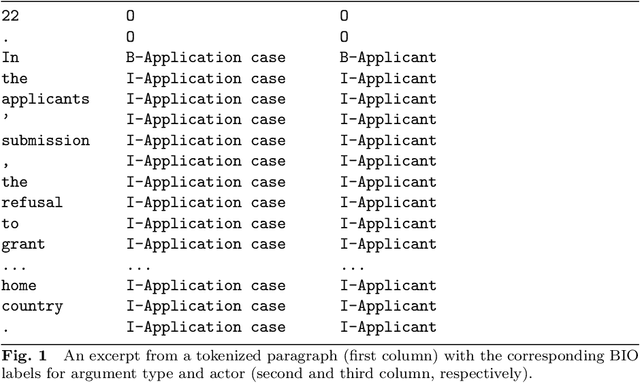
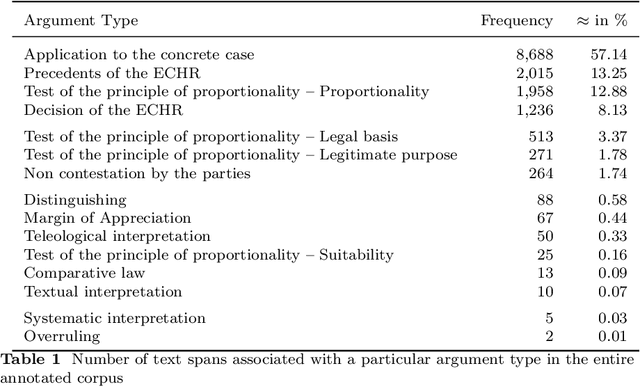
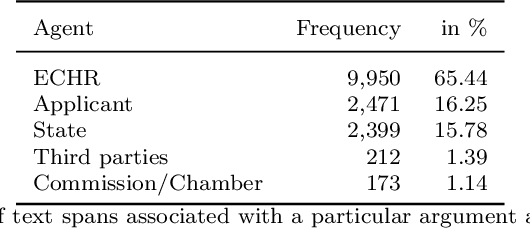
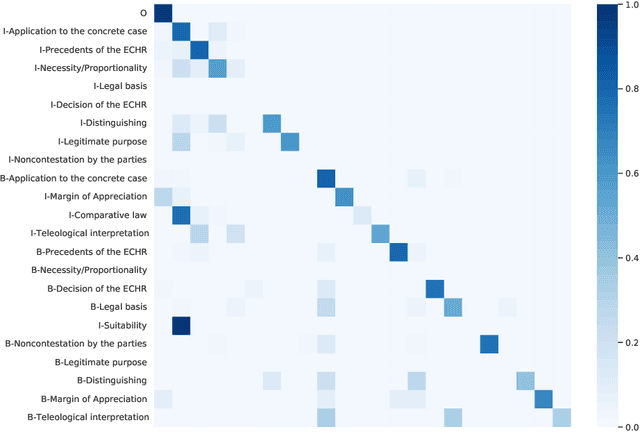
Identifying, classifying, and analyzing arguments in legal discourse has been a prominent area of research since the inception of the argument mining field. However, there has been a major discrepancy between the way natural language processing (NLP) researchers model and annotate arguments in court decisions and the way legal experts understand and analyze legal argumentation. While computational approaches typically simplify arguments into generic premises and claims, arguments in legal research usually exhibit a rich typology that is important for gaining insights into the particular case and applications of law in general. We address this problem and make several substantial contributions to move the field forward. First, we design a new annotation scheme for legal arguments in proceedings of the European Court of Human Rights (ECHR) that is deeply rooted in the theory and practice of legal argumentation research. Second, we compile and annotate a large corpus of 373 court decisions (2.3M tokens and 15k annotated argument spans). Finally, we train an argument mining model that outperforms state-of-the-art models in the legal NLP domain and provide a thorough expert-based evaluation. All datasets and source codes are available under open lincenses at https://github.com/trusthlt/mining-legal-arguments.