 Add to Chrome
 Add to Firefox
 Add to Edge
AeroMELD: A Linear Embedding of Aerosol Populations for Diagnostics and Latent Dynamics
Jul 13, 2026
Accurately representing atmospheric aerosol populations is essential for simulating aerosol-cloud interactions, radiative forcing, and ice nucleation, yet existing reduced schemes impose structural assumptions that limit their ability to capture composition diversity and mixing state. Machine-learning approaches offer more flexible representations, but standard autoencoders do not preserve the mathematical structure of aerosol populations and therefore cannot support physically meaningful process operators. We introduce AeroMELD (Aerosol Measure Embedding for Latent Dynamics), a mathematically grounded framework for constructing low-dimensional latent variables that retain this structure. We show that any permutation-invariant linear encoder must take a scale-shape decomposition, with total number concentration represented explicitly and latent shape given by a barycentric combination of per-particle embeddings. This aggregated latent state retains the diagnostic expressiveness of a Deep Sets model by moving the nonlinear post-aggregation stage into the learned diagnostic map while preserving latent linearity. Using particle-resolved data as ground truth, we encode weighted particle populations directly rather than binned aerosol states; size-resolved mass and number distributions serve only as diagnostic targets and visual summaries. The latent space accurately reconstructs these distributions, CCN spectra, optical coefficients, and immersion-freezing behavior while preserving the linear population structure needed for hybrid ML-physics models. Although the experiments focus on diagnostic reconstruction, the embedding is designed so that emissions and mixing can be represented exactly and nonlinear microphysical processes learned in a controlled latent space. This work establishes a foundation for learning aerosol-process evolution directly in latent space.

Controller-Augmented Hidden Markov Models: A Computational Framework for Constrained Sequential Inference
Jun 11, 2026Hidden Markov models are foundational for sequential inference, but their Markovian assumption fails under pathwise constraints such as precedence requirements, visitation cardinalities, or monotonic state progression, which induce long-range dependencies that invalidate standard dynamic programming algorithms. To deal with this, we present Controller-Augmented Hidden Markov Models (CHMMs), a framework that compiles each constraint into a finite-state controller tracking the minimal sufficient history, after which standard forward--backward and Viterbi recursions on the augmented chain compute exact constrained posteriors and maximum a posteriori paths in both discrete and continuous time, the latter through uniformization. We establish four theoretical guarantees: exactness of constrained inference, monotone ascent of constrained EM, inference complexity linear in the controller cardinality, and a total-variation bound under constraint misspecification. A catalog of controller encodings covering 11 constraint families across the ordering, visitation, path, and temporal categories operationalizes the framework. Empirically, we evaluate CHMMs against 6 alternative decoders on 3 real-world sequence-labeling tasks of substantively different character: gene-structure decoding in \emph{Drosophila melanogaster}, free-living activity recognition in CASAS smart-home environments, and protocol-defined human activity recognition from wearable sensors. The results reveal a clean local-versus-cumulative dichotomy in which controller augmentation is uniquely able to recover globally feasible trajectories on cumulative-constraint regimes, whilst simpler decoders are matched in validity on locally-dominated regimes. Together, theory and experiment characterize when exact controller augmentation is necessary and when simpler approaches suffice.
Integrative Learning of Dynamically Evolving Multiplex Graphs and Nodal Attributes Using Neural Network Gaussian Processes with an Application to Dynamic Terrorism Graphs
Mar 21, 2026Exploring the dynamic co-evolution of multiplex graphs and nodal attributes is a compelling question in criminal and terrorism networks. This article is motivated by the study of dynamically evolving interactions among prominent terrorist organizations, considering various organizational attributes like size, ideology, leadership, and operational capacity. Statistically principled integration of multiplex graphs with nodal attributes is significantly challenging due to the need to leverage shared information within and across layers, account for uncertainty in predicting unobserved links, and capture temporal evolution of node attributes. These difficulties increase when layers are partially observed, as in terrorism networks where connections are deliberately hidden to obscure key relationships. To address these challenges, we present a principled methodological framework to integrate the multiplex graph layers and nodal attributes. The approach employs time-varying stochastic latent factor models, leveraging shared latent factors to capture graph structure and its co-evolution with node attributes. Latent factors are modeled using Gaussian processes with an infinitely wide deep neural network-based covariance function, termed neural network Gaussian processes (NN-GP). The NN-GP framework on latent factors exploits the predictive power of Bayesian deep neural network architecture while propagating uncertainty for reliability. Simulation studies highlight superior performance of the proposed approach in achieving inferential objectives. The approach, termed as dynamic joint learner, enables predictive inference (with uncertainty) of diverse unobserved dynamic relationships among prominent terrorist organizations and their organization-specific attributes, as well as clustering behavior in terms of friend-and-foe relationships, which could be informative in counter-terrorism research.
Memory Efficient And Minimax Distribution Estimation Under Wasserstein Distance Using Bayesian Histograms
Jul 19, 2023We study Bayesian histograms for distribution estimation on $[0,1]^d$ under the Wasserstein $W_v, 1 \leq v < \infty$ distance in the i.i.d sampling regime. We newly show that when $d < 2v$, histograms possess a special \textit{memory efficiency} property, whereby in reference to the sample size $n$, order $n^{d/2v}$ bins are needed to obtain minimax rate optimality. This result holds for the posterior mean histogram and with respect to posterior contraction: under the class of Borel probability measures and some classes of smooth densities. The attained memory footprint overcomes existing minimax optimal procedures by a polynomial factor in $n$; for example an $n^{1 - d/2v}$ factor reduction in the footprint when compared to the empirical measure, a minimax estimator in the Borel probability measure class. Additionally constructing both the posterior mean histogram and the posterior itself can be done super--linearly in $n$. Due to the popularity of the $W_1,W_2$ metrics and the coverage provided by the $d < 2v$ case, our results are of most practical interest in the $(d=1,v =1,2), (d=2,v=2), (d=3,v=2)$ settings and we provide simulations demonstrating the theory in several of these instances.
Spatio-temporal extreme event modeling of terror insurgencies
Oct 29, 2021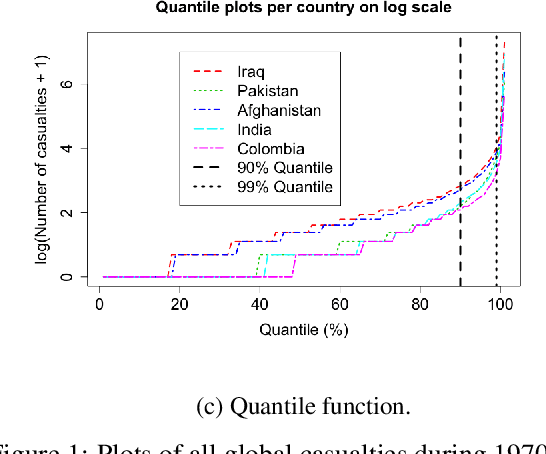
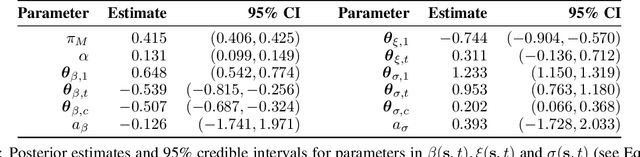
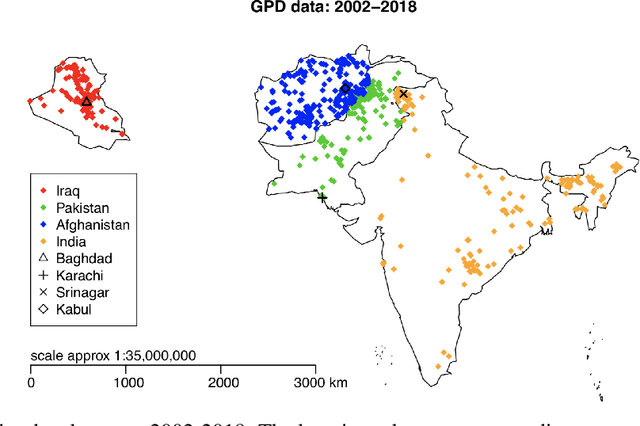
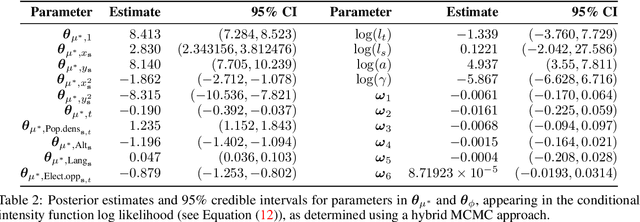
Extreme events with potential deadly outcomes, such as those organized by terror groups, are highly unpredictable in nature and an imminent threat to society. In particular, quantifying the likelihood of a terror attack occurring in an arbitrary space-time region and its relative societal risk, would facilitate informed measures that would strengthen national security. This paper introduces a novel self-exciting marked spatio-temporal model for attacks whose inhomogeneous baseline intensity is written as a function of covariates. Its triggering intensity is succinctly modeled with a Gaussian Process prior distribution to flexibly capture intricate spatio-temporal dependencies between an arbitrary attack and previous terror events. By inferring the parameters of this model, we highlight specific space-time areas in which attacks are likely to occur. Furthermore, by measuring the outcome of an attack in terms of the number of casualties it produces, we introduce a novel mixture distribution for the number of casualties. This distribution flexibly handles low and high number of casualties and the discrete nature of the data through a {\it Generalized ZipF} distribution. We rely on a customized Markov chain Monte Carlo (MCMC) method to estimate the model parameters. We illustrate the methodology with data from the open source Global Terrorism Database (GTD) that correspond to attacks in Afghanistan from 2013-2018. We show that our model is able to predict the intensity of future attacks for 2019-2021 while considering various covariates of interest such as population density, number of regional languages spoken, and the density of population supporting the opposing government.