 Add to Chrome
 Add to Firefox
 Add to Edge
Stepwise Variational Inference with Vine Copulas
Mar 24, 2026
We propose stepwise variational inference (VI) with vine copulas: a universal VI procedure that combines vine copulas with a novel stepwise estimation procedure of the variational parameters. Vine copulas consist of a nested sequence of trees built from copulas, where more complex latent dependence can be modeled with increasing number of trees. We propose to estimate the vine copula approximate posterior in a stepwise fashion, tree by tree along the vine structure. Further, we show that the usual backward Kullback-Leibler divergence cannot recover the correct parameters in the vine copula model, thus the evidence lower bound is defined based on the Rényi divergence. Finally, an intuitive stopping criterion for adding further trees to the vine eliminates the need to pre-define a complexity parameter of the variational distribution, as required for most other approaches. Thus, our method interpolates between mean-field VI (MFVI) and full latent dependence. In many applications, in particular sparse Gaussian processes, our method is parsimonious with parameters, while outperforming MFVI.

Dirichlet Scale Mixture Priors for Bayesian Neural Networks
Feb 23, 2026Neural networks are the cornerstone of modern machine learning, yet can be difficult to interpret, give overconfident predictions and are vulnerable to adversarial attacks. Bayesian neural networks (BNNs) provide some alleviation of these limitations, but have problems of their own. The key step of specifying prior distributions in BNNs is no trivial task, yet is often skipped out of convenience. In this work, we propose a new class of prior distributions for BNNs, the Dirichlet scale mixture (DSM) prior, that addresses current limitations in Bayesian neural networks through structured, sparsity-inducing shrinkage. Theoretically, we derive general dependence structures and shrinkage results for DSM priors and show how they manifest under the geometry induced by neural networks. In experiments on simulated and real world data we find that the DSM priors encourages sparse networks through implicit feature selection, show robustness under adversarial attacks and deliver competitive predictive performance with substantially fewer effective parameters. In particular, their advantages appear most pronounced in correlated, moderately small data regimes, and are more amenable to weight pruning. Moreover, by adopting heavy-tailed shrinkage mechanisms, our approach aligns with recent findings that such priors can mitigate the cold posterior effect, offering a principled alternative to the commonly used Gaussian priors.
Multi-Output Robust and Conjugate Gaussian Processes
Oct 30, 2025Multi-output Gaussian process (MOGP) regression allows modelling dependencies among multiple correlated response variables. Similarly to standard Gaussian processes, MOGPs are sensitive to model misspecification and outliers, which can distort predictions within individual outputs. This situation can be further exacerbated by multiple anomalous response variables whose errors propagate due to correlations between outputs. To handle this situation, we extend and generalise the robust and conjugate Gaussian process (RCGP) framework introduced by Altamirano et al. (2024). This results in the multi-output RCGP (MO-RCGP): a provably robust MOGP that is conjugate, and jointly captures correlations across outputs. We thoroughly evaluate our approach through applications in finance and cancer research.
Permutation invariant multi-output Gaussian Processes for drug combination prediction in cancer
Jun 28, 2024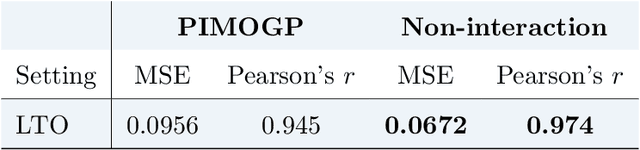
Dose-response prediction in cancer is an active application field in machine learning. Using large libraries of \textit{in-vitro} drug sensitivity screens, the goal is to develop accurate predictive models that can be used to guide experimental design or inform treatment decisions. Building on previous work that makes use of permutation invariant multi-output Gaussian Processes in the context of dose-response prediction for drug combinations, we develop a variational approximation to these models. The variational approximation enables a more scalable model that provides uncertainty quantification and naturally handles missing data. Furthermore, we propose using a deep generative model to encode the chemical space in a continuous manner, enabling prediction for new drugs and new combinations. We demonstrate the performance of our model in a simple setting using a high-throughput dataset and show that the model is able to efficiently borrow information across outputs.