 Add to Chrome
 Add to Firefox
 Add to Edge
Complete Causal Identification from Ancestral Graphs under Selection Bias
Mar 27, 2026
Many causal discovery algorithms, including the celebrated FCI algorithm, output a Partial Ancestral Graph (PAG). PAGs serve as an abstract graphical representation of the underlying causal structure, modeled by directed acyclic graphs with latent and selection variables. This paper develops a characterization of the set of extended-type conditional independence relations that are invariant across all causal models represented by a PAG. This theory allows us to formulate a general measure-theoretic version of Pearl's causal calculus and a sound and complete identification algorithm for PAGs under selection bias. Our results also apply when PAGs are learned by certain algorithms that integrate observational data with experimental data and incorporate background knowledge.

Notes on Forré's Notion of Conditional Independence and Causal Calculus for Continuous Variables
Mar 25, 2026Recently, Forré (arXiv:2104.11547, 2021) introduced transitional conditional independence, a notion of conditional independence that provides a unified framework for both random and non-stochastic variables. The original paper establishes a strong global Markov property connecting transitional conditional independencies with suitable graphical separation criteria for directed mixed graphs with input nodes (iDMGs), together with a version of causal calculus for iDMGs in a general measure-theoretic setting. These notes aim to further illustrate the motivations behind this framework and its connections to the literature, highlight certain subtlies in the general measure-theoretic causal calculus, and extend the "one-line" formulation of the ID algorithm of Richardson et al. (Ann. Statist. 51(1):334--361, 2023) to the general measure-theoretic setting.
Modeling Latent Selection with Structural Causal Models
Jan 12, 2024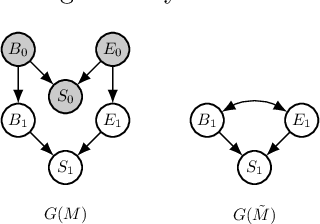
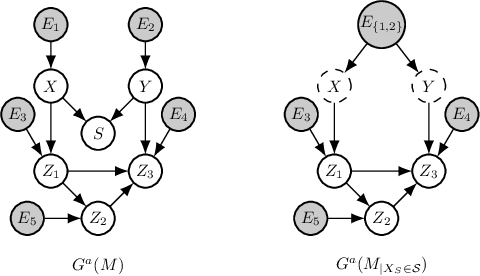
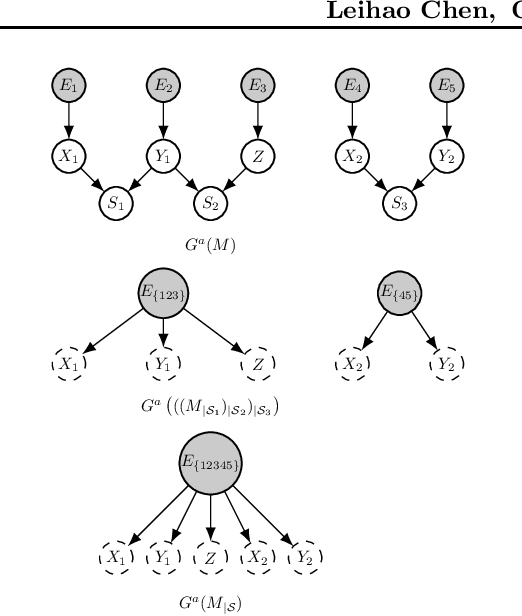
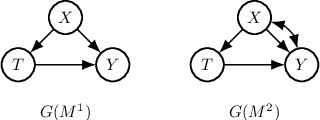
Selection bias is ubiquitous in real-world data, and can lead to misleading results if not dealt with properly. We introduce a conditioning operation on Structural Causal Models (SCMs) to model latent selection from a causal perspective. We show that the conditioning operation transforms an SCM with the presence of an explicit latent selection mechanism into an SCM without such selection mechanism, which partially encodes the causal semantics of the selected subpopulation according to the original SCM. Furthermore, we show that this conditioning operation preserves the simplicity, acyclicity, and linearity of SCMs, and commutes with marginalization. Thanks to these properties, combined with marginalization and intervention, the conditioning operation offers a valuable tool for conducting causal reasoning tasks within causal models where latent details have been abstracted away. We demonstrate by example how classical results of causal inference can be generalized to include selection bias and how the conditioning operation helps with modeling of real-world problems.