 Add to Chrome
 Add to Firefox
 Add to Edge
The monotonicity of the Franz-Parisi potential is equivalent with Low-degree MMSE lower bounds
Mar 20, 2026
Over the last decades, two distinct approaches have been instrumental to our understanding of the computational complexity of statistical estimation. The statistical physics literature predicts algorithmic hardness through local stability and monotonicity properties of the Franz--Parisi (FP) potential \cite{franz1995recipes,franz1997phase}, while the mathematically rigorous literature characterizes hardness via the limitations of restricted algorithmic classes, most notably low-degree polynomial estimators \cite{hopkins2017efficient}. For many inference models, these two perspectives yield strikingly consistent predictions, giving rise to a long-standing open problem of establishing a precise mathematical relationship between them. In this work, we show that for estimation problems the power of low-degree polynomials is equivalent to the monotonicity of the annealed FP potential for a broad family of Gaussian additive models (GAMs) with signal-to-noise ratio $λ$. In particular, subject to a low-degree conjecture for GAMs, our results imply that the polynomial-time limits of these models are directly implied by the monotonicity of the annealed FP potential, in conceptual agreement with predictions from the physics literature dating back to the 1990s.

On the Mechanism and Dynamics of Modular Addition: Fourier Features, Lottery Ticket, and Grokking
Feb 18, 2026We present a comprehensive analysis of how two-layer neural networks learn features to solve the modular addition task. Our work provides a full mechanistic interpretation of the learned model and a theoretical explanation of its training dynamics. While prior work has identified that individual neurons learn single-frequency Fourier features and phase alignment, it does not fully explain how these features combine into a global solution. We bridge this gap by formalizing a diversification condition that emerges during training when overparametrized, consisting of two parts: phase symmetry and frequency diversification. We prove that these properties allow the network to collectively approximate a flawed indicator function on the correct logic for the modular addition task. While individual neurons produce noisy signals, the phase symmetry enables a majority-voting scheme that cancels out noise, allowing the network to robustly identify the correct sum. Furthermore, we explain the emergence of these features under random initialization via a lottery ticket mechanism. Our gradient flow analysis proves that frequencies compete within each neuron, with the "winner" determined by its initial spectral magnitude and phase alignment. From a technical standpoint, we provide a rigorous characterization of the layer-wise phase coupling dynamics and formalize the competitive landscape using the ODE comparison lemma. Finally, we use these insights to demystify grokking, characterizing it as a three-stage process involving memorization followed by two generalization phases, driven by the competition between loss minimization and weight decay.
High-dimensional learning dynamics of multi-pass Stochastic Gradient Descent in multi-index models
Jan 28, 2026We study the learning dynamics of a multi-pass, mini-batch Stochastic Gradient Descent (SGD) procedure for empirical risk minimization in high-dimensional multi-index models with isotropic random data. In an asymptotic regime where the sample size $n$ and data dimension $d$ increase proportionally, for any sub-linear batch size $κ\asymp n^α$ where $α\in [0,1)$, and for a commensurate ``critical'' scaling of the learning rate, we provide an asymptotically exact characterization of the coordinate-wise dynamics of SGD. This characterization takes the form of a system of dynamical mean-field equations, driven by a scalar Poisson jump process that represents the asymptotic limit of SGD sampling noise. We develop an analogous characterization of the Stochastic Modified Equation (SME) which provides a Gaussian diffusion approximation to SGD. Our analyses imply that the limiting dynamics for SGD are the same for any batch size scaling $α\in [0,1)$, and that under a commensurate scaling of the learning rate, dynamics of SGD, SME, and gradient flow are mutually distinct, with those of SGD and SME coinciding in the special case of a linear model. We recover a known dynamical mean-field characterization of gradient flow in a limit of small learning rate, and of one-pass/online SGD in a limit of increasing sample size $n/d \to \infty$.
Inference in Randomized Least Squares and PCA via Normality of Quadratic Forms
Apr 01, 2024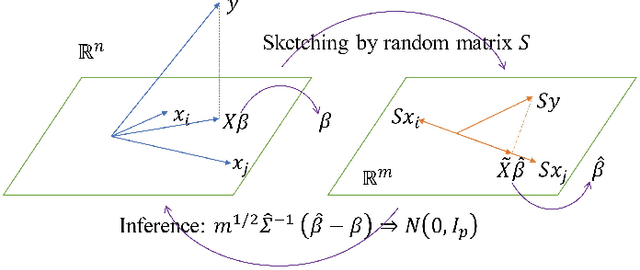

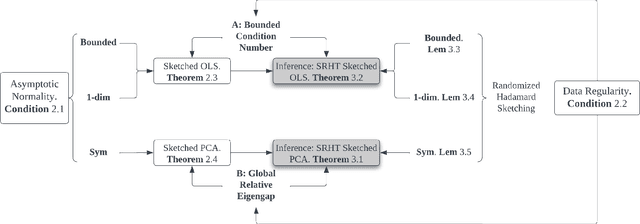
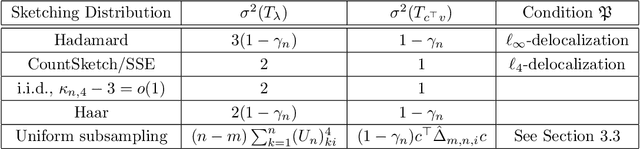
Randomized algorithms can be used to speed up the analysis of large datasets. In this paper, we develop a unified methodology for statistical inference via randomized sketching or projections in two of the most fundamental problems in multivariate statistical analysis: least squares and PCA. The methodology applies to fixed datasets -- i.e., is data-conditional -- and the only randomness is due to the randomized algorithm. We propose statistical inference methods for a broad range of sketching distributions, such as the subsampled randomized Hadamard transform (SRHT), Sparse Sign Embeddings (SSE) and CountSketch, sketching matrices with i.i.d. entries, and uniform subsampling. To our knowledge, no comparable methods are available for SSE and for SRHT in PCA. Our novel theoretical approach rests on showing the asymptotic normality of certain quadratic forms. As a contribution of broader interest, we show central limit theorems for quadratic forms of the SRHT, relying on a novel proof via a dyadic expansion that leverages the recursive structure of the Hadamard transform. Numerical experiments using both synthetic and empirical datasets support the efficacy of our methods, and in particular suggest that sketching methods can have better computation-estimation tradeoffs than recently proposed optimal subsampling methods.