 Add to Chrome
 Add to Firefox
 Add to Edge
Logical Embeddings for Argument Analysis
Aug 15, 2026
We propose a new framework for machine-learning-oriented argument analysis tasks. Our proposal involves replacing traditional contextualized word embeddings used in most NLP tasks with logical embeddings, an alternative encoding that directly exploits argumentation structures. In essence, logical embeddings encapsulate the logical semantics of an argument, allowing for a better representation of its meaning. Supporting these embeddings is a mathematical logic-based similarity measure that offers a transparent notion of proximity and is guaranteed to satisfy several desirable theoretical properties that current cosine similarity-based contextualized word embeddings cannot assure. This similarity measure induces a positive semi-definite kernel on the set of arguments, enabling us to uniquely define logical embeddings using the theory of Reproducing Kernel Hilbert Spaces (RKHS). Moreover, we prove that this encoding is optimal, in the sense that no logical information is lost in the process. As with other RKHS applications, logical embeddings can be used in numerous supervised and unsupervised tasks. We provide an implementation of the method and aim to test it against literature benchmarks. Additionally, we demonstrate that logical embeddings outperform most standard embedding methods on a classification task.

Contrastive Entity Coreference and Disambiguation for Historical Texts
Jun 21, 2024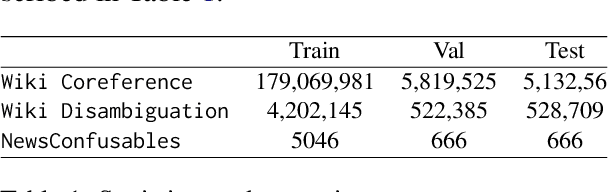

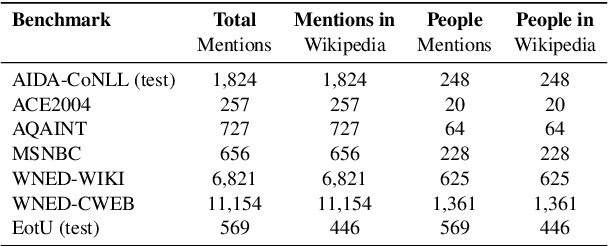

Massive-scale historical document collections are crucial for social science research. Despite increasing digitization, these documents typically lack unique cross-document identifiers for individuals mentioned within the texts, as well as individual identifiers from external knowledgebases like Wikipedia/Wikidata. Existing entity disambiguation methods often fall short in accuracy for historical documents, which are replete with individuals not remembered in contemporary knowledgebases. This study makes three key contributions to improve cross-document coreference resolution and disambiguation in historical texts: a massive-scale training dataset replete with hard negatives - that sources over 190 million entity pairs from Wikipedia contexts and disambiguation pages - high-quality evaluation data from hand-labeled historical newswire articles, and trained models evaluated on this historical benchmark. We contrastively train bi-encoder models for coreferencing and disambiguating individuals in historical texts, achieving accurate, scalable performance that identifies out-of-knowledgebase individuals. Our approach significantly surpasses other entity disambiguation models on our historical newswire benchmark. Our models also demonstrate competitive performance on modern entity disambiguation benchmarks, particularly certain news disambiguation datasets.
American Stories: A Large-Scale Structured Text Dataset of Historical U.S. Newspapers
Aug 24, 2023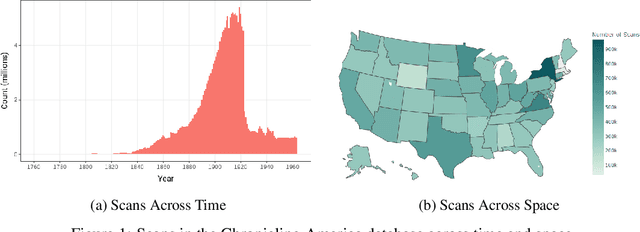
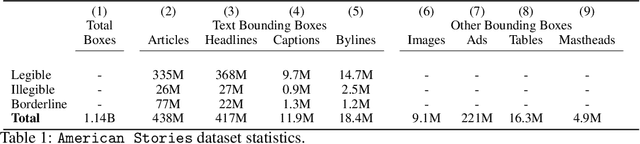
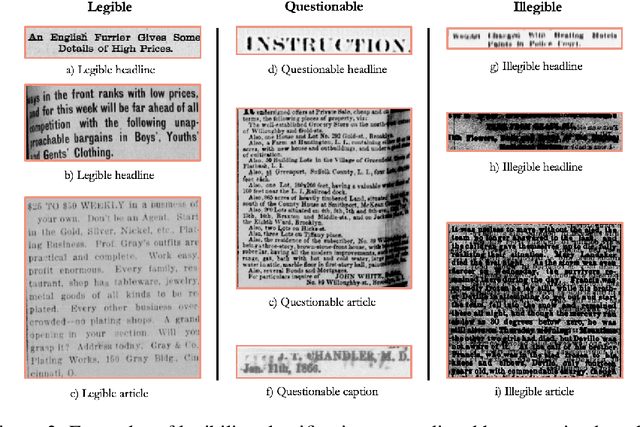

Existing full text datasets of U.S. public domain newspapers do not recognize the often complex layouts of newspaper scans, and as a result the digitized content scrambles texts from articles, headlines, captions, advertisements, and other layout regions. OCR quality can also be low. This study develops a novel, deep learning pipeline for extracting full article texts from newspaper images and applies it to the nearly 20 million scans in Library of Congress's public domain Chronicling America collection. The pipeline includes layout detection, legibility classification, custom OCR, and association of article texts spanning multiple bounding boxes. To achieve high scalability, it is built with efficient architectures designed for mobile phones. The resulting American Stories dataset provides high quality data that could be used for pre-training a large language model to achieve better understanding of historical English and historical world knowledge. The dataset could also be added to the external database of a retrieval-augmented language model to make historical information - ranging from interpretations of political events to minutiae about the lives of people's ancestors - more widely accessible. Furthermore, structured article texts facilitate using transformer-based methods for popular social science applications like topic classification, detection of reproduced content, and news story clustering. Finally, American Stories provides a massive silver quality dataset for innovating multimodal layout analysis models and other multimodal applications.