 Add to Chrome
 Add to Firefox
 Add to Edge
Seeking Late Night Life Lines: Experiences of Conversational AI Use in Mental Health Crisis
Dec 29, 2025
Online, people often recount their experiences turning to conversational AI agents (e.g., ChatGPT, Claude, Copilot) for mental health support -- going so far as to replace their therapists. These anecdotes suggest that AI agents have great potential to offer accessible mental health support. However, it's unclear how to meet this potential in extreme mental health crisis use cases. In this work, we explore the first-person experience of turning to a conversational AI agent in a mental health crisis. From a testimonial survey (n = 53) of lived experiences, we find that people use AI agents to fill the in-between spaces of human support; they turn to AI due to lack of access to mental health professionals or fears of burdening others. At the same time, our interviews with mental health experts (n = 16) suggest that human-human connection is an essential positive action when managing a mental health crisis. Using the stages of change model, our results suggest that a responsible AI crisis intervention is one that increases the user's preparedness to take a positive action while de-escalating any intended negative action. We discuss the implications of designing conversational AI agents as bridges towards human-human connection rather than ends in themselves.

Secondary Stakeholders in AI: Fighting for, Brokering, and Navigating Agency
Jun 08, 2025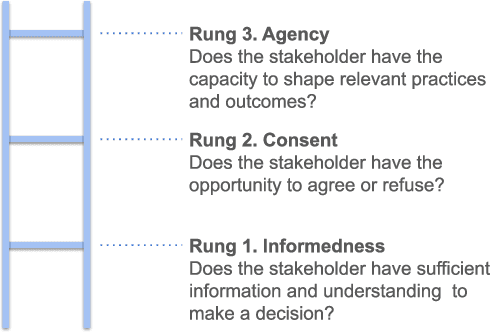
As AI technologies become more human-facing, there have been numerous calls to adapt participatory approaches to AI development -- spurring the idea of participatory AI. However, these calls often focus only on primary stakeholders, such as end-users, and not secondary stakeholders. This paper seeks to translate the ideals of participatory AI to a broader population of secondary AI stakeholders through semi-structured interviews. We theorize that meaningful participation involves three participatory ideals: (1) informedness, (2) consent, and (3) agency. We also explore how secondary stakeholders realize these ideals by traversing a complicated problem space. Like walking up the rungs of a ladder, these ideals build on one another. We introduce three stakeholder archetypes: the reluctant data contributor, the unsupported activist, and the well-intentioned practitioner, who must navigate systemic barriers to achieving agentic AI relationships. We envision an AI future where secondary stakeholders are able to meaningfully participate with the AI systems they influence and are influenced by.