 Add to Chrome
 Add to Firefox
 Add to Edge
Graph-Augmented LLMs for Swiss MP Ideology Prediction
May 06, 2026
Approximating the ideological position of Members of Parliament (MPs) is a fundamental task in political science, helping researchers understand legislative behavior, party alignment, and policy preferences. While Large Language Models (LLMs) have shown promising results in estimating MPs' ideological stances, there are more actors and elements in the parliamentary system, and relations between them, that could provide a wider and more informative picture. However, due to the complexity of integrating them in the prediction task, these additional elements are generally ignored. In this work, we propose an LLM framework, PG-RAG, that implements a retrieval-augmented generation pipeline: it first queries a political knowledge graph (KG) and then integrates the resulting graph-structured information into the context. This allows for capturing both textual semantics and inter-MP relationships, another relevant information source in any parliamentary system. We evaluate the approach on the task of ideology prediction, using data from a Swiss parliamentary dataset. When comparing graph-augmented models against several state-of-the-art baselines, the results demonstrate that incorporating this enriched information, which encodes information about different entities and relations, improves prediction performance. These results help to highlight the value of domain-specific relational information in modeling political behavior.

Disentangling Active and Passive Cosponsorship in the U.S. Congress
May 19, 2022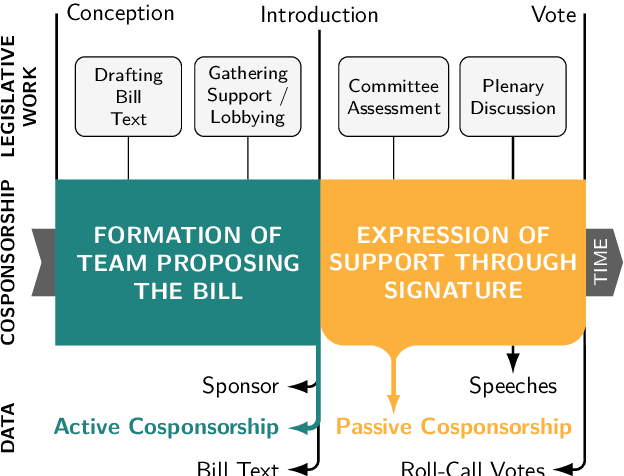
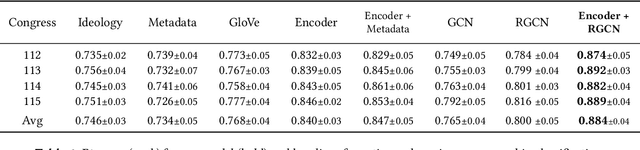
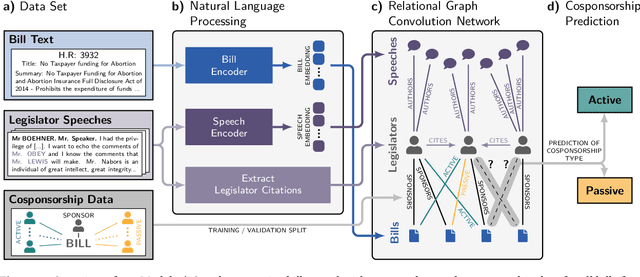
In the U.S. Congress, legislators can use active and passive cosponsorship to support bills. We show that these two types of cosponsorship are driven by two different motivations: the backing of political colleagues and the backing of the bill's content. To this end, we develop an Encoder+RGCN based model that learns legislator representations from bill texts and speech transcripts. These representations predict active and passive cosponsorship with an F1-score of 0.88. Applying our representations to predict voting decisions, we show that they are interpretable and generalize to unseen tasks.