 Add to Chrome
 Add to Firefox
 Add to Edge
Personalized Spiking Neural Networks with Ferroelectric Synapses for EEG Signal Processing
Jan 05, 2026
Electroencephalography (EEG)-based brain-computer interfaces (BCIs) are strongly affected by non-stationary neural signals that vary across sessions and individuals, limiting the generalization of subject-agnostic models and motivating adaptive and personalized learning on resource-constrained platforms. Programmable memristive hardware offers a promising substrate for such post-deployment adaptation; however, practical realization is challenged by limited weight resolution, device variability, nonlinear programming dynamics, and finite device endurance. In this work, we show that spiking neural networks (SNNs) can be deployed on ferroelectric memristive synaptic devices for adaptive EEG-based motor imagery decoding under realistic device constraints. We fabricate, characterize, and model ferroelectric synapses. We evaluate a convolutional-recurrent SNN architecture under two complementary deployment strategies: (i) device-aware training using a ferroelectric synapse model, and (ii) transfer of software-trained weights followed by low-overhead on-device re-tuning. To enable efficient adaptation, we introduce a device-aware weight-update strategy in which gradient-based updates are accumulated digitally and converted into discrete programming events only when a threshold is exceeded, emulating nonlinear, state-dependent programming dynamics while reducing programming frequency. Both deployment strategies achieve classification performance comparable to state-of-the-art software-based SNNs. Furthermore, subject-specific transfer learning achieved by retraining only the final network layers improves classification accuracy. These results demonstrate that programmable ferroelectric hardware can support robust, low-overhead adaptation in spiking neural networks, opening a practical path toward personalized neuromorphic processing of neural signals.

TEXEL: A neuromorphic processor with on-chip learning for beyond-CMOS device integration
Oct 21, 2024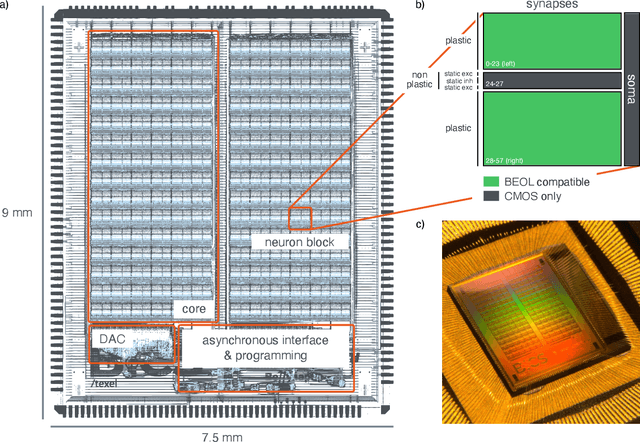
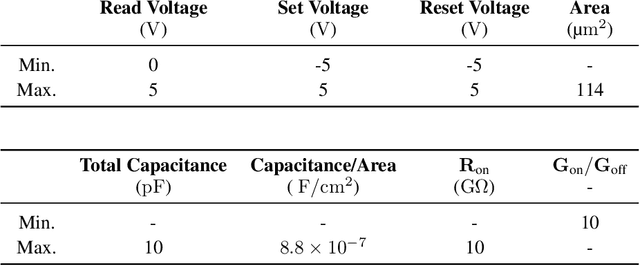
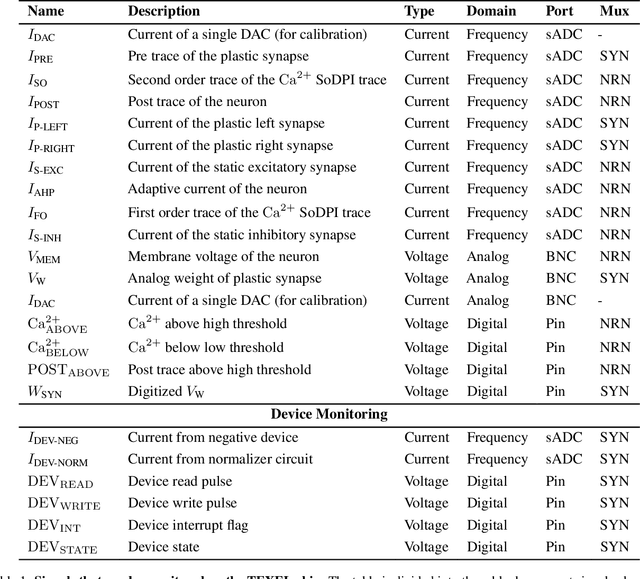
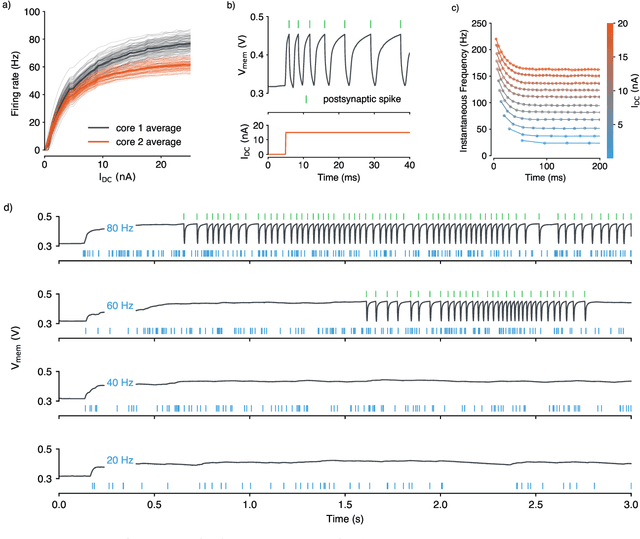
Recent advances in memory technologies, devices and materials have shown great potential for integration into neuromorphic electronic systems. However, a significant gap remains between the development of these materials and the realization of large-scale, fully functional systems. One key challenge is determining which devices and materials are best suited for specific functions and how they can be paired with CMOS circuitry. To address this, we introduce TEXEL, a mixed-signal neuromorphic architecture designed to explore the integration of on-chip learning circuits and novel two- and three-terminal devices. TEXEL serves as an accessible platform to bridge the gap between CMOS-based neuromorphic computation and the latest advancements in emerging devices. In this paper, we demonstrate the readiness of TEXEL for device integration through comprehensive chip measurements and simulations. TEXEL provides a practical system for testing bio-inspired learning algorithms alongside emerging devices, establishing a tangible link between brain-inspired computation and cutting-edge device research.