 Add to Chrome
 Add to Firefox
 Add to Edge
DUET -- Dual User Embedding Transformers for Offsite Conversion Prediction
Jun 08, 2026
Offsite conversion rate (OCVR) prediction is an important ranking problem in computational recommendation systems. This task presents a modeling challenge: click signals are abundant and exhibit short temporal horizons, whereas conversion signals are inherently sparse, long-delayed, and frequently unattributed. Despite these statistical disparities, both signal types must inform models that operate within strict serving-latency constraints. Prior pre-training approaches address this heterogeneity with a single, undifferentiated encoder applied uniformly across both data streams. We propose DUET (Dual User Embedding Transformers), a framework that explicitly partitions user behavioral data into two domain-coherent streams -- clicks and conversions -- and pre-trains dedicated transformer encoders with architectures tailored to each stream's statistical characteristics: multi-layer self-attention for the dense click stream and interleaved cross- and self-attention for the sparse conversion stream. The resulting complementary embeddings are jointly consumed by a downstream ranker without exceeding serving-latency budgets. Evaluation demonstrates up to 0.38% normalized entropy (NE) reduction relative to the strongest baseline, and A/B test shows consistent improvements in OCVR prediction accuracy.

Fetal Pose Estimation in Volumetric MRI using a 3D Convolution Neural Network
Jul 10, 2019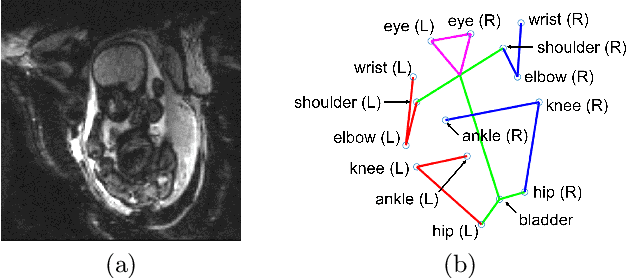
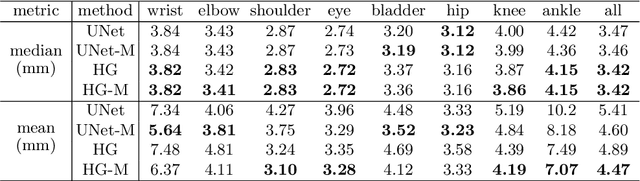
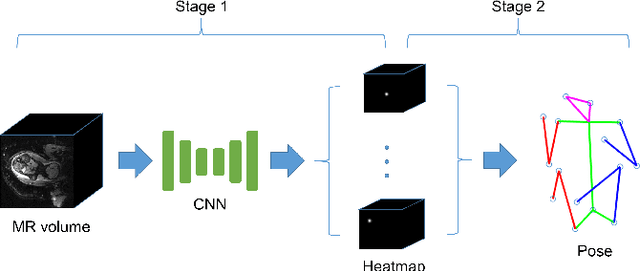

The performance and diagnostic utility of magnetic resonance imaging (MRI) in pregnancy is fundamentally constrained by fetal motion. Motion of the fetus, which is unpredictable and rapid on the scale of conventional imaging times, limits the set of viable acquisition techniques to single-shot imaging with severe compromises in signal-to-noise ratio and diagnostic contrast, and frequently results in unacceptable image quality. Surprisingly little is known about the characteristics of fetal motion during MRI and here we propose and demonstrate methods that exploit a growing repository of MRI observations of the gravid abdomen that are acquired at low spatial resolution but relatively high temporal resolution and over long durations (10-30 minutes). We estimate fetal pose per frame in MRI volumes of the pregnant abdomen via deep learning algorithms that detect key fetal landmarks. Evaluation of the proposed method shows that our framework achieves quantitatively an average error of 4.47 mm and 96.4\% accuracy (with error less than 10 mm). Fetal pose estimation in MRI time series yields novel means of quantifying fetal movements in health and disease, and enables the learning of kinematic models that may enhance prospective mitigation of fetal motion artifacts during MRI acquisition.