 Add to Chrome
 Add to Firefox
 Add to Edge
PRISM: Perinuclear Ring-based Image Segmentation Method for Acute Lymphoblastic Leukemia Classification
May 13, 2026
Automated analysis of peripheral blood smears for Acute Lymphoblastic Leukemia (ALL) is hindered by low contrast and substantial variability in cytoplasmic appearance, which complicate conventional membrane-based segmentation. We found that many recent approaches rely on heavy neural architectures and extensive training, but still struggle to generalize across staining and acquisition variability. To address these limitations, we propose the Perinuclear Ring-based Image Segmentation Method (PRISM), which replaces explicit cytoplasmic delineation with adaptive concentric zones constructed around the nucleus. These perinuclear regions enable the extraction of robust cytoplasmic descriptors by integrating color information with texture statistics derived from grey-level co-occurrence patterns, without requiring accurate cell-boundary detection. A calibrated stacking ensemble of traditional classifiers leverages these descriptors to achieve a high performance, with an accuracy of 98.46% and a precision-recall AUC of 0.9937.

Asynchronous Probability Ensembling for Federated Disaster Detection
Apr 15, 2026Quick and accurate emergency handling in Disaster Decision Support Systems (DDSS) is often hampered by network latency and suboptimal application accuracy. While Federated Learning (FL) addresses some of these issues, it is constrained by high communication costs and rigid synchronization requirements across heterogeneous convolutional neural network (CNN) architectures. To overcome these challenges, this paper proposes a decentralized ensembling framework based on asynchronous probability aggregation and feedback distillation. By shifting the exchange unit from model weights to class-probability vectors, our method maintains data privacy, reduces communication requirements by orders of magnitude, and improves overall accuracy. This approach enables diverse CNN designs to collaborate asynchronously, enhancing disaster image identification performance even in resource-constrained settings. Experimental tests demonstrate that the proposed method outperforms traditional individual backbones and standard federated approaches, establishing a scalable and resource-aware solution for real-time disaster response.
AGORA: Agentic Green Orchestration Architecture for Beyond 5G Networks
Feb 08, 2026Effective management and operational decision-making for complex mobile network systems present significant challenges, particularly when addressing conflicting requirements such as efficiency, user satisfaction, and energy-efficient traffic steering. The literature presents various approaches aimed at enhancing network management, including the Zero-Touch Network (ZTN) and Self-Organizing Network (SON); however, these approaches often lack a practical and scalable mechanism to consider human sustainability goals as input, translate them into energy-aware operational policies, and enforce them at runtime. In this study, we address this gap by proposing the AGORA: Agentic Green Orchestration Architecture for Beyond 5G Networks. AGORA embeds a local tool-augmented Large Language Model (LLM) agent in the mobile network control loop to translate natural-language sustainability goals into telemetry-grounded actions, actuating the User Plane Function (UPF) to perform energy-aware traffic steering. The findings indicate a strong latency-energy coupling in tool-driven control loops and demonstrate that compact models can achieve a low energy footprint while still facilitating correct policy execution, including non-zero migration behavior under stressed Multi-access Edge Computing (MEC) conditions. Our approach paves the way for sustainability-first, intent-driven network operations that align human objectives with executable orchestration in Beyond-5G infrastructures.
Exploiting Test-Time Augmentation in Federated Learning for Brain Tumor MRI Classification
Jan 19, 2026Efficient brain tumor diagnosis is crucial for early treatment; however, it is challenging because of lesion variability and image complexity. We evaluated convolutional neural networks (CNNs) in a federated learning (FL) setting, comparing models trained on original versus preprocessed MRI images (resizing, grayscale conversion, normalization, filtering, and histogram equalization). Preprocessing alone yielded negligible gains; combined with test-time augmentation (TTA), it delivered consistent, statistically significant improvements in federated MRI classification (p<0.001). In practice, TTA should be the default inference strategy in FL-based medical imaging; when the computational budget permits, pairing TTA with light preprocessing provides additional reliable gains.
Generalizable Hyperparameter Optimization for Federated Learning on Non-IID Cancer Images
Jan 19, 2026Deep learning for cancer histopathology training conflicts with privacy constraints in clinical settings. Federated Learning (FL) mitigates this by keeping data local; however, its performance depends on hyperparameter choices under non-independent and identically distributed (non-IID) client datasets. This paper examined whether hyperparameters optimized on one cancer imaging dataset generalized across non-IID federated scenarios. We considered binary histopathology tasks for ovarian and colorectal cancers. We perform centralized Bayesian hyperparameter optimization and transfer dataset-specific optima to the non-IID FL setup. The main contribution of this study is the introduction of a simple cross-dataset aggregation heuristic by combining configurations by averaging the learning rates and considering the modal optimizers and batch sizes. This combined configuration achieves a competitive classification performance.
Energy-Aware Ensemble Learning for Coffee Leaf Disease Classification
Jan 17, 2026Coffee yields are contingent on the timely and accurate diagnosis of diseases; however, assessing leaf diseases in the field presents significant challenges. Although Artificial Intelligence (AI) vision models achieve high accuracy, their adoption is hindered by the limitations of constrained devices and intermittent connectivity. This study aims to facilitate sustainable on-device diagnosis through knowledge distillation: high-capacity Convolutional Neural Networks (CNNs) trained in data centers transfer knowledge to compact CNNs through Ensemble Learning (EL). Furthermore, dense tiny pairs were integrated through simple and optimized ensembling to enhance accuracy while adhering to strict computational and energy constraints. On a curated coffee leaf dataset, distilled tiny ensembles achieved competitive with prior work with significantly reduced energy consumption and carbon footprint. This indicates that lightweight models, when properly distilled and ensembled, can provide practical diagnostic solutions for Internet of Things (IoT) applications.
Improving Sickle Cell Disease Classification: A Fusion of Conventional Classifiers, Segmented Images, and Convolutional Neural Networks
Dec 23, 2024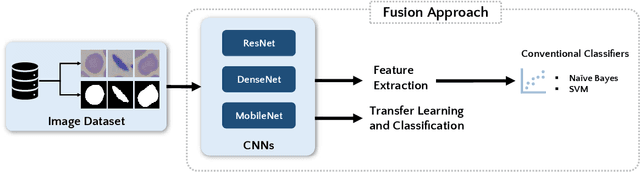
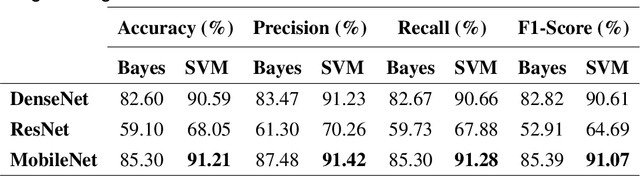
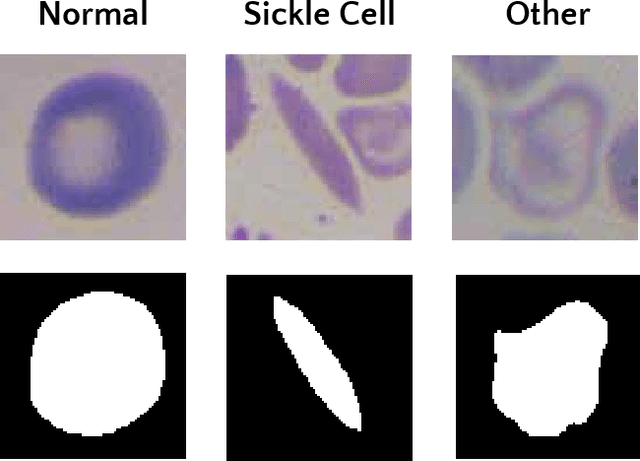
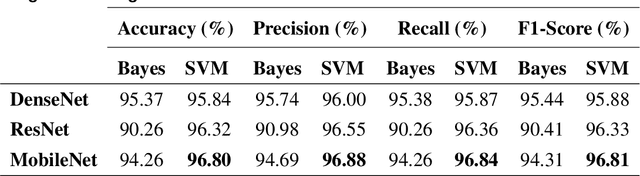
Sickle cell anemia, which is characterized by abnormal erythrocyte morphology, can be detected using microscopic images. Computational techniques in medicine enhance the diagnosis and treatment efficiency. However, many computational techniques, particularly those based on Convolutional Neural Networks (CNNs), require high resources and time for training, highlighting the research opportunities in methods with low computational overhead. In this paper, we propose a novel approach combining conventional classifiers, segmented images, and CNNs for the automated classification of sickle cell disease. We evaluated the impact of segmented images on classification, providing insight into deep learning integration. Our results demonstrate that using segmented images and CNN features with an SVM achieves an accuracy of 96.80%. This finding is relevant for computationally efficient scenarios, paving the way for future research and advancements in medical-image analysis.
* 14 pages
On Enhancing Network Throughput using Reinforcement Learning in Sliced Testbeds
Dec 21, 2024
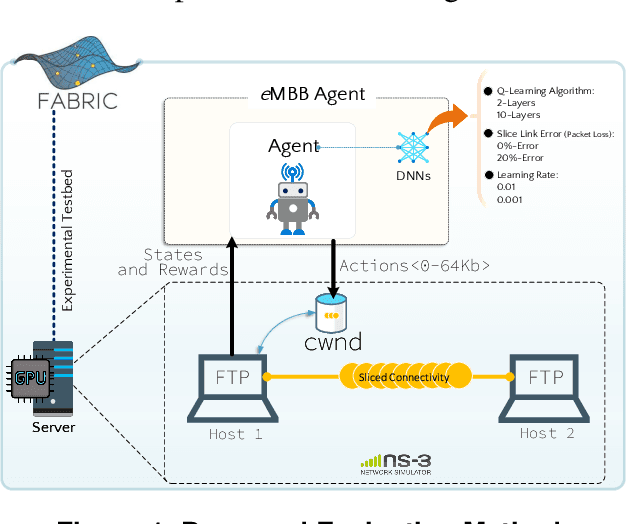
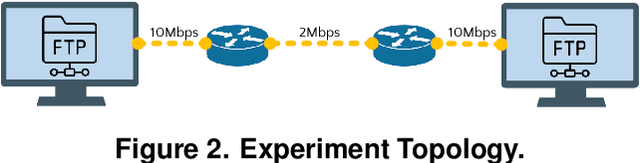
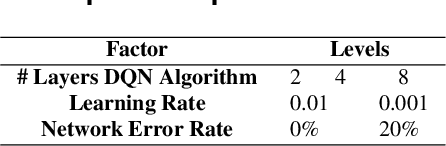
Novel applications demand high throughput, low latency, and high reliability connectivity and still pose significant challenges to slicing orchestration architectures. The literature explores network slicing techniques that employ canonical methods, artificial intelligence, and combinatorial optimization to address errors and ensure throughput for network slice data plane. This paper introduces the Enhanced Mobile Broadband (eMBB)-Agent as a new approach that uses Reinforcement Learning (RL) in a vertical application to enhance network slicing throughput to fit Service-Level Agreements (SLAs). The eMBB-Agent analyzes application transmission variables and proposes actions within a discrete space to adjust the reception window using a Deep Q-Network (DQN). This paper also presents experimental results that examine the impact of factors such as the channel error rate, DQN model layers, and learning rate on model convergence and achieved throughput, providing insights on embedding intelligence in network slicing.