 Add to Chrome
 Add to Firefox
 Add to Edge
Membership Inference Attacks for Retrieval Based In-Context Learning for Document Question Answering
May 05, 2026
We show that remotely hosted applications employing in-context learning when augmented with a retrieval function to select in-context examples can be vulnerable to membership-inference attacks even when the service provider and users are separate parties. We propose two black-box membership inference attacks that exploit query text prefixes to distinguish member from non-member inputs. The first attack uses a reference model to estimate an otherwise unavailable loss metric. The second attack improves upon it by eliminating the reference model and instead computing a membership statistic through a simple but novel weighted-averaging scheme. Our comprehensive empirical evaluations consider a stricter case in which the adversary has a paraphrased version of the text in the queries and show that our attacks can exhibit stronger resilience to paraphrasing and outperform three prior attacks in many cases with small number of prefixes. We also adapt an existing ensemble prompting defense to our setting, demonstrating that it substantially mitigates the privacy leakage caused by our second attack.

Thinking Before Constraining: A Unified Decoding Framework for Large Language Models
Jan 12, 2026Natural generation allows Language Models (LMs) to produce free-form responses with rich reasoning, but the lack of guaranteed structure makes outputs difficult to parse or verify. Structured generation, or constrained decoding, addresses this drawback by producing content in standardized formats such as JSON, ensuring consistency and guaranteed-parsable outputs, but it can inadvertently restrict the model's reasoning capabilities. In this work, we propose a simple approach that combines the advantages of both natural and structured generation. By allowing LLMs to reason freely until specific trigger tokens are generated, and then switching to structured generation, our method preserves the expressive power of natural language reasoning while ensuring the reliability of structured outputs. We further evaluate our approach on several datasets, covering both classification and reasoning tasks, to demonstrate its effectiveness, achieving a substantial gain of up to 27% in accuracy compared to natural generation, while requiring only a small overhead of 10-20 extra tokens.
Certainty-Guided Reasoning in Large Language Models: A Dynamic Thinking Budget Approach
Sep 09, 2025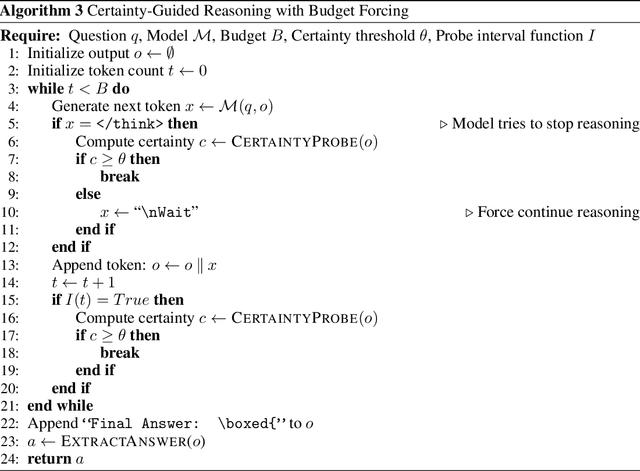
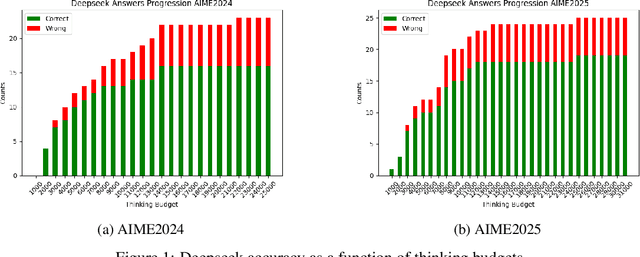
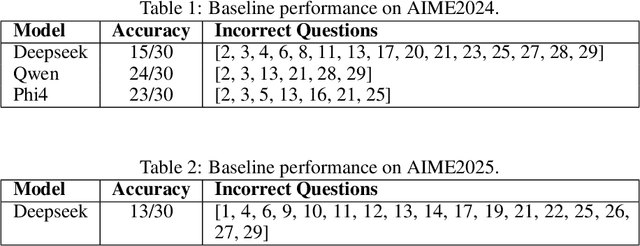
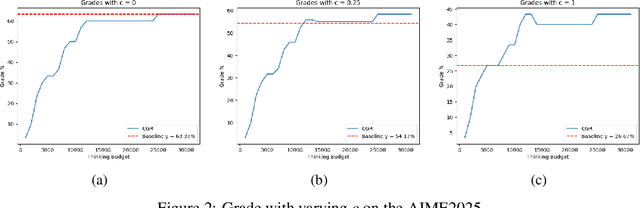
The rise of large reasoning language models (LRLMs) has unlocked new potential for solving complex tasks. These models operate with a thinking budget, that is, a predefined number of reasoning tokens used to arrive at a solution. We propose a novel approach, inspired by the generator/discriminator framework in generative adversarial networks, in which a critic model periodically probes its own reasoning to assess whether it has reached a confident conclusion. If not, reasoning continues until a target certainty threshold is met. This mechanism adaptively balances efficiency and reliability by allowing early termination when confidence is high, while encouraging further reasoning when uncertainty persists. Through experiments on the AIME2024 and AIME2025 datasets, we show that Certainty-Guided Reasoning (CGR) improves baseline accuracy while reducing token usage. Importantly, extended multi-seed evaluations over 64 runs demonstrate that CGR is stable, reducing variance across seeds and improving exam-like performance under penalty-based grading. Additionally, our token savings analysis shows that CGR can eliminate millions of tokens in aggregate, with tunable trade-offs between certainty thresholds and efficiency. Together, these findings highlight certainty as a powerful signal for reasoning sufficiency. By integrating confidence into the reasoning process, CGR makes large reasoning language models more adaptive, trustworthy, and resource efficient, paving the way for practical deployment in domains where both accuracy and computational cost matter.