 Add to Chrome
 Add to Firefox
 Add to Edge
A systematic comparison of supervised classifiers
Oct 17, 2013
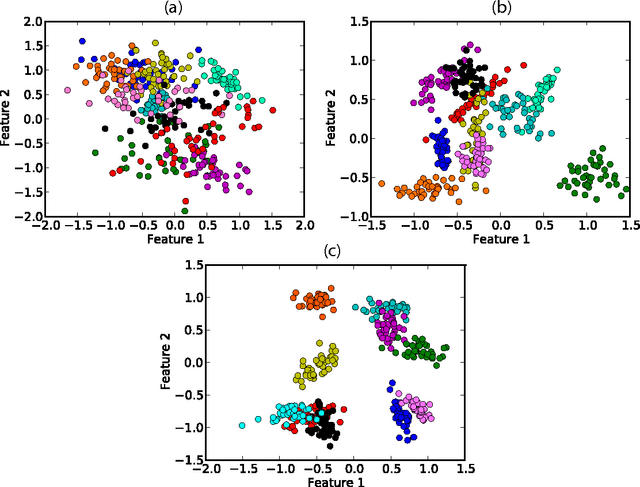
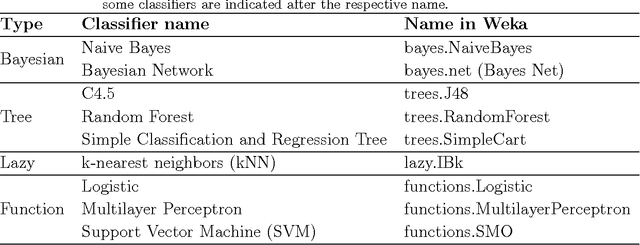
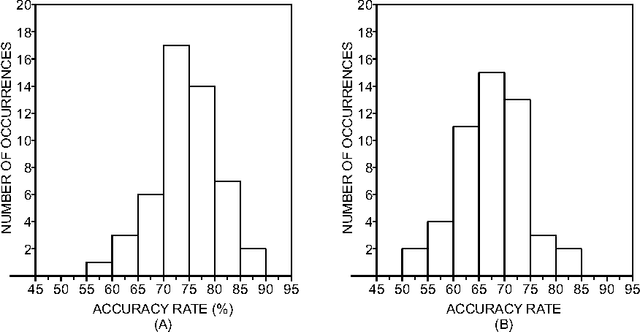
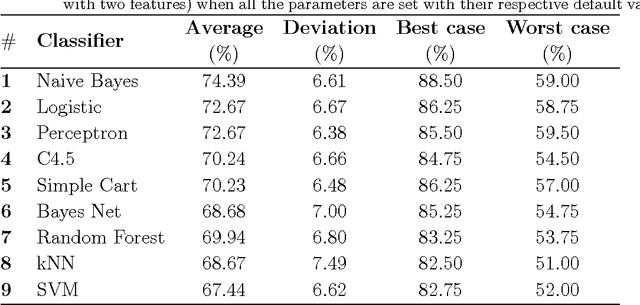
Pattern recognition techniques have been employed in a myriad of industrial, medical, commercial and academic applications. To tackle such a diversity of data, many techniques have been devised. However, despite the long tradition of pattern recognition research, there is no technique that yields the best classification in all scenarios. Therefore, the consideration of as many as possible techniques presents itself as an fundamental practice in applications aiming at high accuracy. Typical works comparing methods either emphasize the performance of a given algorithm in validation tests or systematically compare various algorithms, assuming that the practical use of these methods is done by experts. In many occasions, however, researchers have to deal with their practical classification tasks without an in-depth knowledge about the underlying mechanisms behind parameters. Actually, the adequate choice of classifiers and parameters alike in such practical circumstances constitutes a long-standing problem and is the subject of the current paper. We carried out a study on the performance of nine well-known classifiers implemented by the Weka framework and compared the dependence of the accuracy with their configuration parameter configurations. The analysis of performance with default parameters revealed that the k-nearest neighbors method exceeds by a large margin the other methods when high dimensional datasets are considered. When other configuration of parameters were allowed, we found that it is possible to improve the quality of SVM in more than 20% even if parameters are set randomly. Taken together, the investigation conducted in this paper suggests that, apart from the SVM implementation, Weka's default configuration of parameters provides an performance close the one achieved with the optimal configuration.

Technical Report - Automatic Contour Extraction from 2D Neuron Images
Oct 24, 2008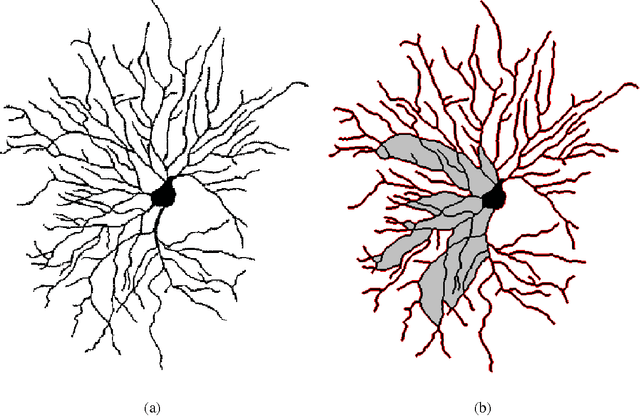
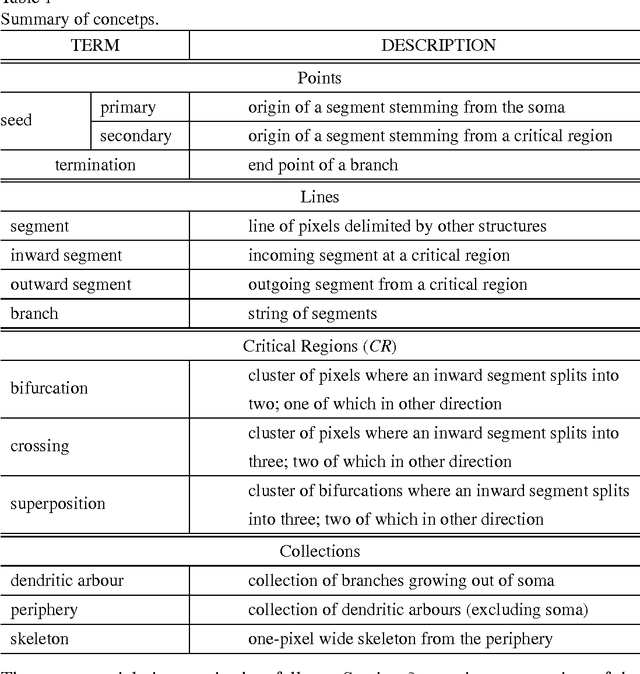
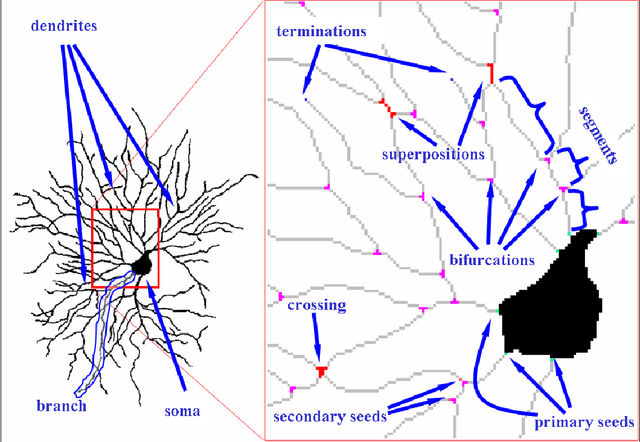
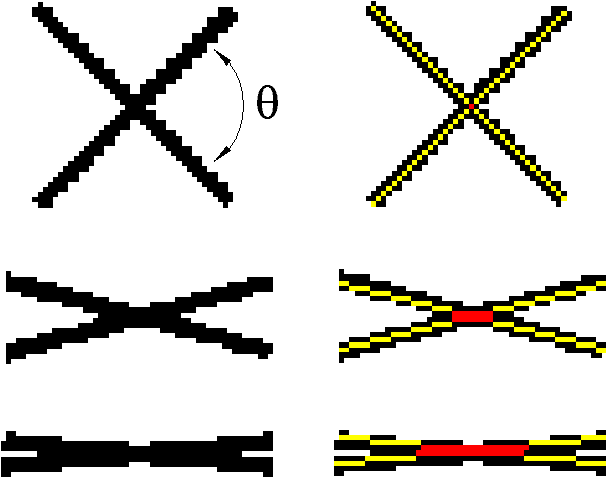
This work describes a novel methodology for automatic contour extraction from 2D images of 3D neurons (e.g. camera lucida images and other types of 2D microscopy). Most contour-based shape analysis methods can not be used to characterize such cells because of overlaps between neuronal processes. The proposed framework is specifically aimed at the problem of contour following even in presence of multiple overlaps. First, the input image is preprocessed in order to obtain an 8-connected skeleton with one-pixel-wide branches, as well as a set of critical regions (i.e., bifurcations and crossings). Next, for each subtree, the tracking stage iteratively labels all valid pixel of branches, up to a critical region, where it determines the suitable direction to proceed. Finally, the labeled skeleton segments are followed in order to yield the parametric contour of the neuronal shape under analysis. The reported system was successfully tested with respect to several images and the results from a set of three neuron images are presented here, each pertaining to a different class, i.e. alpha, delta and epsilon ganglion cells, containing a total of 34 crossings. The algorithms successfully got across all these overlaps. The method has also been found to exhibit robustness even for images with close parallel segments. The proposed method is robust and may be implemented in an efficient manner. The introduction of this approach should pave the way for more systematic application of contour-based shape analysis methods in neuronal morphology.