 Add to Chrome
 Add to Firefox
 Add to Edge
Meta-Ensemble Learning with Diverse Data Splits for Improved Respiratory Sound Classification
Apr 27, 2026
Training reliable respiratory sound classification models remains challenging due to the limited size and subject diversity of datasets. Ensemble methods can improve robustness, but when base models are trained on identical data, models tend to overfit and produce highly correlated predictions, thereby reducing the effectiveness of ensembling. In this work, we investigate a meta-ensemble learning methodology that enhances prediction diversity by training base models on diverse data splits and combining their outputs through a trained meta-model. Specifically, we train base models on the ICBHI dataset using two data split settings: fixed 80-20% split and five-fold cross-validation split, under two data granularity settings: patient- and sample-level. The resulting diversity in base model predictions enables the meta-model to better generalize. Our approach achieves new state-of-the-art performance on the ICBHI benchmark, reaching a Score of 66.49% and showing improved generalization on two out-of-distribution datasets, indicating its potential applicability to real-world clinical data.

Tri-MTL: A Triple Multitask Learning Approach for Respiratory Disease Diagnosis
May 06, 2025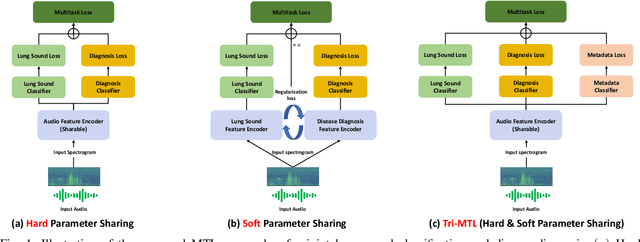
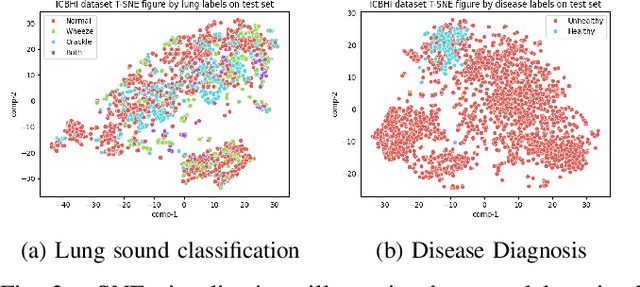
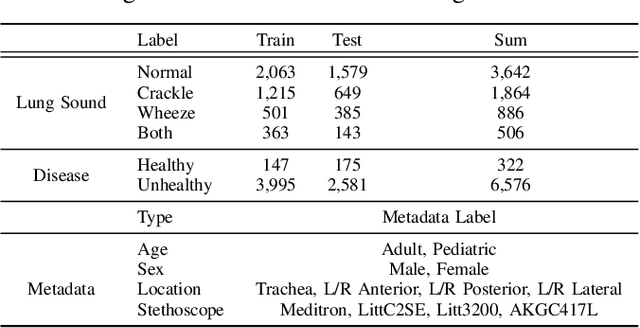
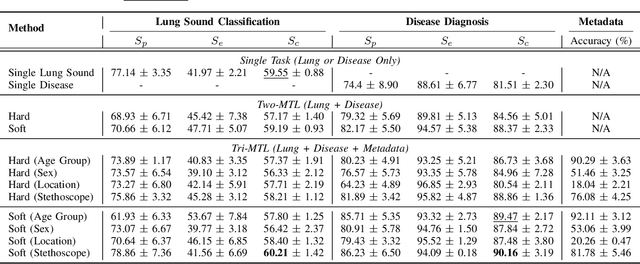
Auscultation remains a cornerstone of clinical practice, essential for both initial evaluation and continuous monitoring. Clinicians listen to the lung sounds and make a diagnosis by combining the patient's medical history and test results. Given this strong association, multitask learning (MTL) can offer a compelling framework to simultaneously model these relationships, integrating respiratory sound patterns with disease manifestations. While MTL has shown considerable promise in medical applications, a significant research gap remains in understanding the complex interplay between respiratory sounds, disease manifestations, and patient metadata attributes. This study investigates how integrating MTL with cutting-edge deep learning architectures can enhance both respiratory sound classification and disease diagnosis. Specifically, we extend recent findings regarding the beneficial impact of metadata on respiratory sound classification by evaluating its effectiveness within an MTL framework. Our comprehensive experiments reveal significant improvements in both lung sound classification and diagnostic performance when the stethoscope information is incorporated into the MTL architecture.