 Add to Chrome
 Add to Firefox
 Add to Edge
COVAriance-Induced Fairness Gap Penalty for Subgroup-Fair Clustering
Jul 20, 2026
Fair clustering aims to make cluster assignments independent of sensitive attributes, but this goal becomes challenging when multiple sensitive attributes jointly define many subgroups. In such settings, directly extending existing fair clustering algorithms is computationally expensive or numerically unstable, especially when the number of subgroups grows exponentially and some subgroups contain only a few instances. To address these challenges, we define a subgroup-fairness gap for clustering and derive a covariance-based surrogate that exactly matches this gap. We then introduce a continuous relaxation of the surrogate, enabling efficient gradient-based optimization and yielding our proposed algorithm, COVA-FC. We also show that subgroup fairness alone does not imply marginal fairness, and extend our framework to capture a subgroup-marginal-fairness gap. Experiments on benchmark datasets show that COVA-FC achieves competitive cost-fairness trade-offs and improves computational efficiency over existing baselines in both subgroup and higher-order marginal settings.

What Drives the Inlier-Memorization Effect? A Theory of Outlier Detection via Early Training Dynamics
Jun 29, 2026Outlier detection (OD) aims to identify anomalous instances by learning the underlying structure of normal data (inliers), and is particularly challenging in fully unsupervised settings where no information about anomalies is available during training. Recent advances have leveraged the inlier-memorization (IM) effect, a phenomenon in which deep models memorize inlier patterns earlier than those of outliers, as a powerful signal for distinguishing outliers. However, despite its empirical success, the theoretical understanding of the IM effect remains limited. In this work, we present a theoretical study of the IM effect. Focusing on a simple autoencoder, we show that, under mild assumptions, the model can successfully memorize inliers while failing to memorize outliers during certain stages of early training. In particular, we characterize not only the emergence of the IM effect, but also its strength and persistence, and analyze how these properties depend on the data distribution and parameter initialization. In addition, building on these insights, we derive simple yet practical guidelines for enhancing the IM effect, including data preprocessing and parameter initialization schemes, achieving state-of-the-art performance on the ADBench datasets. Our findings provide a theoretical foundation for the IM effect and offer actionable directions for improving IM-based outlier detection methods.
Naive Visual Memory is Not Enough: A Failure-Mode Study of GUI Agents
Jun 12, 2026Graphical User Interface (GUI) agents are increasingly used to automate complex computer tasks across applications, websites, and operating systems. To improve their reliability, recent work has introduced experiential memory, where agents retrieve prior trajectories to guide decision-making in similar states. More recent approaches further extend this idea to visual memory by storing and retrieving screenshots from past interactions, providing agents with richer contextual information than text-only memories. However, the effect of visual memory in GUI agents remains insufficiently understood: it is unclear which failures visual memory mitigates, or which failures it exacerbates. To systematically analyze the effect of visual memory, we introduce a taxonomy of four GUI agent failures (i.e., cognitive failure, visual state misunderstanding, hidden operation blindness, and grounding error) that map to distinct stages of the perception-reasoning-action pipeline. We find that prepending full-image memory has a divergent effect on the failure distribution: it reduces state-level failures but worsens action-level ones, and increases hidden operation blindness and grounding error. Motivated by this finding, we propose Action-Grounded Visual Memory (AGMem), an action-grounded memory framework for GUI agents. The core idea of AGMem is to store image crops that capture the local GUI region closely related to a successful action or a recovery, rather than storing full screenshots. Experiments on OSWorld show that AGMem improves task success rates by 33.3 % over full-image memory. These results demonstrate that AGMem is an effective representation for visual memory in GUI agents.
Fair Model-based Clustering
Feb 25, 2026The goal of fair clustering is to find clusters such that the proportion of sensitive attributes (e.g., gender, race, etc.) in each cluster is similar to that of the entire dataset. Various fair clustering algorithms have been proposed that modify standard K-means clustering to satisfy a given fairness constraint. A critical limitation of several existing fair clustering algorithms is that the number of parameters to be learned is proportional to the sample size because the cluster assignment of each datum should be optimized simultaneously with the cluster center, and thus scaling up the algorithms is difficult. In this paper, we propose a new fair clustering algorithm based on a finite mixture model, called Fair Model-based Clustering (FMC). A main advantage of FMC is that the number of learnable parameters is independent of the sample size and thus can be scaled up easily. In particular, mini-batch learning is possible to obtain clusters that are approximately fair. Moreover, FMC can be applied to non-metric data (e.g., categorical data) as long as the likelihood is well-defined. Theoretical and empirical justifications for the superiority of the proposed algorithm are provided.
Fair Bayesian Model-Based Clustering
Jun 15, 2025Fair clustering has become a socially significant task with the advancement of machine learning technologies and the growing demand for trustworthy AI. Group fairness ensures that the proportions of each sensitive group are similar in all clusters. Most existing group-fair clustering methods are based on the $K$-means clustering and thus require the distance between instances and the number of clusters to be given in advance. To resolve this limitation, we propose a fair Bayesian model-based clustering called Fair Bayesian Clustering (FBC). We develop a specially designed prior which puts its mass only on fair clusters, and implement an efficient MCMC algorithm. Advantages of FBC are that it can infer the number of clusters and can be applied to any data type as long as the likelihood is defined (e.g., categorical data). Experiments on real-world datasets show that FBC (i) reasonably infers the number of clusters, (ii) achieves a competitive utility-fairness trade-off compared to existing fair clustering methods, and (iii) performs well on categorical data.
Fair Clustering via Alignment
May 14, 2025Algorithmic fairness in clustering aims to balance the proportions of instances assigned to each cluster with respect to a given sensitive attribute. While recently developed fair clustering algorithms optimize clustering objectives under specific fairness constraints, their inherent complexity or approximation often results in suboptimal clustering utility or numerical instability in practice. To resolve these limitations, we propose a new fair clustering algorithm based on a novel decomposition of the fair K-means clustering objective function. The proposed algorithm, called Fair Clustering via Alignment (FCA), operates by alternately (i) finding a joint probability distribution to align the data from different protected groups, and (ii) optimizing cluster centers in the aligned space. A key advantage of FCA is that it theoretically guarantees approximately optimal clustering utility for any given fairness level without complex constraints, thereby enabling high-utility fair clustering in practice. Experiments show that FCA outperforms existing methods by (i) attaining a superior trade-off between fairness level and clustering utility, and (ii) achieving near-perfect fairness without numerical instability.
Fair Representation Learning for Continuous Sensitive Attributes using Expectation of Integral Probability Metrics
May 09, 2025AI fairness, also known as algorithmic fairness, aims to ensure that algorithms operate without bias or discrimination towards any individual or group. Among various AI algorithms, the Fair Representation Learning (FRL) approach has gained significant interest in recent years. However, existing FRL algorithms have a limitation: they are primarily designed for categorical sensitive attributes and thus cannot be applied to continuous sensitive attributes, such as age or income. In this paper, we propose an FRL algorithm for continuous sensitive attributes. First, we introduce a measure called the Expectation of Integral Probability Metrics (EIPM) to assess the fairness level of representation space for continuous sensitive attributes. We demonstrate that if the distribution of the representation has a low EIPM value, then any prediction head constructed on the top of the representation become fair, regardless of the selection of the prediction head. Furthermore, EIPM possesses a distinguished advantage in that it can be accurately estimated using our proposed estimator with finite samples. Based on these properties, we propose a new FRL algorithm called Fair Representation using EIPM with MMD (FREM). Experimental evidences show that FREM outperforms other baseline methods.
ReLU integral probability metric and its applications
Apr 26, 2025We propose a parametric integral probability metric (IPM) to measure the discrepancy between two probability measures. The proposed IPM leverages a specific parametric family of discriminators, such as single-node neural networks with ReLU activation, to effectively distinguish between distributions, making it applicable in high-dimensional settings. By optimizing over the parameters of the chosen discriminator class, the proposed IPM demonstrates that its estimators have good convergence rates and can serve as a surrogate for other IPMs that use smooth nonparametric discriminator classes. We present an efficient algorithm for practical computation, offering a simple implementation and requiring fewer hyperparameters. Furthermore, we explore its applications in various tasks, such as covariate balancing for causal inference and fair representation learning. Across such diverse applications, we demonstrate that the proposed IPM provides strong theoretical guarantees, and empirical experiments show that it achieves comparable or even superior performance to other methods.
Fairness Through Matching
Jan 06, 2025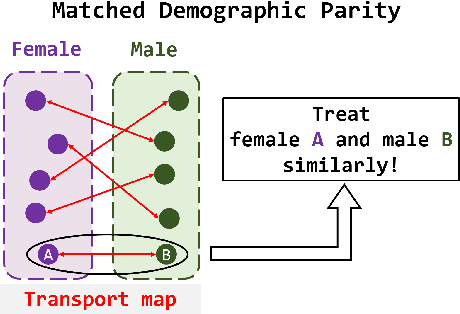
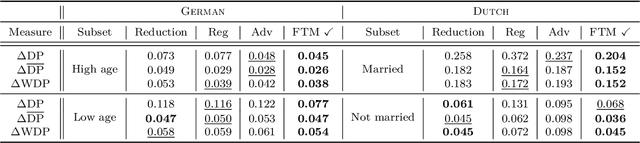


Group fairness requires that different protected groups, characterized by a given sensitive attribute, receive equal outcomes overall. Typically, the level of group fairness is measured by the statistical gap between predictions from different protected groups. In this study, we reveal an implicit property of existing group fairness measures, which provides an insight into how the group-fair models behave. Then, we develop a new group-fair constraint based on this implicit property to learn group-fair models. To do so, we first introduce a notable theoretical observation: every group-fair model has an implicitly corresponding transport map between the input spaces of each protected group. Based on this observation, we introduce a new group fairness measure termed Matched Demographic Parity (MDP), which quantifies the averaged gap between predictions of two individuals (from different protected groups) matched by a given transport map. Then, we prove that any transport map can be used in MDP to learn group-fair models, and develop a novel algorithm called Fairness Through Matching (FTM), which learns a group-fair model using MDP constraint with an user-specified transport map. We specifically propose two favorable types of transport maps for MDP, based on the optimal transport theory, and discuss their advantages. Experiments reveal that FTM successfully trains group-fair models with certain desirable properties by choosing the transport map accordingly.
Improving Performance of Semi-Supervised Learning by Adversarial Attacks
Aug 08, 2023

Semi-supervised learning (SSL) algorithm is a setup built upon a realistic assumption that access to a large amount of labeled data is tough. In this study, we present a generalized framework, named SCAR, standing for Selecting Clean samples with Adversarial Robustness, for improving the performance of recent SSL algorithms. By adversarially attacking pre-trained models with semi-supervision, our framework shows substantial advances in classifying images. We introduce how adversarial attacks successfully select high-confident unlabeled data to be labeled with current predictions. On CIFAR10, three recent SSL algorithms with SCAR result in significantly improved image classification.