 Add to Chrome
 Add to Firefox
 Add to Edge
Overcoming Decoder Inconsistencies in Whisper for Dravidian and Low-Resource Languages
Jun 08, 2026
Multilingual ASR models such as Whisper perform well on high-resource languages but exhibit substantially higher Word Error Rates (WER) for Dravidian languages compared to Indo-Aryan ones. Through linguistic and dataset analysis, we show that Dravidian languages have longer words, higher vocabulary diversity, and lower repetition, resulting in sparse token distributions and frequent character-level substitution errors. Baseline fine-tuning further reveals decoder imbalance between self-attention (linguistic context) and cross-attention (acoustic cues). Although synthetic token-repetition experiments indicate potential gains, they are impractical. Motivated by these observations, we introduce two decoder-level enhancements: Weighted-Attention, which adaptively balances attention sources, and Self-Conditioning, which reinjects intermediate predictions to improve token consistency. Experiments demonstrate consistent WER reductions for low-resource and agglutinative languages.

Listen Like a Teacher: Mitigating Whisper Hallucinations using Adaptive Layer Attention and Knowledge Distillation
Nov 18, 2025The Whisper model, an open-source automatic speech recognition system, is widely adopted for its strong performance across multilingual and zero-shot settings. However, it frequently suffers from hallucination errors, especially under noisy acoustic conditions. Previous works to reduce hallucinations in Whisper-style ASR systems have primarily focused on audio preprocessing or post-processing of transcriptions to filter out erroneous content. However, modifications to the Whisper model itself remain largely unexplored to mitigate hallucinations directly. To address this challenge, we present a two-stage architecture that first enhances encoder robustness through Adaptive Layer Attention (ALA) and further suppresses hallucinations using a multi-objective knowledge distillation (KD) framework. In the first stage, ALA groups encoder layers into semantically coherent blocks via inter-layer correlation analysis. A learnable multi-head attention module then fuses these block representations, enabling the model to jointly exploit low- and high-level features for more robust encoding. In the second stage, our KD framework trains the student model on noisy audio to align its semantic and attention distributions with a teacher model processing clean inputs. Our experiments on noisy speech benchmarks show notable reductions in hallucinations and word error rates, while preserving performance on clean speech. Together, ALA and KD offer a principled strategy to improve Whisper's reliability under real-world noisy conditions.
Enhancing Whisper's Accuracy and Speed for Indian Languages through Prompt-Tuning and Tokenization
Dec 27, 2024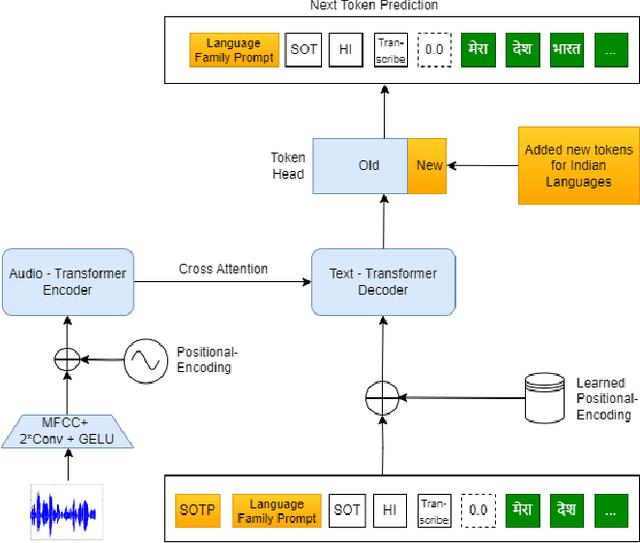
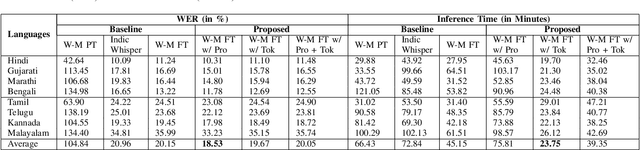

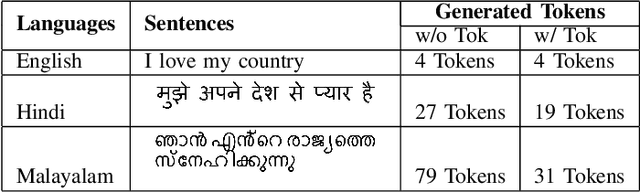
Automatic speech recognition has recently seen a significant advancement with large foundational models such as Whisper. However, these models often struggle to perform well in low-resource languages, such as Indian languages. This paper explores two novel approaches to enhance Whisper's multilingual speech recognition performance in Indian languages. First, we propose prompt-tuning with language family information, which enhances Whisper's accuracy in linguistically similar languages. Second, we introduce a novel tokenizer that reduces the number of generated tokens, thereby accelerating Whisper's inference speed. Our extensive experiments demonstrate that the tokenizer significantly reduces inference time, while prompt-tuning enhances accuracy across various Whisper model sizes, including Small, Medium, and Large. Together, these techniques achieve a balance between optimal WER and inference speed.