 Add to Chrome
 Add to Firefox
 Add to Edge
Heterogeneous Multisource Transfer Learning via Model Averaging for Positive-Unlabeled Data
Nov 14, 2025
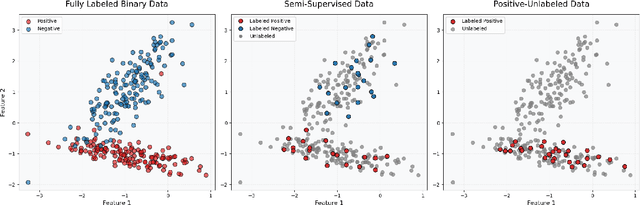
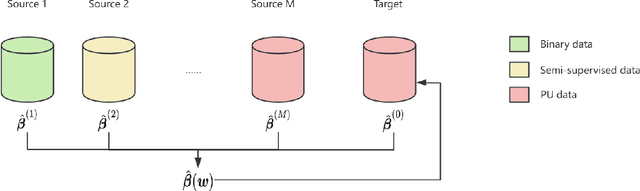
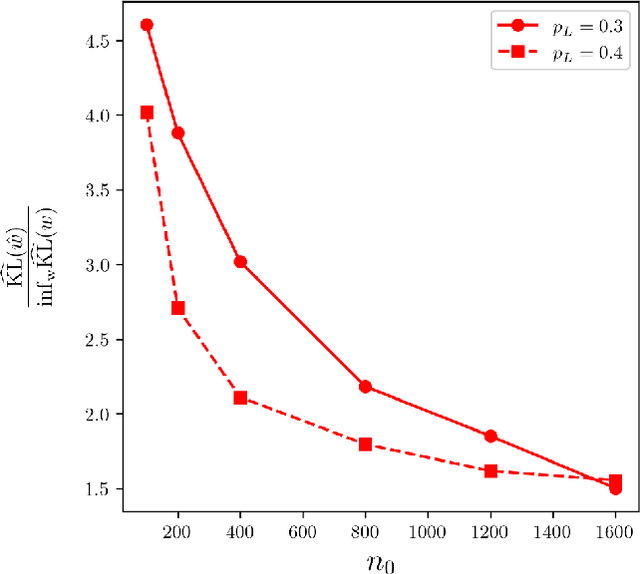
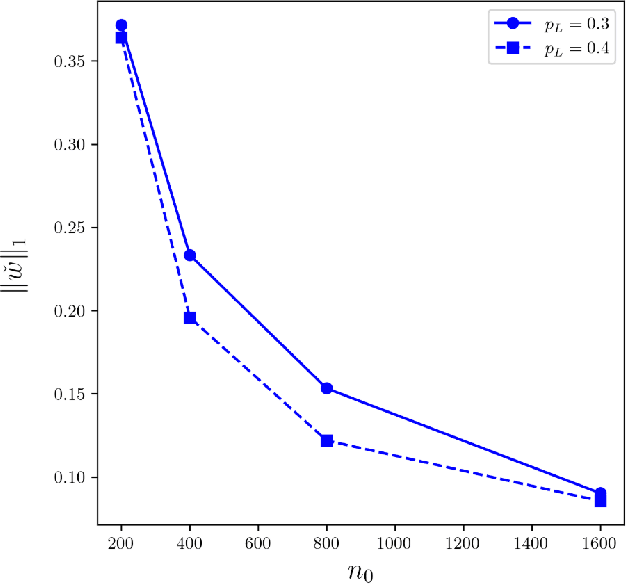
Positive-Unlabeled (PU) learning presents unique challenges due to the lack of explicitly labeled negative samples, particularly in high-stakes domains such as fraud detection and medical diagnosis. To address data scarcity and privacy constraints, we propose a novel transfer learning with model averaging framework that integrates information from heterogeneous data sources - including fully binary labeled, semi-supervised, and PU data sets - without direct data sharing. For each source domain type, a tailored logistic regression model is conducted, and knowledge is transferred to the PU target domain through model averaging. Optimal weights for combining source models are determined via a cross-validation criterion that minimizes the Kullback-Leibler divergence. We establish theoretical guarantees for weight optimality and convergence, covering both misspecified and correctly specified target models, with further extensions to high-dimensional settings using sparsity-penalized estimators. Extensive simulations and real-world credit risk data analyses demonstrate that our method outperforms other comparative methods in terms of predictive accuracy and robustness, especially under limited labeled data and heterogeneous environments.

Transfer learning under latent space model
Sep 19, 2025Latent space model plays a crucial role in network analysis, and accurate estimation of latent variables is essential for downstream tasks such as link prediction. However, the large number of parameters to be estimated presents a challenge, especially when the latent space dimension is not exceptionally small. In this paper, we propose a transfer learning method that leverages information from networks with latent variables similar to those in the target network, thereby improving the estimation accuracy for the target. Given transferable source networks, we introduce a two-stage transfer learning algorithm that accommodates differences in node numbers between source and target networks. In each stage, we derive sufficient identification conditions and design tailored projected gradient descent algorithms for estimation. Theoretical properties of the resulting estimators are established. When the transferable networks are unknown, a detection algorithm is introduced to identify suitable source networks. Simulation studies and analyses of two real datasets demonstrate the effectiveness of the proposed methods.