 Add to Chrome
 Add to Firefox
 Add to Edge
FR-GESTURE: An RGBD Dataset For Gesture-based Human-Robot Interaction In First Responder Operations
Feb 19, 2026
The ever increasing intensity and number of disasters make even more difficult the work of First Responders (FRs). Artificial intelligence and robotics solutions could facilitate their operations, compensating these difficulties. To this end, we propose a dataset for gesture-based UGV control by FRs, introducing a set of 12 commands, drawing inspiration from existing gestures used by FRs and tactical hand signals and refined after incorporating feedback from experienced FRs. Then we proceed with the data collection itself, resulting in 3312 RGBD pairs captured from 2 viewpoints and 7 distances. To the best of our knowledge, this is the first dataset especially intended for gesture-based UGV guidance by FRs. Finally we define evaluation protocols for our RGBD dataset, termed FR-GESTURE, and we perform baseline experiments, which are put forward for improvement. We have made data publicly available to promote future research on the domain: https://doi.org/10.5281/zenodo.18131333.

TRIFFID: Autonomous Robotic Aid For Increasing First Responders Efficiency
Feb 13, 2025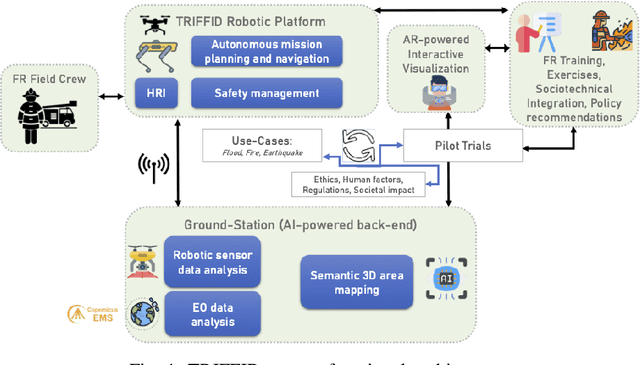
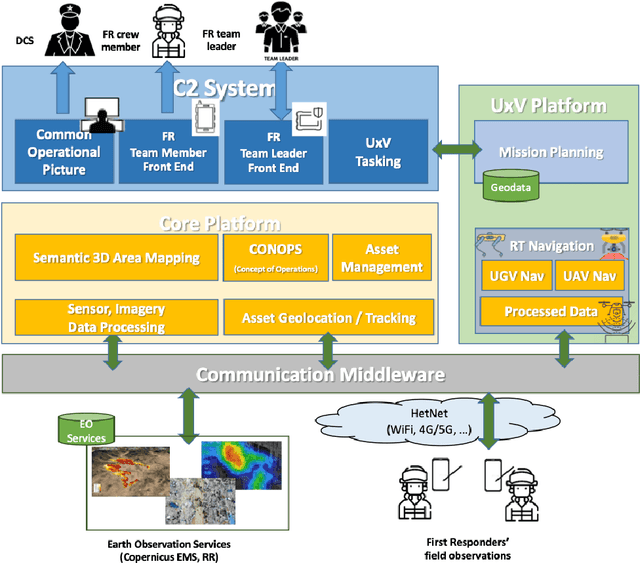
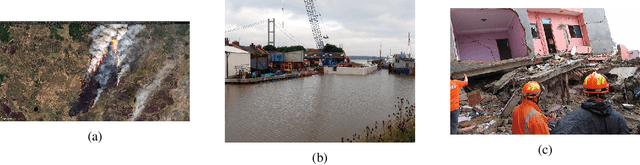
The increasing complexity of natural disaster incidents demands innovative technological solutions to support first responders in their efforts. This paper introduces the TRIFFID system, a comprehensive technical framework that integrates unmanned ground and aerial vehicles with advanced artificial intelligence functionalities to enhance disaster response capabilities across wildfires, urban floods, and post-earthquake search and rescue missions. By leveraging state-of-the-art autonomous navigation, semantic perception, and human-robot interaction technologies, TRIFFID provides a sophisticated system com- posed of the following key components: hybrid robotic platform, centralized ground station, custom communication infrastructure, and smartphone application. The defined research and development activities demonstrate how deep neural networks, knowledge graphs, and multimodal information fusion can enable robots to autonomously navigate and analyze disaster environ- ments, reducing personnel risks and accelerating response times. The proposed system enhances emergency response teams by providing advanced mission planning, safety monitoring, and adaptive task execution capabilities. Moreover, it ensures real- time situational awareness and operational support in complex and risky situations, facilitating rapid and precise information collection and coordinated actions.