 Add to Chrome
 Add to Firefox
 Add to Edge
Distilling Vision Transformers for Distortion-Robust Representation Learning
Apr 24, 2026
Self-supervised learning has achieved remarkable success in learning visual representations from clean data, yet remains challenging when clean observations are sparse or not available at all. In this paper, we demonstrate that pretrained vision models can be leveraged to learn distortion-robust representations, which can then be effectively applied to downstream tasks operating on distorted observations. In particular, we propose an asymmetric knowledge distillation framework in which both teacher and student are initialized from the same pretrained Vision Transformer but receive different views of each image: the teacher processes clean images, while the student sees their distorted versions. We introduce multi-level distillation that aligns global embeddings, patch-level features, and attention maps and show that the student is able to approximate clean-image representations despite never directly accessing clean data. We evaluate our approach on image classification tasks across several datasets and under various distortions, consistently outperforming existing alternatives for the same amount of human supervision.

HighFM: Towards a Foundation Model for Learning Representations from High-Frequency Earth Observation Data
Apr 05, 2026The increasing frequency and severity of climate related disasters have intensified the need for real time monitoring, early warning, and informed decision-making. Earth Observation (EO), powered by satellite data and Machine Learning (ML), offers powerful tools to meet these challenges. Foundation Models (FMs) have revolutionized EO ML by enabling general-purpose pretraining on large scale remote sensing datasets. However most existing models rely on high-resolution satellite imagery with low revisit rates limiting their suitability for fast-evolving phenomena and time critical emergency response. In this work, we present HighFM, a first cut approach towards a FM for high temporal resolution, multispectral EO data. Leveraging over 2 TB of SEVIRI imagery from the Meteosat Second Generation (MSG) platform, we adapt the SatMAE masked autoencoding framework to learn robust spatiotemporal representations. To support real time monitoring, we enhance the original architecture with fine grained temporal encodings to capture short term variability. The pretrained models are then finetuned on cloud masking and active fire detection tasks. We benchmark our SEVIRI pretrained Vision Transformers against traditional baselines and recent geospatial FMs, demonstrating consistent gains across both balanced accuracy and IoU metrics. Our results highlight the potential of temporally dense geostationary data for real-time EO, offering a scalable path toward foundation models for disaster detection and tracking.
Next day fire prediction via semantic segmentation
Mar 20, 2024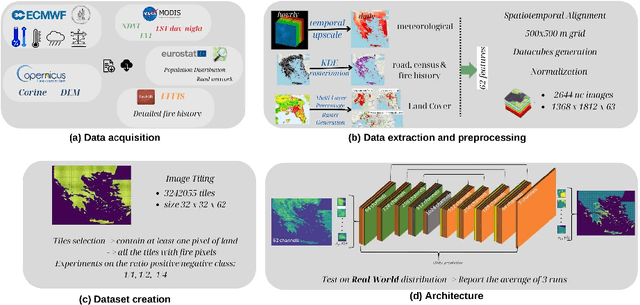

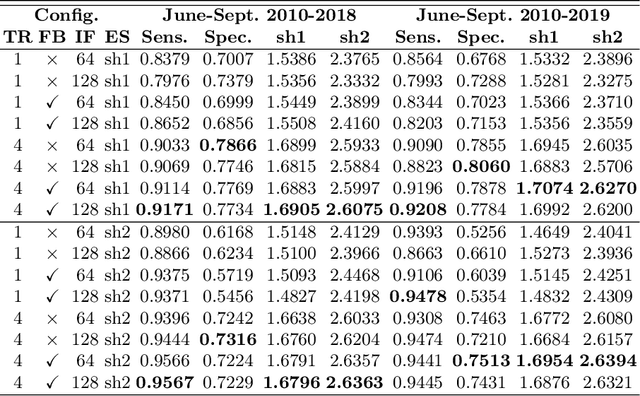
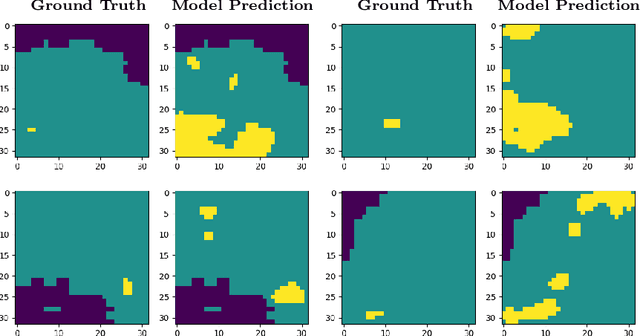
In this paper we present a deep learning pipeline for next day fire prediction. The next day fire prediction task consists in learning models that receive as input the available information for an area up until a certain day, in order to predict the occurrence of fire for the next day. Starting from our previous problem formulation as a binary classification task on instances (daily snapshots of each area) represented by tabular feature vectors, we reformulate the problem as a semantic segmentation task on images; there, each pixel corresponds to a daily snapshot of an area, while its channels represent the formerly tabular training features. We demonstrate that this problem formulation, built within a thorough pipeline achieves state of the art results.