 Add to Chrome
 Add to Firefox
 Add to Edge
AUGUSTE: Online-Learning dApp for Predictive URLLC Scheduling
Jun 02, 2026
Ultra Reliable and Low Latency Communications (URLLC) was one of the main motivations behind 5G, with 3GPP advertising 1-10 ms latency targets for applications such as industrial automation, Vehicle-To-Everything (V2X), tactical edge networking, and unmanned-system control. Years on, real 5G Time Division Duplexing (TDD) networks still show median Uplink (UL) round-trip times in the 50-70 ms range, largely because of the Scheduling Request (SR) procedure that a User Equipment (UE) must complete before transmitting UL data. Existing remedies, primarily Configured Grant (CG) scheduling, only eliminate this overhead for strictly periodic traffic and require cross-layer synchronization, which has limited their adoption. We propose AUGUSTE (Anticipatory Uplink Grants for URLLC via Self-Adapting Temporal Estimation), a learning-based Medium Access Control (MAC) scheduling framework that embeds online Machine Learning (ML) models in the UL scheduler to predict packet arrivals and proactively allocate resources before an SR is issued. An adaptive state machine alternates between a learning phase that collects unbiased arrival statistics and a confident phase that exploits the learned predictions to schedule only when traffic is expected. We evaluate AUGUSTE on a real 5G testbed running OpenAirInterface across three URLLC traffic patterns (request-response, ML edge inference, and periodic autonomous reporting), and show that it operates at the best achievable point on the latency-overhead trade-off: it matches always-on scheduling's median Round Trip Time (RTT) (around 10 ms, halving the 20 ms SR-based baseline) at roughly one-tenth its resource cost (7-10 percent overhead).

AgentRAN: An Agentic AI Architecture for Autonomous Control of Open 6G Networks
Aug 25, 2025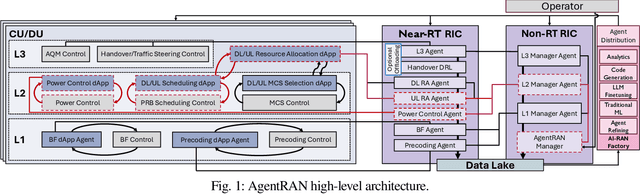
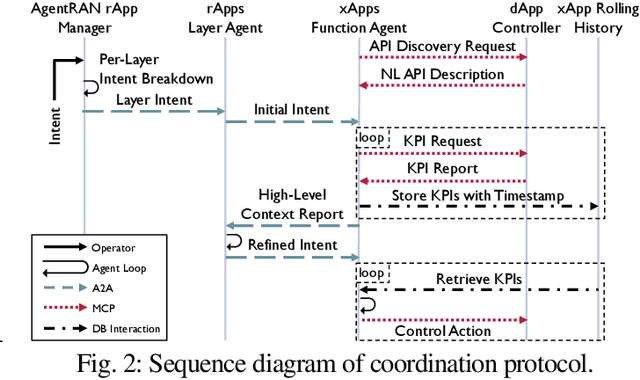
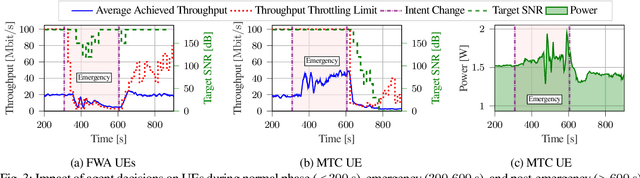
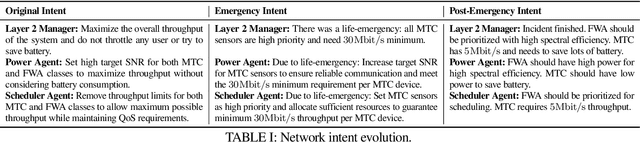
The Open RAN movement has catalyzed a transformation toward programmable, interoperable cellular infrastructures. Yet, today's deployments still rely heavily on static control and manual operations. To move beyond this limitation, we introduce AgenRAN, an AI-native, Open RAN-aligned agentic framework that generates and orchestrates a fabric of distributed AI agents based on Natural Language (NL) intents. Unlike traditional approaches that require explicit programming, AgentRAN's LLM-powered agents interpret natural language intents, negotiate strategies through structured conversations, and orchestrate control loops across the network. AgentRAN instantiates a self-organizing hierarchy of agents that decompose complex intents across time scales (from sub-millisecond to minutes), spatial domains (cell to network-wide), and protocol layers (PHY/MAC to RRC). A central innovation is the AI-RAN Factory, an automated synthesis pipeline that observes agent interactions and continuously generates new agents embedding improved control algorithms, effectively transforming the network from a static collection of functions into an adaptive system capable of evolving its own intelligence. We demonstrate AgentRAN through live experiments on 5G testbeds where competing user demands are dynamically balanced through cascading intents. By replacing rigid APIs with NL coordination, AgentRAN fundamentally redefines how future 6G networks autonomously interpret, adapt, and optimize their behavior to meet operator goals.