 Add to Chrome
 Add to Firefox
 Add to Edge
PMOF: A Dataset and Benchmark for Passenger Monitoring Using Overhead Fisheye Cameras
Jun 11, 2026
Autonomous staff-free public transport requires reliable in-vehicle passenger monitoring. However, perception inside moving vehicles is challenged by confined spaces, variable illumination, motion-induced background variation, occlusion, and limited viewpoints. To mitigate these spatial constraints, ceiling-mounted fisheye cameras provide full-scene coverage from a single viewpoint. Yet existing public overhead fisheye datasets are recorded in static environments and do not capture the domain shift introduced by vehicle motion. To fill this gap, we introduce PMOF, Passenger Monitoring using Overhead Fisheye cameras, the first public dataset of top-view fisheye imagery captured inside a moving vehicle, comprising over 19k manually annotated frames. PMOF provides rotated bounding boxes, tracking identifiers, and action labels, supporting object detection, tracking, and action recognition. We benchmark PMOF using YOLO26m-obb models fine-tuned under multiple dataset configurations that combine PMOF with existing overhead fisheye datasets. Cross-domain fine-tuning with custom rotation-aware augmentation achieves 94.8% AP50 on PMOF and 96.5% AP50 on an unseen overhead fisheye dataset from a different domain. Our results highlight the domain gap between static and moving environments and show that incorporating PMOF improves detection performance and advances generalization beyond passenger monitoring to broader fisheye-based person detection tasks. The dataset and code are available at https://swermuth.github.io/pmof/.

From Transportation to Manipulation: Transforming Magnetic Levitation to Magnetic Robotics
Mar 02, 2026Magnetic Levitation (MagLev) systems fundamentally increase the flexibility of in-machine material flow in industrial automation. Therefore, these systems enable dynamic throughput optimization, which is especially beneficial for high-mix low-volume manufacturing. Until now, MagLev installations have been used primarily for in-machine transport, while their potential for manipulation is largely unexplored. This paper introduces the 6D-Platform MagBot, a low-cost six degrees of freedom parallel kinematic that couples two movers into a composite robotic platform. Experiments show that the 6D-Platform MagBot achieves sub-millimeter positioning accuracy and supports fully autonomous pick up and drop off via a docking station, allowing rapid and repeatable reconfiguration of the machine. Relative to a single mover, the proposed platform substantially expands the reachable workspace, payload, and functional dexterity. By unifying transportation and manipulation, this work advances Magnetic Levitation towards Magnetic Robotics, enabling manufacturing solutions that are more agile, efficient, and adaptable.
SHaRe-RL: Structured, Interactive Reinforcement Learning for Contact-Rich Industrial Assembly Tasks
Sep 17, 2025High-mix low-volume (HMLV) industrial assembly, common in small and medium-sized enterprises (SMEs), requires the same precision, safety, and reliability as high-volume automation while remaining flexible to product variation and environmental uncertainty. Current robotic systems struggle to meet these demands. Manual programming is brittle and costly to adapt, while learning-based methods suffer from poor sample efficiency and unsafe exploration in contact-rich tasks. To address this, we present SHaRe-RL, a reinforcement learning framework that leverages multiple sources of prior knowledge. By (i) structuring skills into manipulation primitives, (ii) incorporating human demonstrations and online corrections, and (iii) bounding interaction forces with per-axis compliance, SHaRe-RL enables efficient and safe online learning for long-horizon, contact-rich industrial assembly tasks. Experiments on the insertion of industrial Harting connector modules with 0.2-0.4 mm clearance demonstrate that SHaRe-RL achieves reliable performance within practical time budgets. Our results show that process expertise, without requiring robotics or RL knowledge, can meaningfully contribute to learning, enabling safer, more robust, and more economically viable deployment of RL for industrial assembly.
Precision-Focused Reinforcement Learning Model for Robotic Object Pushing
Nov 13, 2024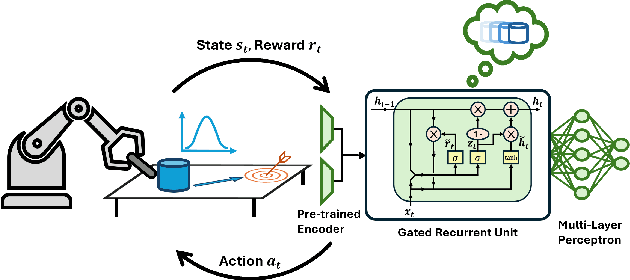
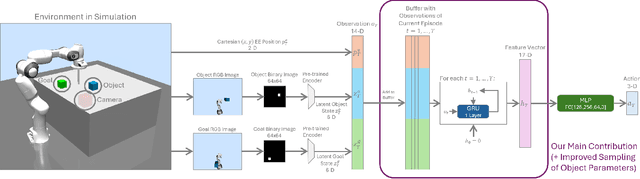
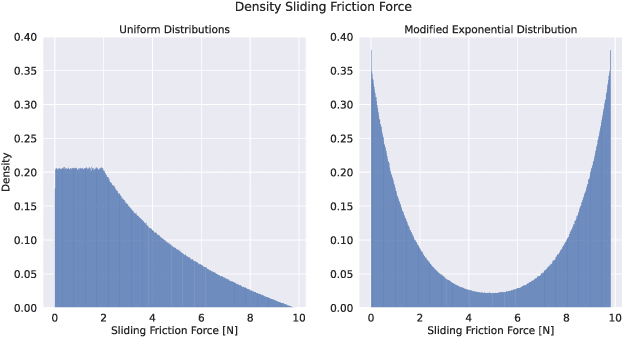
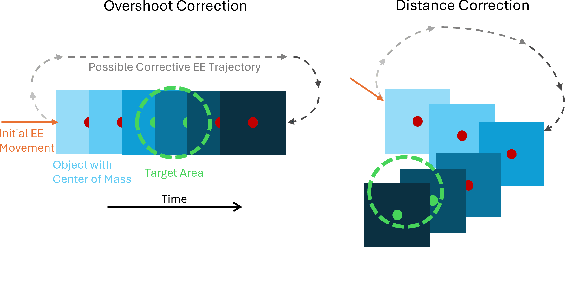
Non-prehensile manipulation, such as pushing objects to a desired target position, is an important skill for robots to assist humans in everyday situations. However, the task is challenging due to the large variety of objects with different and sometimes unknown physical properties, such as shape, size, mass, and friction. This can lead to the object overshooting its target position, requiring fast corrective movements of the robot around the object, especially in cases where objects need to be precisely pushed. In this paper, we improve the state-of-the-art by introducing a new memory-based vision-proprioception RL model to push objects more precisely to target positions using fewer corrective movements.