 Add to Chrome
 Add to Firefox
 Add to Edge
Stake the Points: Structure-Faithful Instance Unlearning
Mar 13, 2026
Machine unlearning (MU) addresses privacy risks in pretrained models. The main goal of MU is to remove the influence of designated data while preserving the utility of retained knowledge. Achieving this goal requires preserving semantic relations among retained instances, which existing studies often overlook. We observe that without such preservation, models suffer from progressive structural collapse, undermining both the deletion-retention balance. In this work, we propose a novel structure-faithful framework that introduces stakes, i.e., semantic anchors that serve as reference points to maintain the knowledge structure. By leveraging these anchors, our framework captures and stabilizes the semantic organization of knowledge. Specifically, we instantiate the anchors from language-driven attribute descriptions encoded by a semantic encoder (e.g., CLIP). We enforce preservation of the knowledge structure via structure-aware alignment and regularization: the former aligns the organization of retained knowledge before and after unlearning around anchors, while the latter regulates updates to structure-critical parameters. Results from image classification, retrieval, and face recognition show average gains of 32.9%, 22.5%, and 19.3% in performance, balancing the deletion-retention trade-off and enhancing generalization.

RainbowPrompt: Diversity-Enhanced Prompt-Evolving for Continual Learning
Jul 30, 2025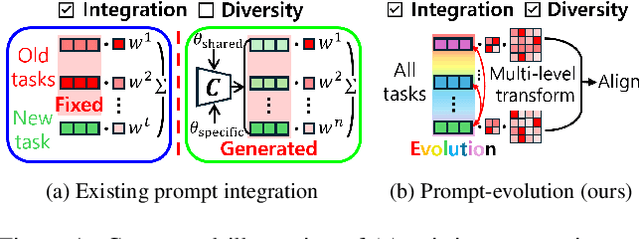
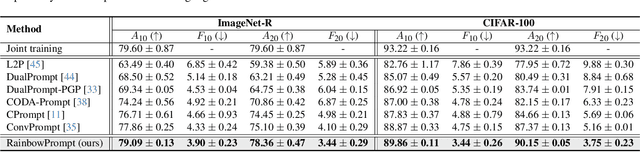
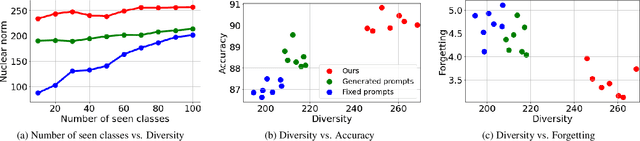
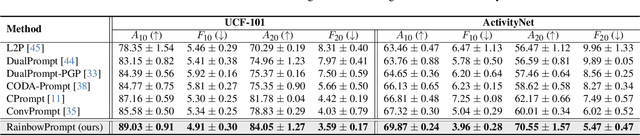
Prompt-based continual learning provides a rehearsal-free solution by tuning small sets of parameters while keeping pre-trained models frozen. To meet the complex demands of sequential tasks, it is crucial to integrate task-specific knowledge within prompts effectively. However, existing works rely on either fixed learned prompts (i.e., prompts whose representations remain unchanged during new task learning) or on prompts generated from an entangled task-shared space, limiting the representational diversity of the integrated prompt. To address this issue, we propose a novel prompt-evolving mechanism to adaptively aggregate base prompts (i.e., task-specific prompts) into a unified prompt while ensuring diversity. By transforming and aligning base prompts, both previously learned and newly introduced, our approach continuously evolves accumulated knowledge to facilitate learning new tasks. We further introduce a learnable probabilistic gate that adaptively determines which layers to activate during the evolution process. We validate our method on image classification and video action recognition tasks in class-incremental learning, achieving average gains of 9.07% and 7.40% over existing methods across all scenarios.